Sermon for CANDLEMAS 2013
Malachi 3:1-4
Hebrews 2:14-18
Luke 2:22-40
RECORDING OF SERMON – CANDLEMAS
The Lord is not slow in keeping his promise, as some understand slowness.
He is patient with you, not wanting anyone to perish, but everyone to come to repentance.
2 Peter 3:9
A little earlier this week I was reading a blog by my former bishop back in England where he strongly recommended a book on a theme about which I was very interested. Back in the times of monasteries, St Benedict had said that to enter a monastery you had to make promises, take vows – and there were four. You had to give up your possessions – a vow of poverty – you had to give up any idea of getting married – a vow of chastity – and you had to promise to do as you were told – a vow of obedience. These were the three classic monastic vows – but St Benedict added a fourth – you had to promise to stay – a vow of stability. You had to stay put – in the place you had been called to – not go gadding off and moving around – not flitting from one monastery to another. You know, if you didn’t like one – well you go and try and find another more suited to you. And it is that vow of stability in which I was particularly interested.
So I did what we all do when we want a book – I went to Amazon – only to discover that it wasn’t going to be released until February 21st!! Nearly a whole month!!! But then I found it was available on Kindle!! YES!! [Kindle – ‘start reading this book in less than a minute’] And I clicked on the link “ Due to copyright restrictions this Kindle book is not available to buy in New Zealand”!!!
But I want it NOW!!! I wonder how many of us have had that experience of driving a car and you’re stopped at lights, and for a moment you attention drifts away and you don’t notice the lights change – SUDDENLY the blare of a horn wakes you – my the light has been green for a whole two seconds!!!
We are not good at waiting [wishing our lives away – ‘can’t wait to go to School!’] – Waiting requires us to stay put, to stay in one place.’Oh I haven’t got time for that, I have to be here and here and here’ – but nowadays we can be quite still and yet not staying put. I wonder how many of us rather than sit down quietly for the evening with a good book, sit in the same place all evening with a laptop or a tablet and flick from place to place to place on the internet – Tumblr one minute, then Facebook, then back to Tumblr – checking your emails, or a friends txts. [Phone] Our bodies in one place – but our minds moving from place to place to place [And by the way – don’t say you’re multistasking – all the psychological evidence is that when we behave like this we are not paying attention to anything – it takes several minutes for our brains to move from one task to another – in other words as we move from one to the other to the other – we haven’t actually paid any attention to any of them!]
And because we are not patient, we don’t stick with something, we don’t attend to it – we can’t wait for something more. If something doesn’t deliver immediately we give up on it.
We’re not good at waiting and so we waste our lives and fritter them away. Jesus tells a story with which some of us are familiar – He tells a story about a young man who cannot wait – he cannot wait for his Father to die – because when his father is dead he will get all that belongs to his father – so he tells him. The father has two sons, and so he divides all he has in two and gives have to his impatient son – who runs off . . . and spends it all . . . and is left with nothing . . . because he couldn’t wait – he had His Life to live and he was jolly well going to get on and live it – and then its all spent, all gone . . . and Jesus say’s ‘the young man came to his senses’ What am I doing? BAck home even those people who worked for my dad had all their needs taken care of – they had plenty to eat and wear, and here I am with nothing . . . all because he couldn’t wait
Today we celebrate the Feast of the Presentation of Christ in the Temple. The End of the season of Epiphany – it’s culmination, the End of Epiphany and the End of Waiting. God’s people have been waiting – in the words of the prophet Malachi, ‘The Lord whom you seek, will suddenly come to his temple’. The one you have been waiting for . . . he will suddenly come to his Temple.
Malachi wrote those words 400 years before!! 400 years – waiting for 400 years
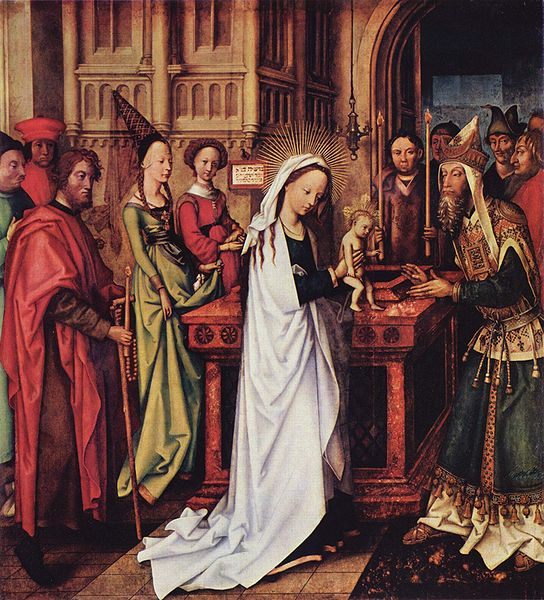
And when MAry and Joseph bring Jesus to the Temple – there are two people waiting for them – Simeon and Anna – an old man and an old woman – who have been waiting their whole lives for this moment . . . waiting for the father’s gift
Can we begin to imagine what it might be that was worth waiting your whole life for? What would we give up our lives to wait for??
Simeon holds Jesus in his arms and utters an extraordinary prayer – Lord – you have allowed your servant to depart in peace, according to your promise. You promised and that was enough. I waited and although I waited my whole life, you have been good to your word – I have seen what I was waiting for. Anna and Simeon were waiting for the same thing – Simeon we are told was waiting for the ‘Redemption of Israel’ Anna sees the child and she goes out to tell everyone who is waiting for the redemption of israel.
What is this?? What is Redemption?? What does it mean to redeem something? Why is this so important??
Well it’s all tied up with that visit of MAry and Joseph to the Temple – when you had a child you came to the Temple to offer a sacrifice, a sacrifice of purification according to the ritual law. But in the case of a first born son – there was a second sacrifice, or payment to be made. According to the law, all the first born sons belonged especially to God and so you went to the Temple effectually to buy them back, to Redeem them. When someone takes something from you you can pay them and then they have to return it. So when your first born son came along, you paid 5 shekels to the Temple, to buy them back, to redeem them
But listen When the time came for their purification according to the law of Moses, they brought him up to Jerusalem to present him to the Lord 23(as it is written in the law of the Lord, “Every firstborn male shall be designated as holy to the Lord”), 24and they offered a sacrifice according to what is stated in the law of the Lord, “a pair of turtledoves or two young pigeons.” No 5 shekels. They made the sacrifice of the birds as required for the purification following the birth of a child – but no redemption price, for their son. They presented him to the Lord – they gave him to God – they did not pay the price for him, for He is the one who pays the price for us
Simeon and Anna were waiting for the one who would pay the price to bring us back to the one who rightfully we belong to God.
The young man in Jesus’ story had forgotten whom he belonged to – he had forgotten whom he was and he was utterly lost – he had lost everything, squandered everything, but he thought he’d cut a deal . . . so he walked home with a careful little speech – ‘You know I’m really sorry – I’ve done an utterly terrible thing – I deserve nothing’ Perhaps there are some amongst us who feel that way – I know from time to time I do – but here is the amazing thing – the son’s father had been waiting for him – watching out for him – longing to see him back – waiting for him to stop frittering his life away – waiting for him to come to his senses – to stop – to come home
When we think of impatient Sts – I am sure Peter comes to mind – but St Peter too, comes to his senses – he writes much later in life The Lord is not slow in keeping his promise, as some understand slowness. He is patient with you, not wanting anyone to perish, but everyone to come to repentance.
God’s people had waited 400 years . . . finally their redemption had come – the price had been paid – now as God in Jesus came to his home – the price was paid – anyone now could come home – the waiting is over. Our deepest need, the life of GOd which transforms everything is now available – we don’t have to wait – we can run home. He is waiting for us
As he waits for us today – as in the Eucharist we come to him – he has paid the price in his body and blood – he is pouring out his life for us. The waiting is over, so like Simeaon and Anna – let us come quickly – let us rejoice – let us run to him. The one who has been waiting for us ever since we left home



 the elves are heading west