An Anglican Priest of Northern English extraction
Discovering Home
Learning to be a Friend, father and husband - but above all, and indeed radically redfining all of this, a Disciple of the Risen One
I’ve just been reading yet another of those seemingly endless and interminable articles in the ‘Christian’ media on ‘why it is so hard to love ourselves . . .’, and consequently teaching us to learn to do so, in the hope that eventually we might love ourselves and then love our neighbours . . .
Brothers and sisters, heaven cannot wait.
Actually, with one or two exceptions, we all love ourselves and to a point where perhaps we have lost the plot – and as witness I cite the innumerable blog posts etc. cited above
So just to make it clear
Love your neighbour as yourself
Simple
I give an example
Do we have enough food to eat today?
Do we know of anyone who doesn’t?
Share our bread with them
Again
Do we have enough clothes to keep you warm and protected from the elements?
Do we know of anyone who doesn’t?
Share our clothes with them
Again
Do we have sufficient money etc to live in a house that is warm?
Do we know anyone who doesn’t?
Share what we have with them so that they also may be warm – indeed we might even welcome them into the warmth of our house – it will cost nothing – we may even find new friends and thus break the cycle of our narcissitic isolation which leads to the sort of articles we waste our time writing and reading.
You see, we love ourselves enough to make sure that we take care of our basic needs – this is the embodied understanding of love which the entire Scripture points us to in Christ who loves us in the flesh, by the giving of his body.
Loving ourselves involves taking care of our physical needs – as St Paul puts it in an aside ‘For no one ever hates his own body, but he nourishes and tenderly cares for it’. By and large, we love ourselves plenty. Indeed many if not most of us have ‘ample goods laid up for many years’. (Luke 12 vs 19)
We have food and clothes and warmth for today, and tomorrow, and day after day after day – we love ourselves so much, we even have planned for years down the line . . .
Our problem is not that we do not love ourselves, it is that our self love has blinded us to our neighbour (Luke 16:19-31)
The irony of all this is that if we obeyed Christ in this regard – shared our bread with the poor etc. we may well enter into a way of Life in which our narcissitic obsession with self acceptance became nothing more than a dream that fades from our memories as the light shines into the darkness
A couple of weeks ago we thought about the proposition ‘God loves us too much to give us what we want. . .’ and I ended with the reason that God desires to give us his very self, but we desire far lesser ends. We seek a comfortable life, or one thing or another. Things that in themselves are not bad, for all God creates is good, but things which fade into the background when we See who God is, in and through Jesus Christ. To rework something CS Lewis wrote – we choose to be content playing with mud pies in a slum, when a life at the Seaside is offered us.
God in Jesus Christ has given us his very self – we might well say, there is nothing else God can give us, for he has given us all he has in Christ Jesus. He has given us his Son, he has given us his LIFE.
Last week we pondered how God in Christ has descended to the very depths of all that is, and then ascended to far above the heavens – that he might fill all things and in that filling all things he might sanctify them, so that with the eye of faith, the eye that has seen the self emptying love of God in Jesus Christ -‘whoever has seen me has seen the Father’ – sees everything in the Light of Christ. This is one way of expressing what it means to walk in the Light. It is as if we look out at creation and everywhere we look and everyone we see has a large flag stuck out of their head saying ‘belonging to God the Father in and through Jesus Christ’. To see with the eye of faith is to see the world as it is – to see that Christ fills all things.
In the words of the beautiful ancient hymn, St Patrick’s breastplate
Christ behind me, Christ before me,
Christ beside me, Christ to win me,
Christ to comfort and restore me.
Christ beneath me, Christ above me,
Christ in quiet, Christ in danger,
Christ in hearts of all that love me,
Christ in mouth of friend and stranger.
So with the eye awakened by faith we See Christ in and through all that is good. We see The Good, in and through the good. Our failure of faith is to confuse the good, with the Good, the Creator with the Creation, that sets off the insatiable fires of hellish longing, ‘if only I had. . .’ when God has given us all he has, himself.
As most folk know, there are a couple of ‘significant’ wedding anniversaries amongst us this weekend – and marriage provides us with a model for this seeing. For in the Self giving of husband and wife – we See through that to The Self Giving of Christ to the Church as St Paul so fully sets it out in Ephesians. Marriage is like everything good a Sacrament of God’s self – giving. And this passage is worth quoting at length in order to make her holy by cleansing her with the washing of water by the word, so as to present the church to himself in splendour, without a spot or wrinkle or anything of the kind—yes, so that she may be holy and without blemish. In the same way, husbands should love their wives as they do their own bodies. He who loves his wife loves himself. For no one ever hates his own body, but he nourishes and tenderly cares for it, just as Christ does for the church, because we are members of his body. ‘For this reason a man will leave his father and mother and be joined to his wife, and the two will become one flesh.’ This is a great mystery, and I am applying it to Christ and the church. Each of you, however, should love his wife as himself, and a wife should respect her husband.
Note what St Paul says, This is a great mystery and I am applying it to Christ and the Church – each of you however should love his wife as himself. In other words the good of Christian marriage, points beyond itself to The Good – which is Christ and his selfemptying love for the Church.
Now lets follow this a little further . . . lets imagine that in a marriage, a husband only loved a wife because of what she did for him, or gave to him. Put another way, if it wasn’t for those things there would be no love. We would say and rightly, that in a true marriage, it is the Self giving of the person which is the foundation, apart from which there is no marriage. The husband gives himself totally in love to his Wife, and the wife gives herself totally in love to her husband. Now of course the things the husband does for the wife and vv may be expressions of that self giving, but at the heart is the desire to give yourself totally to your spouse, to become one flesh. In other words, no other person will do. Someone else could well serve you in the same way, but it is the person who is fundamental and in a real sense – someone else could not serve you in the same way.
So it is with God and the things of God. It is in Loving God in and for himself, that the good things he give come into proper perspective. But if we do not love God, then the Things the good things assume a false significance. They loom in our imagination – our imagination is filled with things, not full of the vision of Christ himself, a vision which gives the things a radically different dimension. The things become idols, and lead us not to Life in its fulness but to death – we chase after the things for love of them, not love of God. We desire marriage, not for the sake of Christ, but for itself – and thus marriage loses its meaning, for it as with All things, are given precisely that we might know Christ – for to know him Is eternal life.
Put another way, because Christ Fills all things, we can only know the Truth about anything in so far as we Know Jesus Christ . . . Apart from the Intimate Knowledge of Jesus Christ – Knowing Him and seeking to Love him – the idea of Christian Values is meaningless.
When you read the accounts of the Early Church, you realise that they seemed as it were to be straining at gnats from our perspective. Why, WE might ask does it matter at all what we think about God?? Heresies and conflicts over heresies were always about what seem to us to be very minor and obscure matters, but as I suggested last week, perhaps, if we are not as a starting point seeing the world around us in and through Jesus Christ, perhaps it is our perspective that is skewed??
Which is what is most unhelpful about all this talk of Christian values and why talking about ‘values’ can rapidly lead us away from Christ. Let’s take for example what many would take to be the core Christian value – so much so that it is not at all uncommon to say ‘It’s all about Love isn’t it . . .’ . . . But the problem is this. Apart from Jesus we do not know what Love is. So we put up this ‘value’ – by the way, actually it is a Virtue and not a value and that downgrading in itself is not unimportant – and we say ‘It is all about Love’ and if we are at all alert we will say, hang on where is Jesus in this? And we might say – well Jesus shows us what love is, true, but Love has no existence apart from Him and in saying Jesus shows us what love is it is as if Jesus reveals something other than himself – but as John says ‘God is Love’
As I said last week – He fills All things – so to speak or think of anything apart from him is not to know it at all. One cannot Know anything about the Christian Virtues apart from Him – for He HImself is the centre of all things and in him all things hold together. Apart from Him they fall apart.
To say we are only interested in Christianity for the sake of its values, is like saying ‘I’m only interested in marriage for the sake of having someone make my breakfast . . .’
Here I think we suffer from the modern account of ‘Religions’ in which Christian existence is but one of many – but what is utterly unique about Jesus is this – he is the only one who says All that I say and do has but one purpose – to point to me, so that you might Know God and thus Know the Life He desires to give, his very self. And this teaching of Jesus comes to a single focus here in John’s gospel ‘I am the living bread that came down from heaven. Whoever eats of this bread will live for ever; and the bread that I will give for the life of the world is my flesh.’ I am the Living Bread that came down from heaven – I am the Life and Light of the World – I am the Good shepherd. Over and over and over again the teaching of Jesus turns out to be teaching about Jesus, and through Him that we might Know God.
In fact Jesus sharpens the focus even further in the Gospel for next week – ‘Very truly, I tell you, unless you eat the flesh of the Son of Man and drink his blood, you have no life in you. 54Those who eat my flesh and drink my blood have eternal life, and I will raise them up on the last day; 55for my flesh is true food and my blood is true drink. 56Those who eat my flesh and drink my blood abide in me, and I in them. 57Just as the living Father sent me, and I live because of the Father, so whoever eats me will live because of me. . . .
And it is not long before what Jesus is saying finds disciples leaving him, left right and centre – whoever eats me, will live because of me . . . I am Offering you Life in all its fullness, and it is to be found Here, In me . . . and some want a code for good living – others want, well a million and one things – but all God has to give is His very self
Why do they leave? In a sense because it is utterly outrageous – offensive even to our modern sensibilities – that Anyone might claim to be the Bread of heaven – that anyone might say ‘whoever eats me will live because of me’ – and of course it is utterly outrageous. If we are searching for values, for ‘a better way to live our lives, then the bookstalls, the internet, the world is full of people offering advice – and you can patch together a pretty reasonable existence out of it . . . but to find our life in Jesus Christ is . . . well it can only be known in Knowing Him.
We live in a time of seemingly unending persecution of the Church – it is very much as if we are at the end of days. More Christians died because they were Christian in the C20 – already the C21 looks as if the bride of Christ is being butchered once more and now right down to the root, as our brothers and sisters in Iraq and Syria are beheaded and crucified in their hundreds if not their thousands. There in the world’s oldest churches, places where unbeknownst to us the church has worshipped for almost two thousand years without a break . . . there above all, there is no talk of Christian values – only Christ.
On their doors, the IS militias paint this symbol – that of the Nazarene – the title of those Christians – a title of scorn – the very name they gave Christ in Matthews Gospel – ‘and he will be called a Nazorene’. In Life and in death bearing the name of the one who died for them, and is their life. No talk of values, just Christ. In Life and in death – for He has given His all for them, and He is their Life.
Sermon for 9th Sunday after Trinity – Year B – 2015
“That he may fill all things”
‘They said to him, ‘What must we do to perform the works of God?’ Jesus answered them, ‘This is the work of God, that you believe in him whom he has sent.’
A joke, A Confession, A Question, and why we modern Christians seem to need our eyesight checking
Allegedly, the old jokes are the best – ‘Sunday school teacher – ‘what is small, flightless, nocturnal and has a long beak?’ A child hesitantly puts up their hand, ‘Well I know it sounds like a Kiwi – but given we’re in Sunday School, is the answer Jesus??’
This joke, which I first heard in an Anglicised form – (Squirrel replacing Kiwi) – at theological college, is interesting, in that if jokes are translatable within cultures, and we told it to a Christian of the Middle Ages, they wouldn’t See the joke . . . for undoubtedly Christians for the first thousand or so years of the Church’s history had a different way of speaking of the Reality of their existence – in that they might readily speak Christianly of any manner of things, and that it would seem utterly normal and entirely unforced to speak of any aspect of the created order, and Jesus Christ in the same breath.
That there was no dimension of life which we could begin to speak about in Truth, without beginning with Christ . . . That there was no dimension of life which we could begin to speak about in Truth, without beginning with Christ . . . That Jesus Christ was the key to understanding the True nature of Everything, Everywhere, and for all time – and that apart from Knowing Jesus Christ, one was as it were blind to the world . . . And if we see the world in that way, then perhaps we don’t get the joke?
Well I’ll come back to the Kiwi Jesus in a few moments, but let’s move on to the Confession. And for once, sorry to disappoint, it’s not one of mine. Rather the Confession of David, which may seem every bit as odd to our ears as the Kiwi Jesus Christ, and indeed perhaps to us at least, outrageous, but for precisely the same reasons.
We pick up the story from last week, as we remember – David – quietly humming Crimmond, ‘The Lord’s my Shepherd, I’ll not want . . .’ wanders onto the roof of his palace, and . . . Oh Hello!!!’ David sins, taking the wife of another man, and when the consequences of his actions begin to appear, he compounds his sin by having her husband murdered, and then taking her as his wife and she bears him a child.
David we remember stands for all of us Western Consumers with power over so much, and no thought for the consequences – He sees, He LIKES, he sends (he uses a servant – we moderns perhaps use the internet) – and he takes . . . But for David, unlike us, the consequences of his consumer habits are visited directly upon him, and that swiftly. David is rudely awakend from his premise that He is the centre of the universe, and REALITY smacks him in the face. ‘the thing that David had done displeased the LORD’ Davids ability to send and to dispose depends utterly on his knowing that he is the Servant of the LORD. The one who Sends, the one who sent ‘a man named John’, the One who sent the One whom we are commanded to believe in.
The LORD Sends Nathan to David, and Nathan the prophet skillfully leads David to speak the Truth from his own mouth – reminding us all, do not judge your brother, for the measure you give will be the measure you get – ‘You are the man!’ ‘You are the sheep stealer who deserves to die, as you yourself have said’
So far, so comfortable – He’s done wrong and Nathan lays it out how David is going to get it as a consequence, . . . But let us remind ourselves of what happens next . . . David said to Nathan, ‘I have sinned against the Lord.’ Nathan said to David, ‘Now the Lord has put away your sin; you shall not die.’
Well if talking about the Kiwi Jesus Christ was ridiculous, and silly to our ears – surely this is outrageous!!! What is more it is amplified in David’s Psalm of penitence which we recited together – ‘Against you, you only have I sinned, and done what is evil in your sight’. What about Bathsheba? What about URIAH!!! Then to make it worse, Nathan goes on, ‘Nevertheless, because by this deed you have utterly scorned the Lord, the child that is born to you shall die.’ And for those who can only interpret the Sunday School teacher in terms of religious naivety and silliness, it would be hard for them to hear the judgement pronounced upon the innocent child and not think of The LORD as some capricious deity, who lashes out at the innocent . . .
And I suggest again that our problem is that we don’t see the nature of reality in the same way as those who read and heard the Scriptures in the first thousand years or so of the Church – indeed that we are those whose responses reveal us to be those who cannot see. [I think it is sobering to reflect on our attitudes to previous generations in the light of Jesus’ denunciation of those who think they see, but do not See Him] I will return also to David’s outrageous confession and the dreadful consequences of his actions
A Joke, A Confession, and a Question . . . Why as Christians – as those who in Baptism are included in Jesus Christ – should we have a concern about the Created order?? Now just ponder that for a moment – and if you have an answer, what place does Jesus Christ play in it? What does it mean to believe in Jesus Christ in terms of the ecological collapse we face?? What does the Creation have to do with Jesus??
As some of you know I have an interest in Climate Change and the impact of the human on the Created order. And so I have read many books on it by ‘Christian’ Writers, but rather strangely, Jesus is all but absent from them. Almost without exception they read the same if written by someone other than a Christian, of any faith, or none, except obviously ‘God’ gets a mention, but not Jesus. Which is troubling. If Jesus Christ is the centre of God’s self revelation – if as Jesus tells us, ‘the work that God gives is to believe in Him’. If THE Work that God gives us is to believe in Christ . . .
What does that mean?? Our question might be to Jesus, what does it mean to believe in you?? Nothing less than to See Everything in terms of the Person of Jesus Christ, Incarnate, Crucified, Resurrected and Ascended . . . and our forebears in the faith shaking their heads and inviting us to see things as they did, with the eye of faith in Christ. With the eye of faith. Faith is not so much about what we think, but what we See . . . to be born of the Spirit is about our Sight, and Christ Fills our entire field of view
When God took on human flesh in the person of Jesus, he took on materiality. God who is Spirit, embraced not just humanity, which is the focus of nearly all modern Christian piety be it liberal or Conservative, he embraced the whole Cosmos. This is the Gospel, of Jesus Christ. God in Jesus Christ is revealed as the Creator of all that is, and apart from Knowing Him, we cannot Know the Created order
Listen to St Paul as he writes to the Colossians. [Jesus Christ] is the image of the invisible God, the firstborn of all creation; for in him all things in heaven and on earth were created, things visible and invisible, whether thrones or dominions or rulers or powers—all things have been created through him and for him. He himself is before all things, and in him all things hold together. He is the head of the body, the church; he is the beginning, the firstborn from the dead, so that he might come to have first place in everything. For in him all the fullness of God was pleased to dwell, and through him God was pleased to reconcile to himself all things, whether on earth or in heaven, by making peace through the blood of his cross. Like a drumbeat – ‘all things, all things, all things’ Whatever is going on on the Cross, it goes further, much much further than ‘a mechanism for dealing with human sinfulness’, insofar as we see sinfulness purely in terms of moral infraction. The descent of God in Christ into human flesh through the obedience of The Blessed Virgin Mary – his death upon the Cross – his resurrection from the Dead and his Glorious Ascension into the presence of the Father – is nothing less than God in Jesus Christ taking to himself the entire Cosmos. God was in Christ reconciling himself ‘to the world’
And so Paul again this time from our epistle this morning When it says, ‘He ascended’, what does it mean but that he had also descended into the lower parts of the earth? He who descended is the same one who ascended far above all the heavens, so that he might fill all things.
So back to our medieval friends . . . how we damn the medieval era, turning into a term of abuse . . . and yes there were things that were wrong, but brothers and sisters, human action would not have wrought the devastation we wise moderns have caused – because to look upon the creation was to see it in Sacramental terms. God in Christ had taken the Creation to himself, and as to wound our neighbour was an offence against God, so too to wound Creation, for was not Christ Sacramentally present in the materiality of bread and wine?? Had not God in Jesus Christ taken hold of all things?? Was he not Sacramentally present in the person who hungered? Was he not Sacramentally present in the very dirt of the ground, he descended into the lower parts of the earth . . . The medieval imagination would not permit for example ploughs driven by more than a couple of oxen, for the very ground was to be treated with reverance, after all were we not made from mud oursleves? Did not Jesus Christ take on the dust of which we are made?? Not that he WAS those things, – but that apart from HIm, theuir true nature could not be known.
That we might seek to release all the energy we could possibly do to extract every last ounce of everything from it, and then to fill the gaping wound in the earth with the detritus of our madness, would be understood for what it is an offence against Christ himself . . .
That, in a very sketchy outline is the Truth about the Creation and our lives in the light of it. That is why if the Sunday School teacher was perhaps hoping that the answer might have really been Jesus, he or she was groping towards some truth which the church has known since the beginning, yet has forgotten. And why David’s Confession is Truthful, against you, you only have I sinned, for in sinning against my neighbour, I have sinned against you O Lord, for you in Christ fill all things. I was blind and I did not see you . . .
And the child?? There is a line of thought which some Christians fall into when seeing the death of the innocent – that somehow in the mysterious purposes of God it is ‘necessary’ as ‘God works out his purposes and we are drawn as humanity deeper into the truth of God’ That brothers and sisters is Blasphemy . . . no, the child dies because our actions have consequences. That in losing sight of the one for, through and too all things are made – the one who fills all things – we lose sight of the reality of our very existence and becoem as blind bulls in shops of the most delicate china.
Yes, we may well come to our senses, see what we have done, and repent of destroying the created order, but the innocent will continue to die as a result of our consumptive madness. We were called to live our lives in the light of Christ who fills all things, we chose not to and the consequences were and are visited upon the countless innocent.
But has God no answer to this?? Indeed he does, His answer is the One who inhabited the dust of our lives, the Innocent one who died for the sins of the World, who stepping down so far taking up the lost and the last and the weak and poor and those who die for no fault of their own. God will see that they are recompensed and more than fully, for he raised Him who stepped down into the depths to the highest place, and feeds those who hunger because of our refusal to share, and gives abundant life to those who die in their powerlessness – for he gave up all power, he hungered and thirsted . . . and as The Innocent One – assumed all the innocent in His death and was raised with them . . .
In repentance we turn once more to the one who fills all things, we face Reality – and we too hear the words of the Lord to David ‘Now the Lord has put away your sin; you shall not die.’ And in Love and mercy and Grace he once more says – come to my table – Here in Bread and Wine – here in heaven and Earth Woven together – here in my Body and my blood ‘Remember me’ . . . I have often said, we all need our eyes opened to the Truth manifested in the Eucharist – for it is the Truth about everything. For truly – he is the same one who ascended far above all the heavens, so that he might fill all things. In that is God’s Judgement, In that is God’s Life extended even to us
God loves us too much to give us what we want . . .
Back from the UK . . . perhaps a certain concern – 9 weeks ‘at home’ . . . homesickness – itchy feet???
Certainly, just this last week I posted this on Facebook . . .
Gifted with one precious day . . .
I believe I would be truly content – if only . . .
I wonder what your . . . if only . . .
I believe I would be truly content – if only . . .and certainly there might be ways for me to get what I want . . . and surely God wants me to have what I want and to be happy??
If I had THAT all would be perfect!
A longing for some thing, or some one, or a career or . . . but of course none of my desires affect just me . . .
How many conflicts in the church and in the home and the wider world have their roots in this longing – this desire – this Sehnsucht as CS Lewis was fond of calling it . . .
So David – Established as King – stands looking over ‘His domain’.
‘I have everything – ‘The Lord is my shepherd, I shall not want . . .’
But the next moment – he sees – he sends and he takes . . .consumed by his desires
And David epitomises the modern person – trained to consume, but in truth be consumed by our desires . . .we see – we send – we take
In David’s case his desires lead to the death of Uriah, Bathsheba’s husband, the death of the child conceived, and sees the unravelling of David’s kingship . . .
‘The Lord is my Shepherd, I shall not be in want . . . but if only . . .
And our desires have similar effects – we see . . . a car, a phone, yet another something for the kitchen – we see, we send, we take – without a thought for the land that was taken to provide the metals, as we know locally an Aluminuim smelting plant is required for this sort of thing, most definitely NOT onour doorstep – rather on that of the poor who have no political clout, the streams that were polluted, the people’s displaced, in some cases as we know all too painfully well, lives closer to home are torn apart . . . And perhaps worse – trained as we are now in patterns of consumption – we take the name of the Lord in vain and say ‘God wants me to have this or that or the other’ . . . and for what??? For things that are passing away . . . for things that will fill landfill, that our families will throw away when we’re gone, for the dream relationship that when it becomes reality is just the same because we are just the same . . .
So we might therefore say, that God loves US to much to give E what I want because my wants ignore their impact on others – often many thousands – so God loves US to much because he wants us to take seriously the command ot loveourneighbour as ourself. If I want a car, I should be happy to have the Aluminium smelter disrupt my life etc. etc.
BUT it goes far far deeper than that – Love your neighbour as yourself is the second commandment . . .
One of the biggest regrets of my life is the poverty of my relationship with my father. He frequently was away on business which meant that to some considerable degree he and I were strangers to one another – and whenever he returned from his travels – he brought presents, and in my childishness I learned at some deep level to value the presents far more than my father – I lost sight of the far deeper longing to know and be known by him and substituted it for the desire for what he would bring back when he returned . . .
You see our problem as CS Lewis puts it so well is not that our desires are too strong, but they are too weak . . .half hearted creatures fooling around with drink and sex and ambition, when Infinite joy is offered us, like ignorant children making mud pies in slums because we cannot imagine what is meant by the offer of a holiday at the sea . . .
And so it is with us and God, the Father from whom all families in earth and heaven take their name . . . If only I had this or that or the other I would be happy . . . God wants me to be happy – he wants me to have this or that or the other
This is why in many respects and for most is not all of us, the life of discipleship can be a long training in disappointed hopes and desires, because God’s desire for us exceeds all that we can imagineably ask or conceive – our vision is too small – we are too readily satisfied – our capacity is not extended sufficiently – for God desires to give us his very self . . .
This is why Paul prays that he wants us to know ‘the depth the height, the breadth the depth and the length of the Love of God – for if we for one moment we saw even a scintilla of the Vastness of God’s Love. The inexpressibility of His Beauty – The Universe dwarfing Oceans of his tenderness and mercy . . . we would never desire anything or anyone ever again
The answer to our deepest longings and desires, Love the Lord your God with all your heart and soul and mind and strength . . .
If for a moment we can say –yes I know the depths of God’s love for me, but . . . we have no idea of the Love of God for us . . . God desires that we might so know him that we might be filled with all his fullness and be unmistakeably his treasured children.
When Israel was in the wilderness He gave them what they needed, bread and forgiveness: the Manna and the sacrificial system – by giving them himself – God at the centre of the community feeding, forgiving and nourishing them with his very self – and so comes Jesus feeding the 5000, pointing to the Cross where he will pour out his very self as Bread, as forgivness as LIFE . . . and in his mute appeal from the Throne of his Glory, the crucified one asks ‘Am I not enough?’ ‘Is it nothing to you, all you who pass by?’
Find rest O my soul, find your home in God alone – Come to me and I will give you unimagineably more than all you could possibly ask or conceive
After my FB post a friend asked ‘Are you homesick?’ – I replied – aren’t we all? We’ve just forgotten where home is, but the Good shepherd comes looking for his sheep to lead them home, to lead them to green pastures
Sermon for Easter 3 – Year B – 2015
Sunday April 19th
Acts 3:12-19
1 John 3:1-7
Luke 24:36b-48
‘You are witnesses of these things . . .’
In my family there is a certain question which we have learned not to ask, because to ask it would to be met with a chorus of correction. The question is one often asked of children – ‘What do you want to be when you grow up?’
And the correction is simply this – ‘it’s not what you want to be, it’s what do you want to do!’ However much work is tied up with identity in the World, and how often in casual conversation with a stranger we ask – what do you do for a living – a subtle way in which we value some people higher than others, I still remember the pain of a wonderful man I knew who kept it hidden from most people he knew that his work was as a bus cleaner . . . indeed we may well ask how many of us know people engaged in the menial work without which our comfortable lives would quickly fall to pieces, I still also remember the horror of a very well qualified friend when they learned that one of my highly educated daughters was training to be a nurse . . . So perhaps it is not surprising that we confuse that which we do for a living with who we are, whereas more subtly it is Lives Lived that reveal the truth about us. And, as with aspiring to highly paid careers, it is that upon which we fix our eyes and our hopes that in the end reveals our essence.
Over the last couple of weeks we have reflected on the terrifying fact of the resurrection of Jesus. I must admit that last Sunday as we celebrated communion, I was almost overcome by it. For ‘if Christ be raised from the dead’ then the World is not as we think, and as Christians we have the most significant of Vocations in bearing witness to that fact, that the death AND resurrection of Jesus changes everything.
As I have said before, all too often we are left saying, Good Friday changes everything – but without Easter Day, there is no Good to that Friday, it is just another Friday like thousands of others. Nothing is changed and those Christian narratives which place the emphasis upon the cross for the here and now, as the thing to which we must respond, leave the story dangerously half told, and the people of God half baptised. Placed down into the waters of Baptism, but with no one to draw them up out – death of the Old self, but no sign of the new, until after we die. But the Resurrection of Jesus comes crashing in to our present existence. The Resurrected Jesus terrifies his disciples and then eats grilled fish – he invites Thomas to put his fingers and hands in his open wounds. He does these things not purely to persuade the disciples that he is risen – his emphasis on the Physical proclaims them that New Life has come into being, that the worlds narratives of Sin and Death have been triumphantly renounced. The Life to which John the Evangelist bears witness takes on flesh and blood, it cannot be known apart from it.
The Gospel is no disembodied message of hope for life after we die – it is the total metamorphosis of life before the end of our physical bodies. It is at once utterly challenging, but also utterly compelling. It is at once both terrifying, and yet the source of exultant Joy.
It is New Life in Jesus Christ – and for us as Christians, that gives each one of us, and the Church together a Vocation unlike any other. A doing and a call to a new being.
The doing of Christian life is very very simple, yet utterly challenging. ‘You’ says the Risen Jesus, ‘are witnesses of these things’ Witnesses.
It is a word which loses some of its resonance for us – it is a largely passive word in our language – we see something happen. It only becomes active IF we are called to give an account of what we have witnessed.
But the word ‘Witness’ of course in the Christian tradition has a far deeper more engaged meaning – it is Active – it is Participatory. Something to which the realisation that ‘witness’ and ‘martyr’ are one and the same word in the language of the scriptures, bears eloquent witness. To witness is to give your life for . . . we note such language in Paul when he calls the Roman church to present your bodies as a living sacrifice, holy and acceptable to God, which is your spiritual worship. Our Being – our Existence is given over to God in response to, as witnessing to what God has done for us in and through Jesus Christ. The meaning of each and every moment of our Life has been named – it is Witness – Martyr
For too long in the church, witness has been reduced to ‘speaking about Jesus’ as and when the opportunity arises – and given our shyness in this regard, witness has all but disappeared – yet the biblical vision of witness as giving our lives for the truth of the Gospel – takes us way way beyond all of this. To be a witness is to lay down our lives in testimony to the one who laid down his life for us. It is our whole existence, we receive the New Life of the Risen Christ and so become witnesses. In living through and out of the glorious reality of the Resurrection, our Radically New Lives become vessels of witness.
See what love the Father has given us, that we should be called children of God; and that is what we are. The reason the world does not know us is that it did not know him.
We Are children of God – that is through the Sacrament of Baptism – we have been included in the death and Resurrection of Jesus Christ and now become participants in the very Life of God in and through His Son. In other words, our Lives, our Baptismal identity is a New Life , which sets us apart – Insofar as our lives as Christians do not make sense to those amongst whom we live – we reveal the World’s hostility to the God who so loved the World that he gave his only Son – ‘The Reason the world does not know us, is that it did not know Him’
The Church in her anxiety about what seems to be happening rushes after the false God of relevance, seeking at every opportunity to become more and more like the World – but that is to abandon our baptismal vocation – to bear the same reviling that Christ suffers from the World for the Love of the World – we do not hear the Words of Jesus – Woe to you when all men speak well of you. ‘Ah how relevant and rational – how up to date your church seems . . .’ In seeking to make sense to the world in which we live, we abandon our discipleship – our commitment to Jesus and deny our true parenthood.
But for those who do not do so, God has something truly breathtaking in store. It is the very vision of God which is the source of our Life. Beloved, we are God’s children now; what we will be has not yet been revealed. What we do know is this: when he is revealed, we will be like him, for we will see him as he is.The old St Iranaeus said – The Glory of God is a Man fully alive – may people have taken hold of this and thought that it therefore justifies our lives as they are, but no, for he goes on ‘and the glory of man is the vision of God . . .’ What is it to be fully alive – but to have our vision consumed by the Living God – we will see him as he is . . . where is our vision? Where are we looking?? Perhaps that old childhood question is appropriate . . . ‘what Will you be when you grow up??
Perhaps it is time, perhaps it is Always time for the church to remember its identity – its God given Vocation of being those living witnesses to the Life of Jesus Christ – radically free in the world – for the sake of the world and to the everlasting glory of God the Father. Time to grow up
‘the whole group of those who believed were of one heart and soul, and no one claimed private ownership of any possessions, but everything they owned was held in common. With great power the apostles gave their testimony to the resurrection of the Lord Jesus, and great grace was upon them all’
As I’ve said on occasion, those who set the lectionary readings for Sunday at times refuse to treat the Church like adults, carefully chopping out passages which may offend our sensibilities and in the process infantilising the church. Well that hasn’t happened today, although if we were to attend to what we heard perhaps it might call into question the reality of our faith andn common life . . . but this reading from Acts comes immediately before a reading you will never hear on a Sunday, that is the story of Ananias and Sapphira. No sooner have we heard of the revulutionary life of a community which is filled with the Life of God, than we are told of a couple in the church who chose not to live out of that Life of God.
They too sell a piece of property but choose to deceive the church and suggest that they have given the Church all that they have. Having received the forgiveness of sins and Gift of the Holy Spirit in the name of Jesus, they choose to continue to live in the old life of sin and deceit. Except, as our Easter liturgy dramatically announces ‘The Age of Sin is Dead’ – . One after the other they lie to the Apostles, and one after the other they drop down dead.
As we said last week it is the events of that first Easter day which should be far far more troublesome to us than those of Good Friday. The world is a world of endless Good Fridays – there seeming to be no other way. The Life of God and With God we thus put off until after we die – the message of Easter is as it were put off until we complete the cycle of Good Fridays. Nothing is disturbed if the Life of God is for after our earthly bodies expire. But that is not the case.
As St John puts it We declare to you what was from the beginning, what we have heard, what we have seen with our eyes, what we have looked at and touched with our hands, concerning the word of life— 2this life was revealed, and we have seen it and testify to it, and declare to you the eternal life that was with the Father and was revealed to us— 3we declare to you what we have seen and heard so that you also may have fellowship with us; and truly our fellowship is with the Father and with his Son Jesus Christ.
The Church has but one proclamation, Life in the name of its Risen Lord Jesus in the power of the Holy Spirit. This Life has been revealed and it is the testimony of the Church, n word and action. The Church has no business living out of anything else, for she has discovered that there is nothing else to live out of, but the Life which is made known to us in our Risen Lord
5This is the message we have heard from him and proclaim to you, that God is light and in him there is no darkness at all. 6If we say that we have fellowship with him while we are walking in darkness, we lie and do not do what is true; 7but if we walk in the light as he himself is in the light, we have fellowship with one another, and the blood of Jesus his Son cleanses us from all sin.
Everything else is darkness and death – and here we must gently but firmly insist on one thing, that God is Light and in him there is no darkness at all – we know what is Good and True and Beautiful only in so far as we have fellowship with the Father and with His Son Jesus Christ. THis is Life – all else is darkness and death.
Which is why Ananias and Sapphira disappear so dramatically from the story of the early church. They choose death rather than Life – they elect to walk in darkness and deceit, a life which has been declared Death by the resurrection of Jesus. In what we are confidently told over and again is a world of infinite choice, a story which is steering all of creation into destruction – the Resurrection of Jesus reveals the One Way – there is the Life of God and nothing else, all else is death
So we live in the lIght which means complete light regarding ourselves – no longer living in the self deception of saying we are without sin – freely confessing our sisns one to another, living in the Light of Christ, not the darkness of self deception. Those who live in fear of being known fully for who they are still do not know the Love of God in Jesus Christ for His Love drives out all fear. 8If we say that we have no sin, we deceive ourselves, and the truth is not in us. 9If we confess our sins, he who is faithful and just will forgive us our sins and cleanse us from all unrighteousness. 10If we say that we have not sinned, we make him a liar, and his word is not in us.
The endless Grey of Good Friday is dispersed by the Light of the Risen Christ, brighter than a million suns burning with full force. Darkness flees in his presence, there is only Life. All else is Death.
And so Jesus comes to his disciples, to cast out Fear “Peace be with you.” 20After he said this, he showed them his hands and his side. Then the disciples rejoiced when they saw the Lord.
And then commissions and empowers them to Walk in the Light – empowers, not force. There is no Coercion in Love. Life has been revealed but Death is still choice “Peace be with you. As the Father has sent me, so I send you.” 22When he had said this, he breathed on them and said to them, “Receive the Holy Spirit. 23If you forgive the sins of any, they are forgiven them; if you retain the sins of any, they are retained.”
Receive the Holy Spirit – now that which Sin made impossible for you I make possible. humanly speaking who can forgive Sin but God alone? Receive His Life – and Live out of it! Whosoever Sins you forgive they are forgiven! As the Son of Man hath authority of Earth to forgive sins, so those who Live His Risen Life are also empowered so to do . . . but it is choice – it is not coercion.We can still choose death ‘Whoseover sins you retain, they are retained’
God in His superabundant mercy has freely given us all things – to hide, to live in the dark, to choose not to sell what we have for the sake of the hungry, those are our choices, the Way of Life and the Way of Death having been put before us. The early church full of the Spirit knew no poor amongst them, for whenever someone saw someone else in need and had the means to feed clothe did so. As John puts it elsewhere in his letter How does God’s love abide in anyone who has the world’s goods and sees a brother or sister in need and yet refuses help?
And of course it is obvious. Someone is hungry, we have the means to help and we do not – we are clearly outside of the life of the God who superabundatnly and freely hath given us all things. There is no more dangerous myth to the health of our souls perhaps than ‘I have earned all I have’ and those weasel words ‘I did what I could . . .’ no – God has put it into our hands and we are utterly responsible to Him for it. As St Vincent de Paul puts it – when we give to the poor we do not do so with any sense of ‘doing good’ but rather asking their forgiveness for having closed our hearts against them.
There is no worse understanding of Spiritual than that which is not rooted in the Holy Spirit – the Life of the Living God made known to us in Jesus Christ. Jesus the Son breathes the third person of the triune God into us – the Divine Life. This is no warm glow feeling, no mountain top experience – this is the very life of The Living God who has called everything into existence who is the source of all that is Life, before whom even the nations are as grasshoppers, His Life!
So too the frequent warnings about forgiveness – ‘if you do not forgive your brother or sister from your heart, God will not forgive you’ – Jesus in giving his Life and breathing upon us the Holy Spirit – releases the forgiveness of God into the world – ‘Father forgive them for they do not do what they are doing. We in mercy freely forgive all people for everything – but we are not robots – we are still responsible agents. We receive the Holy Spirit in fear and trembling – this is why it is SO important that we are truthful about our own sinful condition – for it is that which will cause our downfall. If we hear the words of Jesus ‘Whoseover sins you retain, they are retained’ and think anythiong other than ‘Why on earth would anyone retain the sisn of another – why on earth would one not forgive??’ we are in mortal danger. Because LIFE has been set free in the Resurrection of Jesus and the world is not as it was
The Resurrection of Jesus means that at last, Life is Loose in the world. We as those who are indwelt by the Spirit KNOW that we can only live in this life – that all else is death.
I have a very vivid recollection of Holy Week in 2001. Unknown to me at that time it was the last Easter I celebrated as a curate, as Sarah and I moved to Gisburn in the December of that year, moving into a community which like many others that year was suffering from a trauma the like of which few if any of us here may have known, the effects of which continue to this day.
Gisburn and Hellifield were of course rural parishes, in the midst of many farms. Gisburn a village of 400 people, was home to one of the largest stock auction markets in the North of England. And it was 2001 – the year of the Foot and Mouth epidemic. Of course my curacy was in a Northern town far from any farm apart from rather unusually, an Ostrich farm 🙂 But for all that no one could be unaware of Foot and Mouth. At the start of the year TV news bulletins carried film of burning mountains of cattle carcasses, a view so distressing that the government ordered in the army to excavate an entire disused airfield so that the tens of thousands of culled beasts could be buried rather than burnt. Access to all open countryside was closed to try and prevent the spread of the disease, so I couldn’t walk my beloved hills
But I was closer to the epidemic than that. We watched with horror as the disease seemingly unstoppable overwhelmed the village in which I‘d grown up in and the surrounding areas, a cousin was involved with the ‘veterinary’ squads who were charged with shooting all the cattle, and somehow dealing with the trauma of that. And of course my own family were farmers.
Tucked away in a very remote valley in the South West Lake District we hoped and prayed that the plague would stay away, but inexorably it inched closer. It was on the Monday of Holy Week that we had the news we’d dreaded. Foot and Mouth had been diagnosed on a farm adjacent to my uncle’s farm. Which meant that all his stock would be culled as well.
Most farming operations involving stock were not huge, industrial scale farming is still pretty much unknown in the English stock sector. And my Uncles farm was no exception. He had about 150 rough fell cattle. Semi Wild – they were hardy and gave birth unassisted.
When he had first moved to the farm in 1970 the first calf was born – they found the mother, obviously having given birth yet they couldn’t find the calf – until late into night, walking the rough moraine landscape, my uncle saw the shape of a calf in the moonlight reflected of a small tarn. They named the cow Moonlight and they named the tarn ‘moonlight tarn’, a name which you now find on OS maps of the area.
We learned that the dreaded cull of the stock would take place on Maundy Thursday, and so it was I went to our Diocesan Chrism Eucharist with the heaviest of hearts and barely able to speak with anyone, rushing out at the end without even acknowledging the bishop. I returned home, to hear things were worse than I thought if that were possible. The stock wagons carrying the armed vets had been unable to get up my uncle’s farm track quickly enough and would be unable to carry out the cull in the space of a day as required. they were to return the next day.
Usually the vets and soldiers with them would round up the stock, but these were wild fell cattle, On Good Friday, early in the morning, my Uncle walked his land alone, to call his stock to their deaths. The oldest cow among them, 31 years old, Moonlight herself.
Good Friday – and on Easter Sunday I had been rostered to preach . . . to a church full of people most of whom had come with Easter joy and cheer . . . I think that this was the first Easter when I had come anywhere close to understanding the terrifying nature of Easter Day.
For the response of the disciples that first Easter morning was not an easy joy – rather they were troubled, they were afraid, they were amazed and terrified . . . For they had seen all their hopes, their lives destroyed. They had given up everything to follow Jesus. They had thrown in their livelihoods, they had walked away from home and family because they believed he was the one who was going to rescue God’s people. They had pinned their lives on him, and he had apparently recklessly taken that all to the Cross, where he had been brutally murdered not only before their eyes, but the eyes of everyone.
My Good Friday Story in a very real sense is nothing out of the ordinary – we live in a world where we live in fear of such things because they can and do happen, and represented amongst us and all those we know are 1001 such Good Fridays. Good Friday is nothing out of the ordinary. It was just the brutal confirmation of the way the world is – all heading inexorably one way or another towards death. Indeed the death of Jesus upon the cross is not in itself at all exceptional. The death of the innocent is a universal human theme, highlighted in brutal fashion this past few weeks in the deaths on Vanuatu and of course the crash of the German Wings plane in Southern France.
Traumatic as these events are, they do nothing to challenge our view of the world. Good Fridays are endless. But not Easter Day. Good Friday we assume to be troubling and Easter Comforting, but in a sense it is entirely the other way round. For all the horror of what my family suffered that Good Friday in 2001, life went on. They still farm there. A small fountain in the farmyard the only visible testimonial to that terrible day, although the pain of it carries on, but in many ways, in most ways, life carries on as normal. It didn’t change anything, it didn’t change the world. Similarly the disciples had seen in the death of Jesus the death of all their hopes. There was no way forward. He was their life. Without Him they were nothing and he was dead. So in a sense were they. It is perhaps not surprising that they too are found in the resurrection stories going back to life as it was, fishing by the shore of Galilee. Back to normality . . . So it is perhaps little or no wonder that they are terrified when early that Easter morning they find the tomb empty and rumours of angels telling them he is Alive.
Good Friday seemingly confirms for us ‘the way of the world’ – Easter Day demolishes it, trashes it, and says not ‘there is another way’, but That way is no way at all. We are confronted in the Risen Jesus with the terrifying realisation that Life is not what we have been told. The Resurrection of Jesus unmasks what we call ‘our everyday existence’ as a tragic illusion, and Satan as the Father of Lies.
And I have to ask has the Resurrection of Jesus had that impact amongst us? Has it so disturbed us, because if it be true as the Church asserts that God the Father Raised Jesus from the dead, not as some ghostly spirit, but as a living breathing man who prepares breakfasts and eats bread and fish . . . then the stories the world tells us about our existence, and most if not all the stories we have built the frail fabric of our tenuous existence upon are untrue.
A couple of weeks ago, Mother Keleni visited us and warned us about our ‘familiarity’ with God . . .I think the danger of comfortable familiarity with the Easter story is just as perilous. We learn it young and for most if not all of us if that familiarity doesn’t breed contempt, as it does without doubt in some, it breeds a sort of spiritual narcolepsy – its like a dream – we have not discovered its truth in our everyday existence, we have not woken up to its Reality – because if it is indeed true then nothing can ever be the same again. No wonder they fled from the tomb . . . because they were afraid. Like a child being born into the world, that which we had taken to be life, the darkness of our existence up to that point, turned out not to be life at all . . .
And we must ask ourselves and especially as the Body of Christ the Church, Have we allowed this new Reality to shake and disturb us as it so terrified the disciples??
Often if not always this is not the case – as with the Living God and Father of our Lord Jesus, we ask questions of the Resurrection without stopping to allow it to ask questions of us . . . Like Peter at the Last Supper, we don’t want Jesus getting to close, we don’t want him overturning our world, the world which in our anxiety and imprisonment we have done our best with and tried to call ‘life’
If Christ be not raised from the dead then we are playing religious games here week by week, games which the wider world has tired of – but if he be raised from the dead, then we have no business playing any religious games. His Resurrection so changes our perception of reality that we are faced with a terrifying choice, go on as we are, or start to live in the light of this New Creation that has come into being.
Indeed it is no choice at all – if Christ be raised from the dead, there is only one existence and that is Life in obedient following of Him, the Risen one who is Alive for ever more. The Resurrection of Jesus is the judgement of the whole world – how then shall we live?
Christ is risen from the dead,
Trampling down death by death,
And upon those in the tombs
Bestowing life!
A Lent course – for St John the Evangelist, Roslyn
Praying in the Name of Jesus
‘The Jesus Prayer’
We do not know what we are doing
The Jesus prayer as the foundation and culmination of prayer
Then Peter, filled with the Holy Spirit, said to them, ‘Rulers of the people and elders, if we are questioned today because of a good deed done to someone who was sick and are asked how this man has been healed, let it be known to all of you, and to all the people of Israel, that this man is standing before you in good health by the name of Jesus Christ of Nazareth, whom you crucified, whom God raised from the dead.
This Jesus is
“the stone that was rejected by you, the builders;
it has become the cornerstone.”
There is salvation in no one else, for there is no other name under heaven given among mortals by which we must be saved.’
Acts of the Apostles Chapter 4 vs 8-12
“Lord Jesus Christ, Son of God, have mercy on me”
Lent is perhaps one of the most helpful seasons to us in discerning our predicament, that which calls us to cry out ‘Lord Jesus Christ, Son of God, have mercy on me’.
For Lent is not a season which can readily be hijacked by our Passions, those desires of which we learned briefly last week, which have been distorted so that their focus is not God, but ourselves. Lent, doesn’t attract, and in this world where ‘everything and everyone has their price’ it is (almost) impossible to commercialise. Like our Saviour, there is nothing in Lent’s appearance that we might desire it . . . yet we notice two trends. Firstly that the classical disciplines of Lent, that is those rooted in The Tradition, have all but disappeared. ‘Fasting’ is largely reduced to ‘giving up things’. Recently someone told me of all the things they were giving up, and after a moments reflection said ‘I suppose that none of them are things I should have picked up in the first place’! In itself a lesson
Secondly that giving things up has been replaced by picking something up . . . and yet Lent was always a time for both. We fasted AND prayed AND gave alms. And we might note, like perhaps giving up things that we shouldn’t have picked up in the first place, these things we pick up are perhaps those things in which we should be engaged all of the time – feeding the hungry, clothing the naked, visiting the lonely.
These practices of Lent should take root, change us – better ‘HEAL us’. It is after all a time for that most fundamental changes Repentance which is the Heart of the Jesus prayer, it is our responding to his presence and his command to ‘take up our mat and walk’. But what does that repentance mean? Why is the continual praying of the Jesus prayer understood as so central to that?
[Jean-Claude Larchet says this of The Jesus Prayer ‘[it] occupies an essential place in Orthodox spirituality and is considered as the most complete form of prayer, containing the qualities of all other forms of prayer. the Fathers designate this type of prayer as prayer in the strict sense, setting it above the other forms of prayer and, notably, above psalmody. . . Yet, a the same time as occupying the apex of spiritual life, this prayer appears as one of the latter’s foundations and as one of the principal means that allow man, by God’s grace to be purified of his sins and healed of his passions and to acquire the virtues. As SS Callistus and Ignatius Xanthopouli state, it is “the beginning of the whole beloved work of God” ’][1]
Let us take a moment to consider a well known, but perhaps oft misunderstood passage of scripture.
Now as they went on their way, [Jesus] entered a certain village, where a woman named Martha welcomed him into her home. She had a sister named Mary, who sat at the Lord’s feet and listened to what he was saying. But Martha was distracted by her many tasks; so she came to him and asked, ‘Lord, do you not care that my sister has left me to do all the work by myself? Tell her then to help me.’ But the Lord answered her, ‘Martha, Martha, you are worried and distracted by many things; there is need of only one thing. Mary has chosen the better part, which will not be taken away from her.’
What is drawn to your attention?
One or two points to note
Martha welcomes Jesus into her home. The home may stand as a metaphor for life or heart. Indeed we often use the language of ‘inviting Jesus into our life’ – but why? Why do we ask him in? And perhaps more importantly ‘Who is He anyway?’
Martha embodies us all – not in her busyness per se, but in her ‘distractedness’. Where is our attention? Caught up in Our Life?
Mary embodies discipleship which is a giving of her total attention to Jesus. In this she is like say Bartimaeus – who is intent on One thing [Note that Bartimaeus, once healed, unusually follows Jesus] Mary we might say ‘sees who Jesus is’
The method of the Jesus Prayer is to bring the distracted head, into the heart. to this end some people use certain postures and breathing techniques when praying the prayer, but these are not recommended without the accompaniment of a staretz. Through our baptism, Christ dwells in our hearts. Through the praying of the prayer we are to make find our home in him, and thus find our true home.
Lent, in stripping away those distractions which we use to insulate us from the presence of God in Jesus, awakes us to SOME of the sense of our predicament. As we noted previously, not all of it, for we would not survive the revelation, but enough to be going on with. And this stripping away is of urgent necessity. For we do not know what we are doing. We are largely unconscious in the most profound sense. And that lack of consciousness is compounded in the Western tradition where we have reduced sin to an individualised moral disorder. Like children we say ‘I didn’t do it!’ Jesus said, ‘I came into this world for judgement so that those who do not see may see, and those who do see may become blind.’ Some of the Pharisees near him heard this and said to him, ‘Surely we are not blind, are we?’ Jesus said to them, ‘If you were blind, you would not have sin. But now that you say, “We see”, your sin remains.
Two others also, who were criminals, were led away to be put to death with him. When they came to the place that is called The Skull, they crucified Jesus there with the criminals, one on his right and one on his left. Then Jesus said,
‘Father, forgive them; for they do not know what they are doing.’
Jesus, we will remember in his dialogue with the wealthy young man, says, ‘Why do you call me good? Only God is Good’. Yet we remember that in the beginning
God saw everything that he had made, and indeed, it was very good.
In the first week of this study we used the imagery of Resonance as Life in its fullness. That when we are truly Well our lives resonate with the Love and the mercy and the forgiveness and indeed the very Glory of God – as does the whole creation. St Paul reminds us that Our place in the Creation is of great significance when he says ‘ I consider that the sufferings of this present time are not worth comparing with the glory about to be revealed to us. For the creation waits with eager longing for the revealing of the children of God; for the creation was subjected to futility, not of its own will but by the will of the one who subjected it, in hope that the creation itself will be set free from its bondage to decay and will obtain the freedom of the glory of the children of God. We know that the whole creation has been groaning in labour pains until now; and not only the creation, but we ourselves, who have the first fruits of the Spirit, groan inwardly while we wait for adoption, the redemption of our bodies. For in hope we were saved. Now hope that is seen is not hope. For who hopes for what is seen? But if we hope for what we do not see, we wait for it with patience.’
If we might join for a moment in an act of imagining – a vast structure of beautiful glass threads, encompassing and threaded through out all of creation, such that as some uncreated Light reflects and refracts in and through, there is a glorious brilliance of colours and lustre beyond any human artifice. Such beauty as we cannot begin to comprehend, although we may have ‘seen’ a slight echo of it, seeing a view that ‘took our breath away’.
These glass threads or strings are not still, but as they are beautiful to behold, marvelously they also vibrate Sounding a symphony the like of which we have never heard but perhaps once again we have ‘seen’ the merest reflection of when caught in an ecstatic moment listening to a great orchestra.
And Knowing that in this Everything is related to everything else through the beating heart of it all – All resonating with One Life
This is the Goodness of the Creation – filled with the Glory of God . . . and then there is the human condition set out in the Passions[2] – wishing as it were to take it to ourselves, without any ‘Sense’ of who or what we are – like wild bulls let loose in a shop selling the most exquisite Limoges. We do not even know what we are doing, or if we do we push the thought deep down. Our Passions have so overwhelmed us . . . (and now they are on the verge of overwhelming the whole created order.)
But . . . let us return for a moment to Martha. Her condition is also ours. She is distracted, and she does not realise who Jesus is or where she is – thinking herself in ‘her house’. When we pray the Jesus prayer we are bringing our distracted minds into our hearts – making our way home.
Next Week: Praying in the Name of Jesus. Discovering who we are.
Further reading resources: All of these are accessible and helpful
‘The power of the name’ Kallistos Ware
‘Mysteries of the Jesus Prayer’ : Norris Chumley (The book of the documentary we watched)
And the classic – the book which was responsible for the modern interest in the West in The Jesus Prayer ; ‘The Way of a Pilgrim’
[1] ‘Therapy of Spiritual Illnesses’ Volume II p101. Published by Alexander Press, Montreal 2012
[2] Pride – Vain glory – Sadness – Anger – Fear – Gluttony – Lust – Acedia – Self-love – Love of money
Sunday March 22nd – St John’s, Roslyn – ‘Week in Community’
Jeremiah 31:31-34
1 Cor 12:20-26 (Alternative Reading)
John 12:20-36
While you have the light, believe in the light, so that you may become children of light.
John 12:36
So here we are, gathered together at the start of our Week in Community. A week in which we spend time considering the nature of our Life Together – Life Together. And what a great place to start: St Paul gives us a beautiful image of that Life Together in the language of The Body of Christ – where ‘If one member suffers, all suffer together with it; if one member is honoured, all rejoice together with it.’ A body in which ‘the members of the body that seem to be weaker are indispensable, and those members of the body that we think less honourable we clothe with greater honour,’. How different from the World.
Many people nowadays have fallen prey to the idea that humankind is on some kind of evolutionary path – even within the household of faith we hear this talk, echoing the false confidence of the late 19th Century in Europe. There is nothing new under the sun when it comes to heresy. Yet Evolution, with which I have little argument as a scientific theory, works like this – Survival of the fittest, and the devil take the hindmost. If you are weak, you won’t survive – and however we dress up the World using the language of Civilisation, this is the underlying narrative of society, not ‘the weaker are indispensable and treated with special honour’. In the early years of the Church, the Emperor Julian broke into a Church demanding they show him their treasures. He was shown to a room where the hungry were being fed
I was particularly struck by the conflict between the Life of the Gospel and the life of the World in our Tuesday discipling group, where we were confronted by the Beatitudes. Those opening verses of the Sermon on the Mount. Jesus – seeing the crowds walks up the mountain. We might imagine Moses ascending Sinai, leaving the Israelites behind – but in this case Jesus is followed, by his disciples. They come out from the crowd. And then Jesus, rather than receiving Words from God, sits down. He adopts the posture of the Rabbi. He Sees in the foreground his disciples, then further off the crowd – and the Greek text is unusual at this point. It says ‘he opened his mouth and spoke’. A most unusual construction. The Greek might have easily said, he began to teach them, but it says ‘he opened his mouth’ And so there on the mountain he opens his mouth and from it comes the words of God. ‘Blessed are the poor in Spirit, for theirs is the Kingdom of heaven, Blessed are those who mourn, for they shall be comforted, blessed are the meek for they shall inherit the earth, blessed, blessed blessed . . .’
Teaching his disciples, in the hearing of the crowd, These are those blessed by God. If you want an example of how the values of the Kingdom of God are utterly incompatible with the values of the world, you need look no further. His disciples come to him – they are separated from the crowd – and here as often with Jesus, there is the offer of Grace in obedience and conformity to the words of Christ, but the possibility of leaving him, dissolving back in to the crowd. The broad and easy way, or the hard and narrow. For living faithfully as the Church, as the Body of Christ it is not possible to at the same time live in the world without severe trial and conflict. Trials and conflicts from which we have been insulated for many years, but which now are becoming much clearer. As the disciple body we stand between Jesus and the crowd – they see us, we see them. It is not a comfortable place to be, to be part of a community which adheres to a way of living, a Life Together which is in complete conflict with the World around us – and to fall neither into pharisaical condemnation of the World, for we know our status as sinners also, yet not to succumb to the temptation to melt back into the world, as so many do without hardly thinking about it. Mourning for the World and the path it has chosen, but not condemning. Poor in Spirit, knowing our only treasure to be Jesus Christ, for whose sake we have left everything . . .
And I think of those institutions which seek to work ‘Christian values’ into their life, but what place do such values have in the World in which we live? The way of the world wins out again and again. And humanly speaking that only leads to the sort of hopelessness, the fruit of which we see around us in despair or its fruit, mindless hedonism. The Way of Jesus is not ‘one thread in the rich tapestry of Life’, it Is Life. Life in its fullness, and the secret of the Church is the eternal life in our midst.
In fact it is such a secret that all too often we forget it ourselves. That is why through Lent we have been learning the practise of praying continually ‘Lord Jesus Christ, Son of God, have mercy on me’, for like Martha we are readily distracted into thinking we might make a life for ourselves and then at the end present it to God, as a child presents their first painting, yet all the while God in Jesus is sat in our midst, offering his life to those who sit at his feet. Which is why we begin this week in prayer and Word and Sacrament. We pray in Christ Jesus, We listen to the Word of Jesus, We receive Christ in Bread and Wine
Our gospel passage finds us as it were at the end of the beginning of the gospel – a turning point. Now among those who went up to worship at the festival were some Greeks. They came to Philip, who was from Bethsaida in Galilee, and said to him, “Sir, we wish to see Jesus.” So many have followed after Jesus wanting Bread, or healing of their physical infirmities, or justice in their suits with their siblings – NOW comes some who seek Jesus, for Himself. Greeks – proselytes probably – going up to the Temple to worship, but wanting to see Jesus. John does not tell us what happens to them – he wants us to hear those words, ‘we want . . .’ ‘We want . . .’ What do we want? What do we seek after here as the followers of Jesus in this place and at this time? What is the desire of our heart as the body of Christ at St John’s? This is the question Christ asks of us, every day, every week, and a question we must ask of ourselves. In our conversations these coming days it is perhaps worth holding that question in the back of our minds all the time ‘Are we looking for Jesus, or are we looking for the things of Jesus?’ ‘Do we desire God’s gifts or the Giver?’ God looks at the heart – what are we seeking after?
For if we are seeking after Jesus, let us hear his words clearly – . ‘Blessed are the poor in Spirit, for theirs is the Kingdom of heaven, Blessed are those who mourn, for they shall be comforted, blessed are the meek for they shall inherit the earth, blessed are those who hunger and thirst for righteousness for they shall be filled. . .’ Hear his words ‘Very truly, I tell you, unless a grain of wheat falls into the earth and dies, it remains just a single grain; but if it dies, it bears much fruit. Those who love their life lose it, and those who hate their life in this world will keep it for eternal life. Whoever serves me must follow me, and where I am, there will my servant be also. Whoever serves me, the Father will honor’
The disciples coming out of the crowd, the Greeks seeking Jesus – the Gospel’s Grace filled, and utterly merciful contradiction of the World becomes clearer and clearer. The contrast – Light and Dark – harder to ignore. And as those disciples must surely have felt the pull, to sink back into the obscurity of the crowd, so too at these times in the Life of Jesus, people fall away, notably of course at the Cross itself.
But on an earlier occasion – when Jesus had spoken of his flesh as real food and his blood as real drink, and in the Light of this revelation, many of his disciples stopped following him, Peter once more spoke what might have seemed to him to be a desperate truth, but Truth all the same. So Jesus asked the twelve, ‘Do you also wish to go away?’ Simon Peter answered him, ‘Lord, to whom can we go? You have the words of eternal life. We have come to believe and know that you are the Holy One of God.’ Jesus answered them, ‘Did I not choose you, the twelve? Yet one of you is a devil.’ Even as others have gone the door is open to disappear into the dark, but Peter names the truth, ‘Lord to whom can we go? You have the words of eternal life’
May God in his inifinite Love and mercy kindle that same conviction within us in this coming week, may we seek all the more with the Gift of this Light ‘believe in the light, so that we may become children of light.’ And that more and more the Life of Jesus is known and revealed amongst us His Body, in our Life Together. Glory to Jesus Christ Glory for Ever
Our three portions of Scripture point us in a common direction, towards the human predicament and God’s answer to it.
When we consider our own lives, let alone the whole world, we may have many views on the nature of the human predicament, but whatever we see out there has a common source, one with which we are all familiar – our failure to Love God with all we have and all we are and our neighbours as ourselves. This failure is in the end a failure of belief. To believe in Jesus is to accept his diagnosis of our condition and to come to him for our healing.
Part of our particular difficulty in this regard is because we live in an age which, even within the church, divides out the Spiritual and the Material or Physical. So our faith only applies to certain areas of life. We see this in the Church – here in our Diocese the Church is on its knees, at least metaphorically, and we wonder what is to be done. But rather than Believe in Jesus, turn to Him in repentance and Faith and Prayer, we try to fix structures, or find money, or have initiatives, none of which address the Source of our problems, that of unbelief.
For most of us most of the time, our hearts and minds are far from God. We in our pride, buttressed by confidence in our modern technological triumph over God’s Creation, which has brought it to its knees, think we can pretty much fix things ourselves. But the problem is this. We are like blind Guides. We do not see the Spiritual depth of our predicament, many for example barely think Church in any sense necessary. We think despite all the evidence to the contrary that the world is full of people of good will and we can fix it all ourselves thank you very much. We think we can get on without God, even in the Church.
The children of Israel had been rescued from Slavery in Egypt by a God who was pretty much unknown to them. They’d been there 400 years and the old stories of the patriarchs, of Abraham, Isaac and Jacob were but dim memories, so that as Exodus records, when they cry out under their suffering, they do not even cry out to God, they just Cry out. (Would many in the Church today know with Confidence to whom it was they cried out?)
The God of Abraham and Isaac and Jacob is all but unknown to them. And so as God in his love and mercy leads them out of slavery, he takes them into the wilderness there to learn that their lives are Gift and come from Him, that He is their life, that apart from Him they have no good thing, just slavery and death.
Certainly it would benefit us much in the Diocese were we just to spend the next year meditating upon that truth, God, made known to us in Jesus Christ, is our Life – apart from him we are nothing, apart from Him we have nothing, apart from Him, all our deeds are as nothing worth.
Here we are in Lent, which takes us back to the context of the wilderness that they and we must learn, and as we hear today, they like us prefer life on their own terms, so they turn against God, they turn against Life – and so snakes are sent amongst them, because turning from Life, all is death. Which explains why Moses is instructed to make a dead snake, a copper snake, a snake with no life and hold it before them. They need to see and believe that God has the power to conquer death. They see there death defeated, and believing, they are healed.
They have passed from death to Life – and so have we. As St Paul puts it – ‘You were dead through 9those deadly snakes of ) the trespasses and sins in which you once lived, following the course of the world’ – living pretty much as everyone else around you lived – and thus ‘following the ruler of the power of the air, the Spirit which is at work amongst those who are disobedient.’ He goes on to tell of our deadly predicament ‘in the passions of our flesh, following the desires of our senses, by nature children of wrath’ Why did we then not share all we had with all who are in need? Because we were held captive by fear which fed our our own desires for safety, for comfort, for life that was no life at all – what we might call ‘ordinary life’ which is under the judgement of God in Jesus Christ.
Of course, even though we have set out on the path of following Jesus, which we call being Christian, we too fall prey to those desires once more. It is all too easy to sit back and say, ‘well, the world’s not all that bad a place. People are pretty good really . . .’ and to find ourselves also back in slavery to fear and our own desires
Last week one of the youngsters on our confirmation course suddenly piped up ‘I’ve just had a thought! If everyone loved one another, there would be no need for money’. Just let that thought sink in for a moment. If everyone loved everyone, there would be no need for money – everything would like the Life of God which would be revealed, everything would be Gift. Think how different that world would look. Then think again about our evaluation of the world . . .
Paul having painted the picture of our predicament then goes on with two of his favourite words . . .‘But God . . .’ Israel was in slavery in Egypt, facing death daily, ‘But God . . .’ You were dead in sin and trespass ‘But God . . .’ God’s alternative reality is so Different, that in the midst of our stories of sin and suffering and death, His Word is like the most dramatic full Stop. All of a sudden in utter darkness there is a blinding light, Israel is rescued from out of the hand of Pharaoh, and we too experience God’s refusal to allow darkness to triumph in the life of his children . . ‘But God, who is rich in mercy,out of his great love with which he loved us even when were were dead in our trespasses, made us alive together with Christ’.
Jesus is the one who by death tramples down death. When we look to the Son of Man lifted up from the earth in Faith we see our truest healing. He is the One who takes upon himself all that keeps us from God, all our disobedience, all our contentment with that which does not give life, all our lack of Love for God and one another and takes it to the grave where it belongs, so that we who in truth do not belong there might be set free to Love God with all we have and all we are, and to Love our neighbours as ourselves, and, who knows, perhaps to live such a life together as the people of God that we begin to do away with our slavery to money . . .
For God did not send the Son into the world to condemn the world, but that the world, through HIm might be Saved


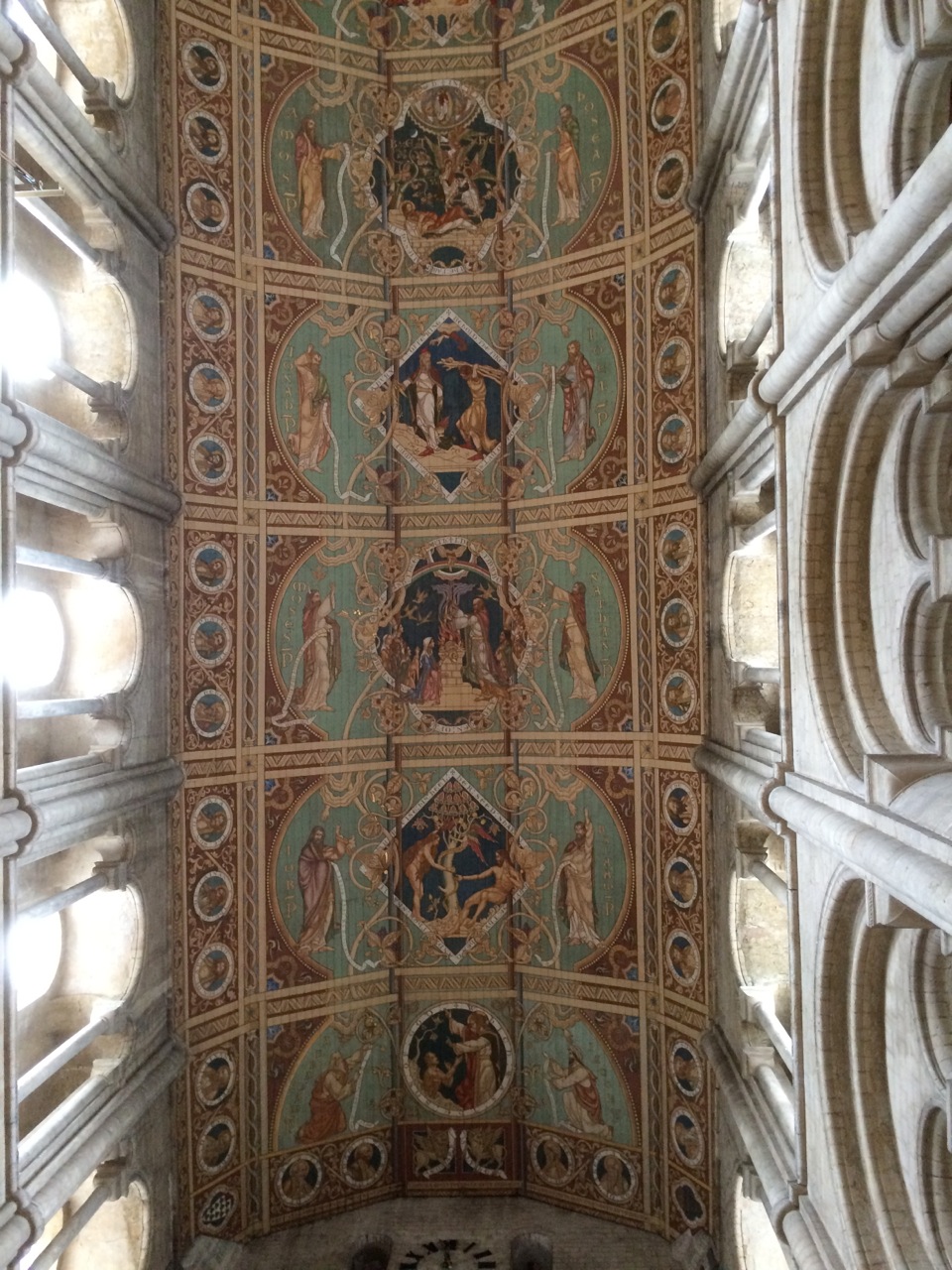


 the elves are heading west