Lent Course 3 – The Jesus Prayer. A more helpful understanding of Sin – The Passions or Desires

A Lent course – for St John the Evangelist, Roslyn

Praying in the Name of Jesus

‘The Jesus Prayer’

  1. A more helpful understanding of Sin.

The Passions / Desires.


Then Peter, filled with the Holy Spirit, said to them, ‘Rulers of the people and elders, if we are questioned today because of a good deed done to someone who was sick and are asked how this man has been healed, let it be known to all of you, and to all the people of Israel, that this man is standing before you in good health by the name of Jesus Christ of Nazareth, whom you crucified, whom God raised from the dead.

This Jesus is

“the stone that was rejected by you, the builders;

it has become the cornerstone.”


There is salvation in no one else, for there is no other name under heaven given among mortals by which we must be saved.’

Acts of the Apostles Chapter 4 vs 8-12

“Lord Jesus Christ, Son of God, have mercy on me”


[This text is a conflation of two sets of notes which were used as the foundation of the class.]


We watched the first 15 minutes of this video


As we have prayed this ancient prayer, we have reflected on a simple song lyric. ‘Lord, I want to be a Christian in my heart. Lord, I want to love everybody in my heart. Lord I want to be a Christian in my heart’ How these words touch the meaning of the Jesus prayer, in that we recognise be it ever so dimly something in the depths of our being which keeps us from that for which we were created, to Love God with all we have and all we are and to love our neighbours as if they were our very selves. That recognition may cause us to cry out “Lord Jesus Christ. Have mercy on me”

First we have considered that when we pray, we are entering into something far greater than our own senses perceive. St Paul paints a breathtaking picture for us of Jesus Christ who is our Life and the one to whom we pray.

He is the image of the invisible God, the firstborn of all creation; for in him all things in heaven and on earth were created, things visible and invisible, whether thrones or dominions or rulers or powers—all things have been created through him and for him. He himself is before all things, and in him all things hold together. Colossians 1:15-17


We used the illustration of Resonance – or lack of – it to think about our lives in the light of this Reality. In the same way that the better we were conversant with the culture of the song we heard in the first week, the deeper its impact might be upon us. So the more closely our lives conform to that of Jesus, the better they resonate, indeed Resound with His great hymn of Love and Life.

Then we considered how to some extent we knew within ourselves this separation between the Reality of the Life of the Risen Christ and our own. We reflected upon the powerful story of Jesus healing the paralytic. Of how Jesus’ deepest act of healing is the forgiveness of his sins, and how the physical healing was almost incidental. This relationship between Sin and illness is very significant, but we also were reminded that in our culture the tendency to individualise our existence, not to see our lives woven together, might lead us to either make simplistic connections ‘you are unwell because you have sinned’, or rejecting those suggestions, to suggest there is no connection.


But from the earliest times in the Church, Sin was understood in terms of a form of illness, indeed a form of madness – a terrible contradiction of our true nature as God’s children. [It is perhaps interesting to reflect that in this age where often people scratch their heads regarding physical illness and its relationship to the Love of God, our perception of Sin is very weak.] This understanding of Sin however is perhaps not the understanding we have been taught or grown up with in the home and elsewhere. However it is the understanding which continues to be the understanding of our brothers and sisters in the Orthodox tradition of the Church in which this prayer took root and continues to flourish.


Note the language of Peter when he addresses the Jewish leaders in the passage at the head of this paper. There is ‘no other name . . . by which we must be saved’


A parting of the ways and a new teaching

{A brief history lesson}


Our Western understanding of Sin owes much to something which happened almost 1000 years ago, when the church divided. To the East the Churches of Byzantium, to the West the Church of Rome. In the immediate aftermath of this split, the Church of Rome underwent several changes, one being that there was a move to what we might call a ‘Juridical’ model. Rome of old had been the seat of what we know as the ‘legal’ system, and the theology of the Western Church had always to a degree been influenced by this, but without the modifying effect of the Greek based Eastern Churches, ideas which have their roots in legal systems began to profoundly affect the teaching of the Church on Sin.


Sin as a Moral condition vs a Sickness


This is important re the words of the Jesus prayer. When we pray ‘have mercy on me’ it is not because Jesus stands over us about to punish us, but that he is near to us desiring to heal us. The word ‘Mercy’ in Greek is very close to the word for Oil, which of course is used in anointing for healing


So Sin as a condition took a back foot, and sins, the symptoms of the condition came to the fore. It was in this Juridical atmosphere that the idea that upon the Cross God was punishing Jesus for ‘all the wrong things we have done’ (as a Christian song has it) – the doctrine of Penal Substitution came to the fore. A ‘sinner’ in this regard instead of someone who is bound – paralysed – by sin and cannot do what they desire in the deepest part of their hearts, like a form of sleep paralysis, became no different to someone who had committed a civil offence and ended up in the courts.


This had multiple consequences. For example many of us grew up being told to ‘be good’ where being ‘good’ consisted in not doing anything naughty! But more troublingly, everything became a matter of transactions. You did something wrong, and you were punished. But because this punishment was ‘separation from God’, something had to be done, someone had to pay the fines! So Penal substitution – Jesus pays the penalty. Yet in our hearts we still know that separation from God . . . To come back to the illustration we used at the beginning of last week, the Western answer, Jesus pays the price for our sins, doesn’t deal with our deepest need – to be restored to the full Likeness of God


For many western Christians, the idea that ‘sin’ is a matter of ‘doing naughty things’ is so ingrained, often through our upbringing that we might readily agree with Penal Substitution or at least its premises, and like the lady we heard of last week, try not to be troubled by the fact that that we go on sinning – that we are not healed of the condition of Sin. And for some of us, we did so well at not doing anything wrong, that like the Pharisees, like the eldest son in the parable of the Prodigal, we really think we have no problem. Sometimes it is our fall into Grave sin which is the point where we realise we are not Good


The Eastern Church continues to teach that Sin is as it were an illness of the Soul – a form of Captivity or soul paralysis. We are held captive by Sin. Indeed their diagnosis is far deeper than that in the West, where Sin is ‘our ongoing tendency to do naughty things’.


We might paraphrase the Eastern Diagnosis thus – ‘Your condition is far worse than you might imagine. But the Healer is One who even raises the dead’


Seven deadly sins . . . or Ten paralysing Passions?

The idea of Seven Deadly Sins is well known, even to those outside the community of faith, but this like the Legal turn with regard to our sins, is also a product of the West. After all, if we are guilty, there have to be ‘sins’ we have committed. But these are actually a corruption of the earliest teaching of the Church on the Passions or Desires. [Desire is a more helpful word]


The Eastern Church teaches that the root of our problem is the distortion of our desires. Desire, which is create Good – gets distorted. Put simply ‘We do not Love God, we do not even want to Love God’ The distortion of our Desires are the Root of our illness.


Having set out on the journey to follow Christ in Baptism, the early Christians soon found themselves impeded and carefully diagnosed our condition most elegantly in terms of these Passions


Pride – Vain glory – Sadness – Anger – Fear – Gluttony – Lust – Acedia – Self-love – Love of money


It is important to note that all of these Distorted desires have the effect of distracting us from the Source of our Life, that is The Risen Christ. This is our problem. The Wages of Sin is Death, not in the sense of a penalty, but a natural consequence. Our Life is in Christ. All that distracts our attention from Him is cutting us off from Life.


Of course The benefit of our continual praying the Jesus prayer is in this respect two fold – it directs our attention to the source of Life, who is also the One who can heal . . . And it also points out something else which the Western View obscures. Obviously if we do something wrong, we commit a sin, there is nothing we can do to to undo what we have done – but if our essential problem is that we are sin sick, then as with any condition, we can participate in our healing. There are things we can do which either help or hinder the healing. Within the Eastern tradition, The Jesus Prayer is The prayer response, and we will look more closely next time at this – How do we take up our mat and walk?


But for now we must attend to one key aspect of praying this prayer which we must needs be aware of.


Last week I used the illustration of My heart as a pond! It was an image that had formed in my mind and which I took to my Spiritual director. The thing is this, and especially it may be true of those who have been brought up to ‘be good’. When we hear all about Jesus forgiving our sins, we can hardly come up with anything worth writing home about (this sometimes is why Grave sin can better alert us to our state)

Our Enemy, and the Eastern tradition is not coy about The Evil One, is very content with this state of affairs. Leave things undisturbed – but if we invite Jesus in, then things get stirred up!! So it is VERY common to start praying the Jesus prayer and realise that we are in deep deep trouble!


Look at these early verses from Mark


They went to Capernaum; and when the sabbath came, he entered the synagogue and taught. 22They were astounded at his teaching, for he taught them as one having authority, and not as the scribes. 23Just then there was in their synagogue a man with an unclean spirit, 24and he cried out, ‘What have you to do with us, Jesus of Nazareth? Have you come to destroy us? I know who you are, the Holy One of God.’ 25But Jesus rebuked him, saying, ‘Be silent, and come out of him!’ 26And the unclean spirit, throwing him into convulsions and crying with a loud voice, came out of him. 27They were all amazed, and they kept on asking one another, ‘What is this? A new teaching—with authority! He commands even the unclean spirits, and they obey him.’ 28At once his fame began to spread throughout the surrounding region of Galilee.

29 As soon as they left the synagogue, they entered the house of Simon and Andrew, with James and John. 30Now Simon’s mother-in-law was in bed with a fever, and they told him about her at once. 31He came and took her by the hand and lifted her up. Then the fever left her, and she began to serve them.

32 That evening, at sunset, they brought to him all who were sick or possessed with demons. 33And the whole city was gathered around the door. 34And he cured many who were sick with various diseases, and cast out many demons; and he would not permit the demons to speak, because they knew him.

35 In the morning, while it was still very dark, he got up and went out to a deserted place, and there he prayed. 36And Simon and his companions hunted for him. 37When they found him, they said to him, ‘Everyone is searching for you.’ 38He answered, ‘Let us go on to the neighbouring towns, so that I may proclaim the message there also; for that is what I came out to do.’ 39And he went throughout Galilee, proclaiming the message in their synagogues and casting out demons.

40 A leper came to him begging him, and kneeling he said to him, ‘If you choose, you can make me clean.’ 41Moved with pity, Jesus stretched out his hand and touched him, and said to him, ‘I do choose. Be made clean!’ 42Immediately the leprosy left him, and he was made clean. 43After sternly warning him he sent him away at once, 44saying to him, ‘See that you say nothing to anyone; but go, show yourself to the priest, and offer for your cleansing what Moses commanded, as a testimony to them.’ 45But he went out and began to proclaim it freely, and to spread the word, so that Jesus could no longer go into a town openly, but stayed out in the country; and people came to him from every quarter.

Jesus steps into the world and all of a sudden sickness and demons are everywhere! We tend often to think of the presence of Jesus as far from disturbing, after all, what business does he have with us? He is here to comfort us in our difficulties, not make more for us 🙂 But of course he is not making difficulties – He is All Light. When we invoke him in prayer – light shines, which the darkness cannot stand and starts to kick up a fuss. The pond is stirred and all of a sudden we realise things are a lot murkier than we might have thought.

One Important note – Jesus never exposes more than he gives us grace to cope with and we pray MORE fervently Jesus Christ have mercy on me a Sinner.

Of Balrogs and Smaug!!

Our approach to Spirituality in the West – a word not used in the Eastern tradition – can leave us is a dangerous state. We do not do this walk together we need experienced guides. Even basic meditation should really be always an accompanied journey.

Older traditions are far wiser – such journeys are always accompanied

Jesus prays ‘Father forgive them, for they do not know what they are doing’ If we are blind to our sin – why do we have such pride in our capacity to understand what happens when we pray


One or two comments

Firstly, and we shall return to this, one of the great weaknesses of the Western Church is its lack of Tradition, or sense of the meaning and Significance of The Tradition. Anglicanism properly understood is well described thus – Based upon Scripture, interpreted by Tradition and applied to our context by Reason. But for many, perhaps most of us Anglicans we have little sense nowadays of ‘Tradition’ which is perhaps why what we call reason is let loose on Scripture, often to tear it to pieces

The Jesus Prayer as we have been exploring lies within a powerful apprehension of Tradition as ‘ the living faith of the dead’ – or perhaps better, ‘the living faith of the cloud of witnesses’ [Abraham rejoiced that he would see my day; he saw it and was glad] At the heart of The Tradition is the Liturgy of the Church, both of which in modern terms are seen as somehow a barrier or irrelevant to the Spiritual Life. The Tradition understands them as indispensable, indeed that to journey without them is at best most unwise, at worst perilous in the extreme, or madness.

In both the East and the remnants of the once common tradition in the West, any ‘individual practice’ must be rooted in the shared life of the worship of the whole church. In this respect we think especially of The Prayers; Auricular Confession and the guidance of Elders; Study of the Scriptures (and we might add, the writings of the Saints); and The Eucharist. The Jesus Prayer is a practice of the Church and can only be fully apprehended within this context.

[Some Orthodox writers would say, within the tradition of the Orthodox Church, and we should be mindful of their counsel and slow to seize hold of a practice which until recently was barely known in the West. Our penchant for practices, as if they were technological tools, to be picked up and discarded at a whim, like a spanner, or worse something to be practiced until we grew bored or give up is at best most unhelpful.]

Second we have problems with words. What I mean by this is that certain words have unhelpful resonances for us. For example, as illustrated above ‘The Church’ is a phrase which generally as people with a largely Protestant heritage we have an inbuilt problem with. We may well think – what is the Church? In some respects we think ‘it may be helpful to me and my journey’, but in others it is like practices ‘disposable’. No doubt, some of this is a deep unconscious apprehension of troubling Church history, when as we all know, the Church has born little resemblance to The Body of Christ.

Or ‘sinner’. Again some of us may well have grown up being taught to ‘be good!’, and that to be a sinner was to be one who was ‘bad’, but ‘sinners’ are those amongst whom Jesus is to be found. It is sinners Jesus calls! Being a Sinner is actually the condition which draws Christ close to us. Of course we are all sinners, but perhaps lacking an apprehension of any particular sins we commit, being blind to our context, we may find this a difficult word to associate ourselves with

Or we might think of the word ‘mercy’. We think of someone pleading for their life, which in a sense we are as we pray the Jesus prayer, but in what sense. As we may well be aware, the sense of ‘mercy’ we are crying for from a Western perspective is that ‘God might not punish us for our sins’. Yet if we return to the Scriptures in which we find the Genesis of the Jesus prayer, the tone is very different

 

THIS is the Temple of the Lord – Sermon for Lent 3 – Year B – 2014

Sermon for Lent 3 – Year B – 2015
Sunday March 8th

Exodus 20:1-17
Psalm 19
1 Corinthians 1:18-25
John 2:13-22

st-marys-gisburn

‘THIS is the Temple of the Lord’

One of my churches in England was a little older than the other, 800 years older – roughly. Actually we have no idea how old Gisburn Church was, we only had the date of the first recorded Vicar in 1124. When we were considering some building alterations to the other church in my care including the possible removal of some pews, someone remarked – ‘why can’t we keep it the same, just like Gisburn has been over the years’ I wanted to laugh, but instead tried gently to point out that the original form of the building was unknown, buried under many many changes over the years. Not least the arrival of pews in the 17th Century – following the reformation.
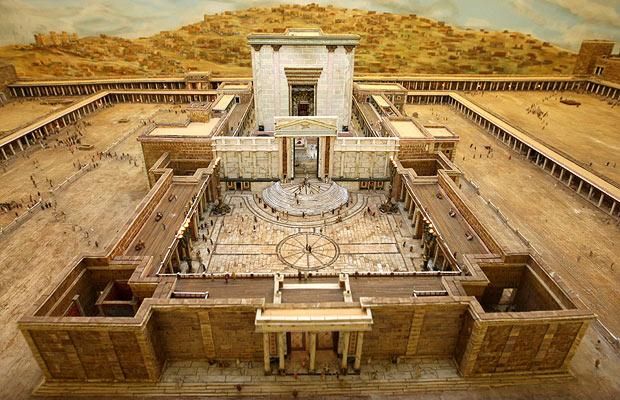
Over the years it had seen many things, many changes. It’s tower was castellated as it was built in an era when the Scots were wont to roam that far South and so it provided a place of refuge and defence. Oliver Cromwell had stabled his horses in it prior to the battle of Foulridge in the English Civil War, and as most medieval churches it had served as a place for storing what passed for the local fire engine, and of course hosting the market. An imaginative Vicar would have had little difficulty summoning up the scene which confronts us in our gospel, as Jesus went into the Jerusalem temple, confronted by sheep, cows, doves and all the mechanisms of financial exchange . . . the Temple was the commercial hub of Jerusalem –  although it hadn’t been around nearly so long as Gisburn Parish Church 🙂 The Jerusalem temple that is, this great Edifice of Herod the Great, under construction these mere forty six years – it hadn’t even been around as long as this church 🙂 500 years previously, the Jewish people had returned from exile and set about the task of rebuilding on the site of Solomon’s Temple, but Herod decided on a huge rebuild programme. It was Vast and said to be coated in Gold Leaf – such that it was almost impossible to look at as the suns light reflected from it.

temple-wide_1355306i
It was visible from Joppa on the sea coast and it was from there that all the many many goods associated with the life of the Temple made their way to Jerusalem. Its expense and upkeep led to what we may remember was called the Temple Tax. And we read in Matthew’s gospel how the tax collectors came to Peter to ask if Jesus did or didn’t pay the temple tax – and how Jesus instructed Peter to go and fish and find the two drachma coin in the fish’s mouth 🙂
Keeping up the Temple was literally life draining from the people of God – indeed it was said that slaves were also bought and sold there. The Temple was in many respects a vast idol – which enslaved the people. As the Church in Gisburn was seen as in many ways central to the village, even by those who only darkened its doors for funerals, and many people helped pay for a new roof – so far far more so Jewish identity was inextricably linked to the Temple – this was why they had gone to So much trouble after the exile to rebuild it, and why those in authority thought nothing of the tax, or the other burdens of upkeep to the vitality of the people.

Jesus in his appearing is like a laser guided missile, aimed right at the very heart of this Identity. In every gospel THE confrontation with the Pharisees and the rest which provokes calls for his death is the Identity forming Day, the Sabbath. And second, the identity forming place the Temple. We might say that the Jewish sense of who they were rested on these two pillars one in time and one in Space, Sabbath and Temple.
The Temple’s significance of course was clear – it was the place where the God of Israel dwelt with his people. And it was understood literally as the Centre of the World – the Creation narrative from Genesis echoing in its six days the arrangement of the various courts of Solomons Temple. The Sea being figured by the great basin for the purification rites, the Lights in the Sky – the great Menorah, the great Lampstand in the Temple and in its heart, the Seventh Day, the Sabbath, the One who dwelt in the Holy of holies – the one in whom we are to find our hearts Rest (as St Augustine puts it)

From the beginning of the story of the forming of Israel, by God’s majestic act of rescue from Slavery in Egypt – He had dwelt in their midst. In the wilderness – which we travel through in Lent. No trappings of luxury. The Ark of the Covenant, containing the Ten Words on the two tablets of stone – overshadowed by a pillar of cloud by day and fire by night – there in the Tabernacle in their midst. But Israel did not listen to the Word, that the God who had brought them out of the land of Egypt and thus entreated them – you shall have no gods before me, was not a God who dwelt in houses built by human hands. The God who frees from slavery is a God who is radically Free, and commands the true freedom which is found in obedience to His Life Giving Word made flesh. Each of those Ten commandments was about Freedom. Do not be enslaved to other Gods, do not be enslaved to Idols, Do not try to enslave me by using my name to back up your plans, do not be enslaved to work, know who you are honour your father and mother, do not be enslaved to other identities, do not be enslaved by the passions and deisres that are murder, adultery, theft, stealing, false witness  – and do not be enslaved by things in covetousness. God is Freedom and His people should be, but in beuilding a house of stone, they themselves have once more become enslaved to the project of its upkeep . . .

St Stephen in his eloquent witness which will lead to His martyrdom again points to the Temple “Our ancestors in turn brought [the tabernacle containing the ark] in with Joshua when they dispossessed the nations that God drove out before our ancestors. And it was [in Jerusalem] until the time of David, who found favour with God and asked that he might find a dwelling-place for the house of Jacob. But it was Solomon who built a house for him. Yet the Most High does not dwell in houses made by human hands; as the prophet says, 
 “Heaven is my throne,
   and the earth is my footstool.
What kind of house will you build for me, says the Lord,
   or what is the place of my rest? 
 Did not my hand make all these things?”

And the significance of the Temple conflict is brought into sharpest focus in John’s gospel. John moves the clearance of the Temple from Jesus last week, to the beginning of His ministry, his first truly public appearance – the first place where he makes himself known amongst the crowds. After a quiet appearance at the Wedding in Cana, he Erupts onto the public stage, In the Temple. Consumed by zeal as Psalm 69 recounted ‘it is zeal for your house has consumed me’ – the prayer of a righteous man suffering untold persecution, the prayer of one who loves God with heart and soul and mind and strength and thus cannot bear to see what has become of the dwelling place of his Father. John is saying – THIS is what he has come for – the Sign? Destroy this Temple and I will rebuild it in three days . . .
You, in the slavery of your minds can only envisage death and destruction, but I am the Light and the Life of the World. Standing up in the midst of the Temple, upon the feast of tabernacles, when the poeple are celebrating their time in the wilderness – Jesus stands up in their midst and ‘cried out with a loud voice – bawling from the centre of his gut – Whoever is thirsty, let him come to me and drink. Whoever believes in me, as the Scriptures say – out of his heart shall flow life giving waters

Ho, everyone who thirsts,
come to the waters;
and you that have no money,
come, buy and eat!
Come, buy wine and milk
without money and without price.
Why do you spend your money for that which is not bread,
and your labour for that which does not satisfy?
Listen carefully to me, and eat what is good,
and delight yourselves in rich food.
Incline your ear, and come to me;
listen, so that you may live.

And again from the end of the Book of Revelation  – that great picture of the presence of God where there is no Temple – Only the throne of God and the Lamb –  ‘It is I, Jesus, who sent my angel to you with this testimony for the churches. I am the root and the descendant of David, the bright morning star.’
The Spirit and the bride say, ‘Come.’
And let everyone who hears say, ‘Come.’
And let everyone who is thirsty come.
Let anyone who wishes take the water of life as a gift.

Destroy this temple, and I will rebuild it again in three days – Jesus Christ. The place where we meet God. The word became flesh and Tabernacled amongst us. For all the brilliance of Herod’s Temple, it is as nothing to the brilliance of God made known to us in Jesus Christ and we have seen his glory . . . say John. Whoever has seen me, has seen the Father says Jesus as he tells of a house with many mansions . . . many many mansions – we dwell in Him and he in us.

And he comes with a refining fire. He Cleanses the Temple – drives from it all that keeps us from him. Through Lent we participate in that refining, that cleansing as we consent to have all that hinders us, we lay aside all that keeps us from Him and his nearer presence, we consent to have it stripped away, in our individual lives and our Life together. No longer slaves but finding our true freedom in obedience to the Word that frees, the Word that Lives for Ever, the Word made flesh – that we might be a fit place for the dwelling place of God, as the Body of Christ in This place.

Lent Course 2 Praying in the name of Jesus – The Jesus Prayer. Jesus and Healing

A Lent course – for St John the Evangelist, Roslyn
Praying in the Name of Jesus
‘The Jesus Prayer’
2. Jesus and healing. Sin and Salvation.

Then Peter, filled with the Holy Spirit, said to them, ‘Rulers of the people and elders, if we are questioned today because of a good deed done to someone who was sick and are asked how this man has been healed, let it be known to all of you, and to all the people of Israel, that this man is standing before you in good health by the name of Jesus Christ of Nazareth, whom you crucified, whom God raised from the dead.
This Jesus is
“the stone that was rejected by you, the builders;
it has become the cornerstone.”

There is salvation in no one else, for there is no other name under heaven given among mortals by which we must be saved.’
Acts of the Apostles Chapter 4 vs 8-12

“Lord Jesus Christ, Son of God, have mercy on me”
First – a song 

(‘Lord, I want to be a Christian’ The Proclaimers)
And so we are working from the assumption that we want to be Christians from our hearts – although with St Theresa we may well acknowledge that that desire is at best a weakly flickering candle, if not a barely smouldering wick. Whilst the Spirit may be (barely) willing, the flesh is weak. Whilst our desire might be to Love, the words of St Paul resonate “I can will what is right, but I cannot do it. For I do not do the good I want, but the evil I do not want is what I do.” Romans 7:18-19
Perhaps we might cavil at the word ‘evil’. After all we live in a society which locates ‘Evil’ out there. The ancient practise of scapegoating is alive and well. Societies need ‘Evil’ people in order to locate ‘Evil’ anywhere but where it resides, in us all. [A good scriptural example of this is The Gerasene demoniac. He is possessed by a Legion of demons, but when he is healed, Jesus the healer is driven from their society . . . or Jesus the scapegoat?]
We also spoke last week of Resonance. Of how God’s intention for all Creation, renewed in Jesus Christ is that it Resonates with his Life and his Love. That in and through our lives, He is perfectly revealed and made known within His Creation.
In that we recognise our predicament, we recognise that we are ‘out of tune’, ‘off key’, and we do not recognise the language of the song, as we did not to one degree or other resonate with Kate Rusby’s song. Yet, we often pray as if ‘we knew what was what’.
Here in New Zealand when someone asks how we are, we tell them ‘We are good!’ Recently I was speaking with someone who told me that their grandfather, A Christian man with a feel for these things would not take that for an answer, responding “You are not good, you are well!”, but the truth is that we are not even well. Actually if we were well we would be good. So we cry out
“Lord Jesus Christ, Son of God, have mercy on me”
This ancient prayer has its roots in the address of so many of those whom Jesus met – yet one might note that it is never heard on the lips of those who plot his destruction. It is the prayer of those who recognise be it ever so faintly that they are not well and that Jesus the healer is in town.
When Jesus returned to Capernaum after some days, it was reported that he was at home. So many gathered around that there was no longer room for them, not even in front of the door; and he was speaking the word to them.
Then some people came, bringing to him a paralysed man, carried by four of them. And when they could not bring him to Jesus because of the crowd, they removed the roof above him; and after having dug through it, they let down the mat on which the paralytic lay.
When Jesus saw their faith, he said to the paralytic, ‘Son, your sins are forgiven.’ Now some of the scribes were sitting there, questioning in their hearts, ‘Why does this man speak in this way? It is blasphemy! Who can forgive sins but God alone?’
At once Jesus perceived in his spirit that they were discussing these questions among themselves; and he said to them, ‘Why do you raise such questions in your hearts? Which is easier, to say to the paralytic, “Your sins are forgiven”, or to say, “Stand up and take your mat and walk”?
But so that you may know that the Son of Man has authority on earth to forgive sins’—he said to the paralytic— ‘I say to you, stand up, take your mat and go to your home.’ And he stood up, and immediately took the mat and went out before all of them; so that they were all amazed and glorified God, saying, ‘We have never seen anything like this!’

What do we notice in this passage? What catches our attention?


Some points to consider
o The Crowd – a sign of the evil that seeks to smother Jesus throughout Mark – eg Mark 5:31. The Jesus Prayer is the prayer of the one who wants to be healed – one who may well sense the evil pressing in, and even more, perhaps within.
o Note the order of the healing. Jesus sees deeper. He is aware of our deepest needs in a way we who ‘See’ are not
o The physical healing is a Sign of his authority to forgive sins. The healing which seems to us greater is actually here a Sign. Jesus heals the man physically in order to show that he has authority to make us truly well. The early church over and again refer to Jesus as ‘The physician’, and whilst there are many recorded physical healings, as throughout the gospel account, they are referring to the deeper healing, that from Sin.

But what is the nature of this healing? With the paralytic we are aware of the physical healing, but what is the outcome of the forgiveness of sins?
o Here note the reaction of the scribes ‘Why does this man speak in this way? It is blasphemy! Who can forgive sins but God alone?’ . . .
 Who can? Who is able to forgive sins? Are the Scribes making a purely ‘religious’ response here? How easy is it to say ‘Your sins are forgiven you’? Rather is there not a terrible affront? Being Unable to forgive sins themselves, they separate themselves from God – ‘only God can forgive sins’
 Jesus answer – ‘that you may know that the Son of Man has authority on earth to forgive sins’
We might tend to think, understandably but erroneously, that Jesus natures, human and divine, are separate. That some things he does out of his divinity, and some he does out of his humanity. So, ‘he heals out of his divinity, but walks and eats and suffers in his humanity’ – but this is because we have lost sight of the nature of our humanity – of who we are. Jesus reveals to us who we are.
o the Son of Man has authority on earth to forgive sins. Upon the Cross, God in the human Jesus is forgiving everyone for everything.
o It is natural for the Human who bears the image of God, to forgive sins – it is their true nature. So we pray ‘Our Father . . . forgive us our sins as we forgive those who sin against us’ To forgive is Divine and we are Children of God
o The Risen Christ, the first fruits of the new Creation, restores in us the Divine Image, the Divine Life in which we are to participate.
Jesus said to them again, ‘Peace be with you. As the Father has sent me, so I send you.’ When he had said this, he breathed on them and said to them, ‘Receive the Holy Spirit. If you forgive the sins of any, they are forgiven them; if you retain the sins of any, they are retained.’

Thus if we say with the Scribes ‘Who can forgive sins but God alone? in a sense we are right, but it is a dangerous half truth. For those who bear the Image of God are vessels of God’s Life. The Scribes question is a revealing of their captivity to Sin which prevents them from ‘Loving everybody from their heart’

And for us who are Christians, it is a denial of our Baptism which makes us Children of God. Having been set free from Sin we choose to allow ourselves once more to be taken captive by it

“Lord Jesus Christ, Son of God, have mercy on me”

In some respects our state is worse than at first. Having been set free we have allowed ourselves to be tangled up in Sin anew.

Now as they went on their way, he entered a certain village, where a woman named Martha welcomed him into her home. She had a sister named Mary, who sat at the Lord’s feet and listened to what he was saying. But Martha was distracted by her many tasks; so she came to him and asked, ‘Lord, do you not care that my sister has left me to do all the work by myself? Tell her then to help me.’ But the Lord answered her, ‘Martha, Martha, you are worried and distracted by many things; there is need of only one thing. Mary has chosen the better part, which will not be taken away from her.’

So quickly we jump to make this story something it is not, that is a story about the relative importance of two types of Christian life, the Active and the Contemplative. We are almost asked to decide which we will be, Marthas or Marys. But the meaning of the story does not require such a leap. Mary is paying attention to Jesus, Martha is not. Martha is distracted from Jesus. Martha is upset and worried by many things. We might see her as a figure of one who is tangled up in sin, so much so that she cannot see her own need. Yet notice how Gently Jesus rebukes her

Mary ‘listened to what he was saying’ This event is after the Transfiguration, when the voice comes from heaven ‘This is my Son, the Beloved, Listen to him’

Yes, we should have a childlike relationship with God our Father in prayer, but we can’t remember how to be children, how to be naturally Children of God. As Jesus sees into the deep need of the paralysed man, so Mary sees there is something more important than getting dinner ready. And how often a child seems oblivious to that which the parent thinks is so obvious. Homework to do, and they are captivated by butterflies 🙂

“Lord Jesus Christ, Son of God, have mercy on me”
This week, set aside say five minutes a day – find a quiet place and say the prayer over and again – with attention. Attention to Jesus, Attention to yourself.
Whilst this is a prayer one can pray all the time, if we are going to Resonate, we need to start gently and attentively. A ‘space’ in which to do this is helpful.
It is not recommended to go beyond this for now, especially if we are starting out

Next Week: A more helpful understanding of sin. We do not know what we are doing. The Passions

Recommended Reading : The Jesus Prayer. Frederica Mathewes-Green
http://www.amazon.com/Jesus-Prayer-Ancient-Desert-Tunes/dp/1557256594/ref=sr_1_2?s=books&ie=UTF8&qid=1424292978&sr=1-2&keywords=the+jesus+prayer

Lent 2 – Year B ‘The meek shall inherit the Earth – Yeah Right!’

Sermon for Lent 2 – Year B
Sunday March 1st 2015

Mark 8:31-38

The meek shall inherit the Earth
Yeah, Right!

Fundamentals

A couple of years ago I had a dream. It was so striking that I wrote it down in my journal. In it I was in a canoe paddling up a stream. The stream, as streams do, became narrower and the water shallower, therefore the effort of paddling became greater until I grounded. Of course the obvious thing was to turn the canoe round, but the stream was too narrow

It must be said, when I ponder that dream and its meaning for me, the contemporary church also hoves into view. The stream getting narrower and shallower, perhaps a metaphor for falling numbers? And trying harder and harder . . . perhaps we need to get our bearings. To remind ourselves of one or two fundamentals . . .

1. God is not relevant to our lives

I have pondered often and long about why so many of us are at the very least hesitant about ‘sharing our faith with others’ – and the answer that came to me in the early hours of one morning this week was that we imagine the conversation in our head – a little like this.

I’m a Christian
I’m not
My faith makes a real positive difference to my life
Really? What? We have been friends for a long time. Your life and my life – they are pretty similar – indeed in many respects you might say I have a better life than you, no?
Well, yes, errm – I see what you are saying, err but I have a profound peace in my heart
Yes. Good. I’m happy for you. I find a walk on the beach does that for me. Isn’t it lovely 🙂

So how are the grandchildren doing then . . .

When I say ‘God is not relevant to our lives’ I mean it. But what do I mean by ‘our lives’. I mean the lives we determine for ourselves. The life which is all about our life story – the story which people may tell of us after we die, of career and home and children and hobbies etc. etc. The lives into which we try to fit God rather like a new kitchen accessory – a Unique selling point in a house, or in this case a life

We have grown up in a culture which springs from Christendom – a world where ‘everyone was a Christian’ – God was in his heaven ‘watching over it all’, and all was well with the world. ‘God’ in this scheme was there to sort out the difficulties of our lives. Like a kindly chaplain, or a Spiritual plumber, or indeed a kindly parking attendant who found us that parking space we really needed or otherwise we’d be so stressed at that important meeting with the bank to discuss our mortgage . . . God is ‘there to look after us’. But of course, for our friend with whom we are in conversation, they pretty much manage to get along very well thank you very much without any of that, and also they have spare time on a Sunday to use as they wish . . . and of course should life’s circumstances become difficult then perhaps we don’t really need this church stuff anyway because God is there looking after us, or perhaps he isn’t and actually it doesn’t seem to really make any difference . . . after all there are lots of helpful guides to having a better life – some are religious, some aren’t . . .

2. Our lives are not relevant to God

Sorry if we find this thought troubling, but they’re really not. God does not spend every moment of his waking hours figuring out how to get our lives sorted out so that we can have the life we always dreamed of . . . indeed we may have noticed that 🙂 And vice versa, there is nothing we can do to ‘help God’. On the one hand the dominant expression of faith is that ‘god is up there somewhere looking over us’, and on the other, the Church seems obsessed in what Margaret of Sienna calls ‘solicitudo religioso pro Deo’ To translate roughly, ‘a blasphemous anxiety to be doing God’s work for him’. Whatever, ‘God’ is largely absent from the proceedings
Like in the canoe dream – people paddling harder and harder as the stream narrows and the water shallows. The church is busier than ever, getting the message out, endless committees, initiatives etc.etc.etc. ‘God’ becomes an ever vague shadow, out there, somewhere, perhaps??

Last week I concluded that we would do well from time to time, not to put ourselves in the disciples’ position, as they observe Jesus healing people, but rather to place ourselves in the position of those who are healed, in other words, In Jesus direct line of sight.
Well, let’s do that this week and where is Jesus looking, oh yes he’s looking at his disciples. He is telling them, quite openly that he ‘must undergo great suffering, and be rejected by the elders, the chief priests, and the scribes, and be killed, and after three days rise again.’

And we all know Peter’s response – And Peter took him aside and began to rebuke him.

Now let’s just pause at this moment. Immediately before our gospel reading, Peter has declared that which God has revealed to him, not what he has figured out for himself, what God has revealed to him, That Jesus is the Messiah, the Christ, the Anointed one, The King of Israel . . .

And Peter took him aside and began to rebuke him?????!!!!!!

3. The problem is ‘Our Lives’ . . .

Jesus words seem like madness to Peter – but it is Peter who has the problem . . . turning and looking at his disciples, Jesus rebuked Peter and said, “Get behind me, Satan! For you are setting your mind not on divine things but on human things.” Jesus tells Peter ‘You don’t get it! You don’t have a clue! You are the One trying to destroy my work . . . and we, like Peter have So much confidence that we do get it . . . but as I said, we cannot give a coherent account of what IT is to those amongst whom we live

The problem is ‘Our Lives’. When we listen to what Jesus says, it seems utter madness, we are there with Peter. Jesus says ‘The meek shall inherit the earth’ – and we rebuke him saying, that’s a nice sentiment Jesus, but actually its the hard work and fine accounting skills, its our genius that will get us what we want . . . and the moth and rust will corrupt and if we store it all in vaults after our deaths, the thieves will break in and steal.

I was in a church meeting a long way from here earlier this week, where the wheels of power were turning. We were planning and proposing. And someone gave a very lengthy account of a significant event in the life of the church and credited one person with all the credit and said how much we owed them by way of thanks, and no one batted an eyelid . . .
No one – myself included – said, ‘Let us pause and offer profound thanks to God without whom Nothing is possible. It was as if God didn’t even exist.’ We’d pulled it all together.

We modern westerners are So in control of Our Lives – and thus the way we run them is in direct opposition to the way of Jesus – Jesus who says ‘The meek shall inherit the Earth’; ‘do not store up for yourselves treasure on earth’, ‘unless you become like a little child’ How could a child even begin to run the church as we do??? Jesus who says For those who want to save their life will lose it, and those who lose their life for my sake, and for the sake of the gospel, will save it. For what will it profit them to gain the whole world and forfeit their life? Indeed, what can they give in return for their life?

4. Jesus response to the problem of ‘Our Lives’

He called the crowd with his disciples, and said to them, “If any want to become my followers, let them deny themselves and take up their cross and follow me.”

As I was painfully reminded this last week by a friend, we miss the horror of what Jesus is saying here. The Cross has become a pretty item of jewelry – or we talk about it is terms of the sufferings that are common to all human kind, broken relationships, illness – ‘We all have our cross to bear’ we sigh. Jesus speaks to the whole people of God, who symbolised by Peter have their minds set on human things and faces them with something horrific. No one there, none of the readers of Mark’s gospel in the first 300 years will have not seen, in all likelihood Many Crosses, not hanging round people’s necks, but with people hanging on them. ‘You really don’t want to go there’, but Jesus says this is the Way.

Pontius Pilate wanting to let people know where the real power lay, didn’t always bother with wood, bit of a waste, he would nail people to the walls of Jerusalem. Everyone knew the horror of it and had seen how literally excruciating was the death of the Crucified, over hours in unendurable agony. The utter destruction of a Life – indeed bodies were left there to be devoured by wild animals and birds.  So horrifying that people could not bear to speak of it or write about it. Truly A Satanic tool.

Jesus takes Our Lives to the Cross, and we are called to follow him. Indeed this is the meaning of our Baptism – not some folk rite, so that we are in on this Chaplain God and can expect his services. Christendom neatly sidestepped the Cross and delivered up a faith of the irrelevant God, placing the human and our lives back in the centre of things. But our Lives are only the centre of things if w are In Christ, the Crucified One. We are baptised into his death so that He might be Our Life, Our All in All. As St Paul puts it in Colossians, ‘For you died, and your life is hidden with Christ in God’  Our baptism is the End of Our Life. The end of Our agendas, the end of Our plans. The life we now live we live by faith in the Son of God. For truly Christian life to begin, Our Lives must end. He must become Our Life. The Risen one

And So we come here, we confess our Sins, that once more we have lived for ourselves and not for Him who loves us, We feed on his word which is Life giving Like honey on our lips, we respond in words irrelevant to the World, the Creed, and in his infinite Grace and Mercy, he feeds us with His Very Life.
Glory to Jesus Christ
Glory for Ever

Lent Course – Praying in the name of Jesus “The Jesus Prayer” – 1. Resonance

A Lent course – for St John the Evangelist, Roslyn

Praying in the Name of Jesus

‘The Jesus Prayer’

  1. Resonance

Then Peter, filled with the Holy Spirit, said to them, ‘Rulers of the people and elders, if we are questioned today because of a good deed done to someone who was sick and are asked how this man has been healed, let it be known to all of you, and to all the people of Israel, that this man is standing before you in good health by the name of Jesus Christ of Nazareth, whom you crucified, whom God raised from the dead.

This Jesus is

“the stone that was rejected by you, the builders;

it has become the cornerstone.”

There is salvation in no one else, for there is no other name under heaven given among mortals by which we must be saved.’

Acts of the Apostles Chapter 4 vs 8-12


“Lord Jesus Christ, Son of God, have mercy on me”


First – a song 🙂

https://www.youtube.com/watch?v=nGSMjgQHIZ0

(‘Lord, I want to be a Christian’ The Proclaimers. Coincidentally, the video link contains pictures of New Zealand)

I was out praying and walking the other morning when it came to me that this song connects so well with the Jesus prayer. For the one who desires to Love God in and through everything, this prayer is the journey we make . . . and to pray the Jesus Prayer is to make a journey. We might say that it is the prayer of the Disciple. ‘Lord, I want to be a Christian, in my heart’

  • A very simple prayer
  • A very ancient prayer
  • Not ‘just another prayer’ . . . although it may be treated as such.
    • Used by millions of Christians every day, and often all day
    • A prayer which takes us into the deep roots of our faith and our existence
  • A prayer which by Grace we may learn to ‘pray without ceasing’, Constant prayer is an essential aspect of a lively faith. Four times Paul exhorts us to this
    • ‘Rejoice in hope, be patient in tribulation, be constant in prayer’ (Romans 12:12)
    • ‘Pray at all times in the Spirit’ Eph 6:18
    • ‘Continue steadfastly in prayer’ Col 4:2
    • ‘Rejoice always, pray constantly, give thanks in all circumstances. For this is God’s will for you in Christ Jesus’ 1 Thess 5:17-18
    • And with Jesus ‘Stay alert! Watch and Pray that you do not enter into temptation’


But first, CONTEXT.

Whenever we dare to speak of prayer we make many assumptions. When we think about Context we may think of our own lives and culture, but to Pray is to enter a far larger world, a far greater context and leaves us with many questions.

How do we Orient ourselves within such a world?? (The verb comes from the practise of lining churches up to face East, towards Jerusalem – Orienting them)

What does it mean to pray?

Why do we pray?

To whom do we pray?

Who is it that prays?

Who am I?

What does it mean to ‘be saved’?

What is the goal of our faith?

Prayer, Faith, Salvation are words which do not belong to our everyday existence, yet we assume we know what they mean. Our answers to these questions will profoundly shape whether we merely Say the Jesus Prayer, or come to Pray the Jesus prayer.


We live in an age of disconnection and technique. We no longer think ‘everything has its place’ even in the world we can see, let alone that which is only revealed in faith, so we might think that we can just ‘use’ this prayer – without any understanding of its context. If we are alert to these things then at least a rudimentary understanding of the significance of context is necessary is we are to pray in this way . . .


It would be very easy to teach ‘The Jesus Prayer’ as a simple ‘prayer technique’. Rather like I could teach you to sing this song . . . ‘My Young Man’ Sung by Kate Rusby (Pure Records)

But truly to pray is to enter far deeper than simply ‘practising a technique . . .’ one may speak, indeed pray with the tongues of men and angels, but utterly miss the goal. This goal we may perhaps slightly better understand through considering how we approach a song like the one we have just heard


From Words to Language

From Admiration to Identification

From Repetition to Resonance

This is a song Kate wrote in memory of her Grandparents. The ‘young man’ of the title is her maternal grandfather whom she never knew, and it is as it were ‘sung by her grandmother’. Her Grandfather was a coal miner in the Yorkshire coalfields, and coal dust gave him emphysema which turned him from a strong man, to one who is in his later years cradled on the lap of his wife. Just the story itself is touching and indeed there may well be themes in it which turn it from being ‘just another song’.

For me, undoubtedly its sad beauty lies in my identification with Yorkshire, a county where I lived many years, and the sound of the Brass ensemble which Kate asked to accompany her singing. The accent of her voice, and the meek mournfulness of the Brass goes deep. (Although, we were a bit posher than that where I grew up in the country away from the coal and manufacturing culture which generated the great Brass Bands. Our village band was a Silver band J)

But of course, for all but Kate, we will all be in one degree or another mere observers – we may Admire, but our level of identification will never be total. You and I are not Kate 🙂

But the Jesus Prayer is given precisely that we might enter into ever deeper Identification with Jesus. Our Life is in Him – and as strings resonate, so every fibre of our existence is given to thrill to and resonate with the Life of God made known to us in Jesus Christ – As St Paul puts it in the letter to the Colossians – ‘He is the image of the invisible God, the firstborn of all creation; for in him all things in heaven and on earth were created, things visible and invisible, whether thrones or dominions or rulers or powers—all things have been created through him and for him. He himself is before all things, and in him all things hold together. He is the head of the body, the church; he is the beginning, the firstborn from the dead, so that he might come to have first place in everything. For in him all the fullness of God was pleased to dwell, and through him God was pleased to reconcile to himself all things, whether on earth or in heaven, by making peace through the blood of his cross.’


We might express ‘being a Christian in my heart’ as being perfectly in tune with Christ Jesus.

If we are to pray this prayer, indeed in a sense if we are to pray meaningfully at all we need to understand at some level the roots of the deep longing which that desire to ‘be a Christian’ in my heart – why is it there? Why for example do I find that song resonates, if not because I want to be a Christian, in my heart 🙂


St Augustine says these familiar words ‘You have made us for yourself, O lord, and our hearts are restless until they find their rest in you’

Some of us have been unhelpfully trained in ‘instant Salvation’ – but from the first this has no place in The Tradition. Paul, again.

If anyone else has reason to be confident in the flesh, I have more: circumcised on the eighth day, a member of the people of Israel, of the tribe of Benjamin, a Hebrew born of Hebrews; as to the law, a Pharisee; as to zeal, a persecutor of the church; as to righteousness under the law, blameless.

 Yet whatever gains I had, these I have come to regard as loss because of Christ.

Sadly, too many Christians have gone astray, because they substitute a ‘Christian’ form of Paul’s confidence before meeting Jesus for Paul’s. The outcome is that their ongoing need of Christ becomes very vague. Something happened to me in the past. I might ask him for guidance on some life decision, but . . . Jesus is seen as central to the faith in some doctrinal manner, but not the living beating heart of all we say and do and are as Christians. And tragically this culture has produced Christians who are hesitant to name God, let alone Jesus. And many false Spiritualities grow up in which Christ is not central. Put simply this is a question of ‘When Peter stand up and full of the Holy Spirit says “There is salvation in no one else, for there is no other name under heaven given among mortals by which we must be saved.” What does he mean by ‘saved’?’

Unless we understand this, we cannot lay hold of the medicine of the Jesus Prayer. As one well educated Christian said to me recently ‘praying to Jesus that he might have mercy on us – well it sounds so negative – surely we’ve moved past that?’

But for all our ‘confidence’ still that song ‘I want to be a Christian, in my heart’ may well resonate. We hear the Great Command – the Word which brings us Life ‘You shall love the Lord your God with all your heart and with all your soul and with all your mind and with all your strength.’ And feel the gap between that and the reality expressed by that disarmingly honest Saint, Theresa

‘Lord I do not Love you, I do not even want to love you, but I do want to want to love you’ Theresa of Avilla


“Lord Jesus Christ, Son of God, have mercy on me”

This week, set aside say five minutes a day – find a quiet place and say the prayer over and again – with attention. Attention to Jesus, Attention to yourself.

Whilst this is a prayer one can pray all the time, if we are going to Resonate, we need to start gently and attentively. A ‘space’ in which to do this is helpful.

It is not recommended to go beyond this for now, especially if we are starting out


Next Week: Jesus and healing. Sin and Salvation. We do not know what we are doing


Recommended Reading : The Jesus Prayer. Frederica Mathewes-Green

http://www.amazon.com/Jesus-Prayer-Ancient-Desert-Tunes/dp/1557256594/ref=sr_1_2?s=books&ie=UTF8&qid=1424292978&sr=1-2&keywords=the+jesus+prayer


‘Somehow I may obtain the Resurrection of the dead’ – Sermon for the evening of Sunday 15th February, 2014. Sunday next before Lent, Year B

Sermon for Evensong
Sunday next before Lent – Year B

Phil 3:7-21

‘That somehow I may attain to the resurrection of the dead’

Faith as conformity to Christ

When I was at theological college – rather a long time ago – although we had little vacation time, I remember visiting one of my old colleagues from the Catholic High School where I had previously been teaching – even Longer ago!

It had been a hard time for him and his family and as I remember they had just suffered the loss of one of their parents – either his father or father in law. Given that I was training in an institution for priests, he wanted to talk with me about this, but the one arena he was particularly interested in  – I had to admit, I had no knowledge of. He thought that when we were in training, we might be told about what happened to someone after they had died, in more than vague terms e.g. you go to face God/you go to be with your loved ones/you go to heaven/you go to the other place . . .

I had to admit that we hadn’t as it were been let in on some secret knowledge. And until very recently I must admit that I’d ever assumed there existed more than such vague elements of teaching. No details were available, and that was that. Until I stumbled upon a book by a very highly regarded scholar in the Orthodox Church, entitled ‘Life after Death’, and realised that there was a very highly developed teaching in this area which had been prevalent throughout the Church in the first few hundred years of its existence and indeed was still known and taught in fairly small circles to this day – but which continues to shape the practise of Orthodox Christians and their liturgy to this day (Of course Orthodox liturgy hasn’t really changed in any notable way for 2000 years 🙂 )

And I must admit that it gives a very very different view of the matter of death and what happens to YOU, that is to the Soul in the days leading up to, through and beyond death. Amongst other things giving a very well reasoned and highly material defence of the idea that Repentance is not possible post mortem – for as they say and it is obvious when you think about it, Obedience, the fruit or faith and repentance is a bodily process. One feeds the poor, one clothes the naked, one doesn’t sleep with one neighbours wife – all actions or desisting from actions in the body. So, the soul having become disembodied (in the three days following death, the Orthodox church teaches) has no vehicle for enacting obedience and this cannot repent. It is of course nothing more that the development of that old saw, ‘the road to hell is paved with good intentions . . .’

The author also stated something which at first sight is odd, but upon reflection is quite reasonable, that for the Christian, death is far more troubling a prospect than for the atheist or agnostic. Why? Well for those folk, whether anything ‘lies beyond’ is such a matter of subjective speculation – and indeed ‘surely it’s just like falling asleep for ever’, whereas the Christian lives their entire life knowing that there is something else coming up – something of which they have no experience.
Coincidentally, the same friend whom I went to visit posted at almost the same time as the book came into my hands, an article he’d found. It was of an imagined dialogue between two twins in the womb. One was convinced that there was something beyond – that there was a ‘Mother’ whose life sustained them, and that one day they would pass into a completely different form of existence and ‘see her’ -the other dismissed this all as nonsense 🙂 Which if you think about it is a striking parallel!
As more than a few saints have reminded us, preparing for our deaths is the work of a lifetime . . .

Certainly for Paul, he doesn’t look towards his death and the Resurrection of the dead,  as if it is unproblematic. Listen again to his words : For [Christ’s] sake I have suffered the loss of all things, and I regard them as rubbish, in order that I may gain Christ and be found in him, not having a righteousness of my own that comes from the law, but one that comes through faith in Christ, the righteousness from God based on faith. I want to know Christ [I want to know] the power of his resurrection and the sharing of his sufferings by becoming like him in his death, [that] somehow I may attain the resurrection from the dead.’

the language is all in the subjunctive mood – Paul is stretching towards something that he has not already grasped, as he makes clear immediately ‘Not that I have already obtained this or have already reached the goal; but I press on to make it my own, because Christ Jesus has made me his own.’

Not, note ‘Christ Jesus has made me his own, therefore I can sit back and relax – eat, drink and be merry’, no ‘I press on to make the goal [the resurrection from the dead] my own, because Christ has made me his own.’

Now I hope from this it is clear that Paul’s understanding of the Christian life, and ‘the resurrection of the dead’ is Very different from that of many people – including I might say, many within the church. On the one hand there is much shall we say ‘folk religion’ alive and well in this regard. So, for example, when my Uncle died suddenly in his 40s, I remember my aunt talking about how he was now ‘playing golf in heaven’ with one of his old friends . . . the old ‘we go to heaven when we die line. Interestingly though there are many who scoff at such things and yet display entirely the same almost casual line in regard to their death – what is called ‘easy believism’ To wit, ‘you have repented and prayed the sinners prayer – you will therefore go to be with Jesus . . .’ an approach which we must say refuses to take any note of ‘THIS life’ and its significance, and indeed leaves the door open quite literally to a host of demons.

Paul’s words here certainly must give pause for thought, yet we see within them evidence that he is engaged on this preparation – that his soul has as it were already set sail towards his eternal destination. Just as that child in the womb knows of nothing else – is very comfortable thank you – lives in a world where its comprehension is seldom troubled by the thought that ‘there may be more to life’, so too Paul had lived such a life. Our reading this evening, following on from evening prayer for last night, begins ‘Yet, whatever gains I had, these I have come to regard as loss because of Christ’. What we may ask were these gains, and the answer is – Paul up to the point of his conversion, had had a highly successful life in the terms of his own culture. His life fitted – and fitted well with his surroundings. In its own sense it was utterly Known, it was secure. He was highly advanced in learning and his birth heritage was impeccable – ‘circumcised on the eighth day, a member of the people of Israel, of the tribe of Benjamin, a Hebrew born of Hebrews; as to the law, a Pharisee;  as to zeal, a persecutor of the church; as to righteousness under the law, blameless.’ In the terms of the day, he had ‘lived a good life’. Yet his encounter with the Risen Christ on the road to Damascus had left all that in tatters. One minute he knew what was what, and the next  . . . well his entire understanding of things lay in tatters

Paul of course is understood as ‘the prototypical zealous convert’ – yet his zeal is marked by this deep deep sense, not that he has now ‘got it all sorted out’, rather that there is something which he must pour all of his life into. He is like the woman who lost the coin and is now engaged in sweeping the house from top to bottom to find it, or the man who finds treasure, but knows he must now sell all he owns to buy the field wherein it lies. He is to use a somewhat overused word, now on a ‘journey’ – yet he has a profound sense of his direction. Not to a knew set of ideas, he has as it were all the information he needs – his destination – yet not a place, or a particular expertise be it philosophical understanding or moral accomplishment – he is not trying to get somewhere or to complete some study so that he might be declared a master of the topic. Indeed he seems to agree that all his learning was worth nothing. No his journey is into a deeper and deeper conformity to the person of Jesus Christ

I regard [all that was] as rubbish, in order that I may gain Christ and be found in him, not having a righteousness of my own that comes from the law, but one that comes through faith in Christ, the righteousness from God based on faith. I want to know Christ and the power of his resurrection and the sharing of his sufferings by becoming like him in his death, if somehow I may attain the resurrection from the dead. Not that I have already obtained this or have already reached the goal; but I press on to make it my own, because Christ Jesus has made me his own.

To return briefly to the helpful teaching of the Orthodox Church in this regard, When we are baptised into Christ’s body the Church – there is as it were two things that happen – first we are washed clean of all that kept us from God, and secondly the image of God is renewed in us. That image is as it were a seed – a seed planted in a garden which has been carefully prepared by the cleansing action of the Holy Spirit. The image, yes, but not yet ‘the likeness’ of God. As a babe carries all the potential to grow up fully into the likeness of a human being, so the one baptised is a babe of God, given the gift of growing up into His likeness.

So we can imagine Paul ‘pressing onward’ seeking to take hold of – to fully indwell this fulness of Life which is his inheritance as Christ has taken hold of him . . .

in the end of course these things are mysteriously veiled. As we have read Mark’s gospel these past weeks we cannot have failed to note how Jesus often tells people not to say who he is – he refuses to perform miracles to prove himself – his transfiguration of which we heard this morning happens only before the eyes of Peter, James and John and as we go into Lent we will be reminded that he will not take the Satanic path of ‘proving himself’ before the crowds. Only the humble Eye of Faith will be granted to see his truth. As Isaiah says, the beauty of Jesus does not reveal itself to the casual eye – there were many who were appalled at him — his appearance was so disfigured beyond that of any human being and his form marred beyond human likeness. Paul’s preaching is of Christ Crucified – there is nothing to attract in that. And so Paul himself finds himself similarly marred in appearance as his labours for Christ take their toll – yet within a light grows ever stronger.

And it is not just this growth into the life of Christ which refuses to reveal itself. We cannot see beyond – although the Orthodox teaching contains powerful hints which are not without foundation, it is always put in terms of allegory and types and hints. YEs there is more but the experience of it, none can reveal – yet what Paul makes eminently clear to us is that in the light of all that Christ has done for us, in Faith we must needs press on to live more fully into Christ – for He is the Risen one. The Only Sign that is given is that of Jonah. Christ alone is the one whom God has raised from the dead, and it is only insofar as we are conformed to him, that we might know the Resurrection of the Dead.

That journey into ever deeper conformity with Christ is the Christian Life – it is the Way of faith.

Transfiguration – The Word became flesh and we have seen his Glory

Sermon for Sunday next before Lent – Transfiguration

Mark 9:2-9

‘And the Word became flesh and tabernacled amongst us . . . and we have seen his Glory.  Glory as of the Father’s only begotten, Full of Grace and Truth’

και ο λογοσ σαρξ εγενετο και εσκηνωσεν εν ημιν, και εθεασαμεθα την δοξαν αυτου, δοξαν ωσ μονογενουσ παρα πατροσ, πληρησ χαριτοσ και αληθειασ.

Just the other evening we had a most wonderful experience in our Baptism preparation class, when one of the youngsters excitedly made a very deep connection between what we had been talking about and the story of our faith.

She suddenly exclaimed ‘Jesus was buried and raised in a Garden!!’ and as she did so, her face lit up and glowed in the way it only can when we have come to see something of Christ and his truth deep within us. Of course, it may be that for many of us, the Deep Significance of this is veiled for us. I know it was for me for many years. It was for example only six years ago, after I had been ordained ten years and was supposed to be at least moderately advanced in my understanding of our faith – I remember the excitement of the discovery – that I first saw the significance of Mary’s mistaking the risen Jesus for the gardener . . . For after all the Creation is a story which focusses on a Garden, and here is the New Creation, and as in the First Garden, The LORD placed a man ‘to till and to keep’ . . . well I’ll allow you to fill in the blanks 🙂

As we explored Why so many of us are so lacking in these insights, we were reminded that for all we have ‘Moses and the prophets’ we do not know the story anywhere near as well as those first Christians did. From time to time, people will speak about unearthing deep truths like this, as if they were hidden away, but for those first Christians, that was not really the case. They would have made the connection instantaneously – they would read about Jesus being buried and raised in the garden and would have known of what John spoke. Why?? Because they carried the story with them wherever they went.

A young Jewish child would attend what we might call Torah School, indeed this is true of many Jews to this day. From the age of about 4-8 they would learn Torah, that is all the first five books of the Scriptures, by heart. Then they would go to another school, so that by the age of about 12 – they would know the whole Tanakh, The Law and the Prophets – by heart . . . 1

So for example in that chilling tale of The Rich Man and Lazarus, when the Rich Man is burning in Hell, because he ignored his brother, and asked ‘Father Abraham’ to send a messenger to his brothers warning them, Abraham replies ‘They have Moses and the Prophets. They should listen to them’ They have Moses and the Prophets – they have committed the Tanakh, all of that which we call Old Testament to heart. They KNOW this stuff, they KNOW they must love their neighbour as themself, they KNOW that the LORD will require an account for how they have been obedient. He as good as shrugs his shoulders – ‘they Know this stuff already – they’ll either obey or not’ Insofar as their is any fatalism in our faith, it is not with respect to the Will of God – it is with respect to our response.

So it is with the Transfiguration of Jesus upon the Mount. It’s meaning is plain if we know the Story. But if we are not familiar then of course it will seem very strange. If our imaginations are soaked in Tanakh – then some things as it were hit us in the text. For example Peter’s babbling . . . we tend I think to suppose that what he says has little or no significance, after all ‘He did not know what to say, for they were terrified’, but the more we immerse ourselves in the story, the more it gets into us, the more we see that nothing is as it were insignificant in the gospels. Like the garden in which Jesus was buried, nothing is incidental. “Rabbi, it is good for us to be here; let us make three dwellings, one for you, one for Moses, and one for Elijah.” Why dwellings?? Here we must admit that we are very poorly served by those who translate the Scriptures for us. If those who translate the Scriptures are not attentive to nuances in the text, if they are merely trying to ‘get the language more up to date’, then we have a problem. Literally Peter says ‘Let us make three tabernacles (σκηνασ,) . . .’ We assume that Peter, babbling away is talking about let’s stay here permanently – but out of his mouth, unbeknownst to him comes the words, ‘let us make three tabernacles . . ‘ And immediately the early Christians who were let us always remember, Jewish, will Get it! Tabernacles!!

Every year they celebrated the feast of tabernacles. This is recorded explicitly in John’s gospel, and implicitly here in Mark and also in Luke and Matthew in the story of the transfiguration. This was the feast where all the people came to Jerusalem and made for themselves ‘tabernacles’, booths or huts made from branches and lived in them, in large part to remember when they had lived in tents in the Wilderness . . . and God had dwelt in their midst. Except of course at this point, in the presence of the Glory, the Shekinah of God they are terrified. They have not known the Presence of God like this since his Glpry filled the Temple under Solomon, or when like a pillar of cloud by night, or fire by day The LORD had dwelt in the midst of his people.

And then, Moses and Elijah. Again Jewish listeners don’t need any translation. The Torah, the first five books of the Scriptures – the books of Moses – and next The Prophets, which for Jewish readers included and includes all what we would call ‘the historical books’, in the midst of them was the Great prophet Eli-Jah – literally, The LORD is God, whom they were waiting for the appearance of before the coming of the Messiah. The Law and the Prophets – embodied, taking on flesh in Moses and Elijah, and in the midst of them??

Jesus took with him Peter and James and John, and led them up a high mountain apart, by themselves. And he was transfigured before them, 3and his clothes became dazzling white, such as no one on earth could bleach them.

We note that Peter is there – we hear his inspired babbling, but there also is John . . . The one who will write these words . . . The Word became flesh and tabernacled amongst us and we have seen his Glory . . . This is no metaphysical speculation. John was there upon the mountain – he saw the Law and the prophets embodied in Moses and Elijah, and ‘Then a cloud overshadowed them, and from the cloud there came a voice, “This is my Son, the Beloved; listen to him!”

The Word made flesh . . . and we have seen his Glory . . . down through the years, the children of Israel had had the Law and the Prophets, and constantly the word came ‘listen to them’ To Listen to Hear is to Obey. They Knew the Law and the Prophets, but had not been faithful and obedient. Now comes Obedient Israel in the person of the Son of God, made flesh – fulfilling in himself The Law and the Prophets . . . and in the church’s year we hear this story now to prepare ourselves for Lent, to see and to follow the obedient one into the wilderness once more, to as it were Enflesh that story of the people of God in the wilderness, but this time in Obedience as he makes his way to the Cross and the burial in the grave in the Garden from which he will be raised  . . .

One final point as we gather here at the Lord’s table. We might still be wondering how those Jewish children stick at their memorising – well the teachers knew a thing or two about human nature 🙂 Before they are old enough for Torah school, children have little wooden blocks with the Hebrew letters on them, and their parents or teachers put honey on the blocks . . . reminding them quietly as they do what any child would do, ‘Your Word is like honey on my lips’ . . . or perhaps as we might put it as we come to the Sacrament, ‘Oh taste and see that the LORD is good’

May the LORD in his love and mercy give us such a hunger for the Life of His Son, a deep desire to hear and obey, to truly listen to The Word made flesh, to take it deep into ourselves – and may he open our eyes as he did for one of our younger brethren just the other night, to behold his Glory. And may we as we feast on the Obedient one, be drawn deeper into lives of Love and faithfulness, ever more reflecting That Glory

Sermon for 4th Sunday after Epiphany – Year B – 2014. “Responsibilities before Rights”

Sermon for 4th Sunday in Epiphany – Year B – 2014

1 Corinthians 8:1-13
Mark 1:21-28

Life together – Responsibilities – not Rights

Jesus said to his disciples, ‘Occasions for stumbling are bound to come,
but woe to anyone by whom they come!
It would be better for you if a millstone were hung around your neck and you were thrown into the sea than for you to cause one of these little ones to stumble.

On more than one occasion, I’ve come close to being killed in the Scottish mountains, but it was probably the first occasion that sticks most forcibly in my mind. In the days long before OSH I was part of a school party climbing in the Cuillin Hills – the most technically demanding ‘walking’ territory in the UK. It was just Easter and large parts of the hill were covered in snow and ice. On a day with no views, our guide had led us to the highest point on the Island, the summit of Sgurr Alasdair, and we had just begun to descend by ‘The Great Stone Chute’ – a 1000’ scree filled gully, that was on this occasion full of snow in the upper reaches. The previous day, with a couple of friends we’d climbed such a gully and so I had few if any fears . . .

Moving-Together-on-a-PD-Alpine-Ridge_medium

Only two of us in the party were wearing crampons. So everyone else dutifully took their axes and started the very slow and laborious business of kicking steps in order to descend. I was one of the two with crampons. I had no idea how to use them, but it seemed straightforward enough, after all they dug well into the ice and my friend with the other set also thought so, as he (somewhat more experienced than I) set off at a fair trot down the gully. I wasn’t sure. But it was too tempting . . . so I set off after him, and after about three of four paces slipped. Covered in waterproof gear as I was, this was for about three or four seconds a far more fun way to descend, until I realised that I was accelerating at an alarming rate. I’m not sure how far I fell. All I know is that something in my head kicked in – In my minds eye, I saw the instruction manual I’d read on Ice axe breaking (I kid you not! This WAS before OSH 🙂 ), and performed a perfect self arrest. Our guide when he got down to me, was I guess mighty relieved, not least as he told me later because as a member of the mountain rescue team, he’d recovered the body of a man from that same place just the previous week, who’d been unable to stop . . .

And of course, reading St Paul’s junctures regarding eating meat ‘sacrificed to idols’, this incident leapt to mind . . . OK, so I might need to fill in one or two gaps 🙂

Right at the beginning of our shared story, in the early chapters of Genesis, a question is asked which reveals the depths of our human predicament. Cain asks God, ‘Am I my brothers keeper?’ In the time of Jesus, human’s being rather sophisticated and advanced in their deceits, the question has evolved, progressed, and it is now – ‘Who is my neighbour?’

Cain’s question can be rephrased, ‘Am I responsible for the life of my brother?’. The question of the Rabbis, foolishly assuming we all know the answer to the first question in ‘Yes of course you are!’ sought to evade responsibility by asking ‘Yes. But Who counts as my brother? my neighbour?’ This was how rabbis worked. You asked a question and they answered with a question. It’s something we find Jesus doing all the time. At least they accepted in principle that one bore responsibility for the life of their brother . . . which is perhaps more than can be said for our age.

Back to that cold mountain. First thing to note. No-one suggested that my friend was careless of MY safety when he, with far greater experience and knowledge started almost to run down the gully . . . it must be said that my method of descent was somewhat faster ultimately 🙂 This in itself was somewhat of an indictment of the day as the first rule of mountaineering is that we do need to look out for the other. If for example you are roped together crossing a sharp ridge and our companion falls to one side of the ridge, you must throw yourself off the other side, thereby saving both of your lives . . .

The questions – ‘Am I my brother’s keeper?’ ‘Who is my neighbour?’ are indicative of our desire, having freed ourselves from God, to disconnect ourselves from one another. We most certainly don’t really consider the metaphor of a party of people roped together along a treacherous ridge to be a metaphor for life in general, let alone the life of the church.

But let us say we take as Truth, that we Are responsible for the physical aspects of the lives of one another. That we shall have to give an account of our feeding of those who are hungry, etc. Surely we’re not responsible for the state of their souls???

As I said last week, The Protestant Reformation, though in many regards well intended, was an exercise in thrashing around in the dark and did as much if not more harm than good, thus is the effect of most if not all human attempts to ‘put things right’. One of the big negatives was that it gave the impression that this Salvation Life was in essence a matter of individual beliefs, not Shared Life in and through which we are Saved, that is ‘caught up into the Life of God through Jesus Christ’. And of course, because it became a matter of belief, it was disembodied and the idea of a Soul became less and less significant.

We know how it is with souls in this day and age. We kind of assume we’ve got one, but our interest in them goes little further than posts on Facebook regarding the likelihood that animals have them as well. The idea that it is something which we should attend to – seems somewhat alien (after all, how many have been brought up in the church being taught how to attend to the sate of their soul??). The idea that we are as responsible for the state of another’s Soul!

My long term Spiritual Director was an immensely wise woman. One of the very first to be ordained a priest in the Church of England. One day talking about her own experience, she recounted her latest session with her own Spiritual Director, another woman. Christine, in discussing the trials and tribulations of parish life had said, ‘Well, at least I’m not responsible for their Salvation!!’ To which her Director came back to her quick as a flash ‘Whatever gave you that idea!!!’

Paul, unlike us, does not understand the human condition in individualistic terms. He knows that his life is with his brother. That we are all mutually and totally interdependent. This is why he is so strong in his letter to the church in Corinth on their factionalism – on their lack of sacrificial love for one another – their lack of concern for one another that they will happily make sure they are well fed and take no heed to their brother or sister who is not. And those who have no concern for the effect their actions has on the soul of the other. The Corinthians were so full of their own self importance, this message of freedom in Christ, that they imagined they were free to live utterly as they saw fit – without any thought for the soul of their brother.

As we come to it, we meet the matter of meat sacrificed to idols where Paul sets out the problem. For a devout Jew, and indeed for other God fearers, idols were to be fled! and to eat meat sacrificed to them . . . was to participate in the life of the idol. But Paul had come with this message of freedom in Christ, telling them that idols were nothing at all. And so SOME amongst the Corinthians happily ate meat even though they knew it had been used in these pagan sacrifices. And one suspects rather mocked ‘the weaker brethren’ who had doubts. Some ate with a clear conscience, but others, could not, but were being persuaded to . . . and St Paul once more, as last week shocks us. LAst week he said ‘Why not rather be wronged? If you take offence you have already lost!!’ This week he tells the Corinthians – you who are so Wise in your own eyes, You must restrain yourselves for the sake of the conscience of the other. If you are genuinely so knowledgeable, then you know that Humility is the path that you must walk, self denial for the sake of the weaker brethren. True Knowledge is revealed in laying down our lives for one another

Listen once more – I paraphrase
“Since some have become so used to thinking about idols as real,  until now, they still think of the food they eat as food offered to an idol; and their conscience, being weak, is defiled. 8“Food will not bring us close to God.” {You say} [It is true] We are no worse off if we do not eat, and no better off if we do. 9But take care that this liberty of yours does not somehow become a stumbling block to the weak. [As Jesus our Lord said – Woe to any who give such occasion!!] 10For if others see you, who possess knowledge, eating in the temple of an idol, might they not, since their conscience is weak, be encouraged to the point of eating food sacrificed to idols? {They are not fully persuaded, so they partake in what they still think of as sinful action, because you are so bold} And then his language is strong “So because you are so determined to do it Your way, because you are puffed up with your knowledge, those weak believers for whom Christ died are destroyed.  And, when you thus sin against members of your family, and wound their conscience when it is weak, you sin against Christ.

And if we find this a strange way to think, perhaps it is because we have lost sight of our own souls, and those of those amongst whom we live. Paul puts it so very strongly, If by my eating meat, my brother’s conscience is defiled, I will never eat meat again.

Which brings us finally to the consecration of Bishop Phillip North as Suffragan bishop in what would have been my Diocese back in England. Most if not all of us are aware of the consecration this week of Rev Libby Lane, the first female bishop in the Church of England. A joyous occasion and I with many others am delighted – not least my friend Dave whom we’ve met on screen, and who will soon have the joy of the inevitable ‘first pastoral interview’ with his new bishop 🙂 BUT there are still some who cannot in good conscience accept this – and so the Archbishop of York who has presided at Libby’s consecration, has asked that none of the Bishops who laid hands on her lay hands on Philip North, for I assume, the sake of his conscience. Sentamu did this I understand without consulting Fr north,, whom I know is a most godly and gentle man – for which he is being excoriated. And before we all leap to our Knowledgeable barricades in defence of The Truth – screaming ‘to hell with his conscience’, as some do over this and other matters in the church, let us pause.

Really? To hell with his conscience? Surely this can only be said by someone whose conscience has been itself killed off? As I said, we think nothing of our souls in this day. For those who say, his conscience doesn’t come into it, surely you would not yourself go against YOUR conscience??? ‘Ah!! one replies – but in this I am right!! I AM RIGHT!
As St Paul says, knowledge puffeth up . . . and so the blogosphere is full of indignation. St Paul says, those who claim to know something does not yet have the necessary knowledge – that is the knowledge of their own soul that leads them into the path of humble love . . . Paul himself is convinced in his own mind that eating meat sacrificed to an idol in not a sin, but for the sake of those who do not possess that knowledge he is prepared never to eat meat again, so seriously does he take his responsibility for the soul, that is the eternal life of his brother. He knows what Jesus says about those who lead little ones, the weak, into sin. It would be better for them to be thrown into the sea with a millstone around their neck – probably crying as they went.YES, BUT I WAS RIGHT!!!

My friends knowledge of how to use crampons had almost led to my death, as I, silencing the voice that said, that doesn’t look safe, set off in pursuit – killing off the small voice, nearly killed me. When we begin to understand a little the sinful motions of our own heart, we also learn great gentleness with those with whom we disagree, even if seriously.

St Paul once more – finally with a helpful test. He says of conscience I do not even judge myself. I am not aware of anything against myself, but I am not thereby acquitted. It is the Lord who judges me.

Our hope in truth is not that we are Right but that God is. As I once said, perhaps the most frightening moment of my life was not falling down a mountain, but when my spiritual director carefully helped me to confess that ‘I would prefer that I am right and God is wrong’. It was as if the earth had opened up under me.

It is a sign of our plight that this is true of so many . . . ‘I wouldn’t want to worship a God who didn’t tell me how right I am’

Lord have mercy on us all