Today’s Sermon

On a Wednesday morning I preach a relatively impromptu sermon after a few minutes spent prayerfully with the Scriptures in the vestry – a practice I trace back to my days as a curate, where each week either myself or my Vicar would put out the chairs and lay the table for Communion whilst the other pondered the texts for the day.

Here at St John’s my custom has been to follow the 1662 prayer book readings for the week, and today the gospel was the account of Jesus’ trials in the wilderness. It was a little remarked upon and so here I try to recapture some of what I said. Of course it is not the same reading a sermon on one’s own as it is to listen to it corporately in the context of the gospel reading and the Eucharist, but I offer it anyway with my prayers, for God to do with as He will. SDG

Gospel reading – Matthew 4:1-11

So we hear the words, as we do each week – ‘this is the Gospel of Christ’ – this is Gospel, Good News! And we may well ask, what is the Good News in that?? Is there Good News to be had in Lent?

Lent, as I began to suggest on Sunday is a time for stripping away illusions – for a confrontation with Reality. It is good to be disillusioned . . . of course we might think to be disillusioned is a ‘Bad Thing’ – we always here it in negative terms – ‘so and so has become very disillusioned’ – but straight away we discover that something we have been taught to think of in negative terms is not – for surely one can only become disillusioned is one was suffering in the first place from an illusion. Disillusionment is an awakening to reality – the reality may not look very pretty, but it is Real – we are no longer Asleep, or as the Scriptures would have it ‘Dead in our sins – we are beginning to come awake.

And Lent faces us with the Reality of Life, which in itself must therefore be thought of in some sense as ‘Good News’.
Last week we were all marked with ash – a double symbol of Reality. The twin related truths of our lives – we are sinners, and we are going to die. We face the Reality about ourselves – square in the face – no hiding. ‘Dust you are, and to dust you shall return!’ That which our contemporary world more than any previous culture does everything in its power to deny – the one thing that despite all our technological prowess we can at the most, given a following wind and a good dose of luck, can no more than delay for a moment – our Death – is pronounced. We were dust, we shall be dust. We are all going to die. We face it.

Although there are two things that we are told are unavoidable, death and taxes, we know that in reality some Do avoid the latter – but the other unavoidable, like death, we want to deny. Sin. It is a word that is out of fashion – but no matter, it still weave its web through each moment of our lives. It’s interesting to see though how even in Christian circles it has become less ‘significant’. For Lent, part of my reading is two books on Sin and the contrast is profound.

One very recent, has a certain jocularity of tone – its searching out of the seven deadly sins allows a little ambiguity as if perhaps each one had, at least in some regards something going for it, not that Pride, Anger, Lust, Envy, Greed, Avarice and Sloth were to be fled from, to be utterly shunned, to be rescued from. No, they are given a sort of charmingly friendly face as if they are a collection of lovable rogues. Not SO deadly sins??? [In a way also how we might be led to think of the Devil in contemporary culture, that is if we haven’t psychologised him away . . .]

The second book however, a meditation upon the Seven deadly sins, but also upon the Virtues – plays no such gamed. Although written recently, the author is a professor of the anatomy of Sin. Guided by early Christian writers, his style is sparse. Whilst the first writer lulls us to sleep in lengthy chapters, the latter with a few brief quotes lays open our condition. Didn’t think yourself proud? You do now! Too old for Lust? Think again! Anger . . . well I guess few if any of us need convincing of that, but we are not allowed any space to entertain it as in any sense less than something to be appalled at in ourselves . . and so the treatment goes on. In the space the first writer uses to try and draw a mist of uncertainty over Pride, the other exposes our condition. Like an Ice cold bath, it is shock therapy – we are Wide Awake. Like Isaiah in the Temple – we cry out ‘Woe is me! I am a man of unclean lips . . .’ It is Good Spiritual Direction – Direct and our malady is Defintiely Spiritual and terminal – Dead in Sin.

Dust you are, and to Dust you shall Return – Repent of your Sins!

Our half of the Reality is exposed – our mortal condition – but also God’s Remedy. Lent takes us with Jesus, towards the Cross and in our gospel today we are at once found out and saved.

Of course, as I have suggested – we don’t seen any good news here – indeed we may well struggle to see what on earth it has to do with us , our image of Jesus sentimentalised, the Devil, little more than a cartoon character and after all we haven’t been tempted to any of These sins, have we! Have we?

I’d like to suggest that already this morning, as with every morning we have at least committed two of them, and that we regularly commit all three, and that they are our way of hiding – hiding from God – by, as we do with death, Sin and the Devil – living as practical atheists – as if God does not exist.

‘but I haven’t turned stones into bread . . .’ I wonder – as we sat to breakfast this morning, did we acknowledge that it was only by God’s grace we had it. Were we not tempted to think we got food by our own power. ‘I earned the money to buy this food . . .’ by the strength of my arm . . . I did it. What is the difference. Jesus we know could have got food, for himself . . . as if God wasn’t the provider – as if He didn’t exist . . .

‘Well ok, but come on – I haven’t thrown myself from the Temple! :)’ No? I know I have. One of my besetting sins is this – or its equivalent. One of the things we notice about Jesus, is his steadfast refusal to draw attention to himself, to make himself the centre of things. I am sure that there is more than one of you here who has from time to time suffered me breaking into what was supposed to be our conversation, by my telling you a story about Me . . . have we this morning even told someone something about ourselves which they did not ask us to? Have we this morning sought to draw attention to ourselves, to try and make ourselves the centre of things? ‘Throw yourself from the Temple! – Make a Splash! Let everyone know you are here’  As if we are the centre of all things – ‘you keep making it all about you,’ as a wise guide constantly reminds me

‘But been offered the whole world???, and accepted???!!!’ . . . and so come the weasel words – you are free to do whatever you want . . . life is your oyster . . . you are in charge of your life . . . it all lies at your feet . . . you can do anything. It’s your Life. God? Well like a wise old uncle, he’ll be there if you need him, but hey . . . with your background, your education, with those lessons life has taught you . . . After all, is God really to be trusted as much as you trust yourself???

We are not secure in who we are as Children of God – we try to do it all for ourselves, and then mutter a prayer at the end in the hope that by doing that we might carry on doing the same

The Apostle Paul tells us – Pray continually, every moment – be turned to God – your life is Not your own, not one moment of it – if you are not dead in your sins, believing the devils lies, then you know surely that it is His Life in You which is your only hope – what God is doing in and through you.

Jesus as the Son, knows his father provides the food, he doesn’t do it for himself.

He knows the Father will glorify him, he doesn’t do it for himself.

He knows the Father will put all things under His feet . . . he does not grasp at it

God’s Remedy is the Obedience of His Son – the Only one who lives for God and so becoming Life for us. He was tempted in every way as we are yet was without sin and so lives forever to intercede for us – his Life, lived towards God, becomes thus life poured out for us.

And so there is no better place to be than here now – we hear the Good News, we See who we are – we See the obedience of Christ – and in bread and wine, God’s Remedy is presented to us – the Life of his obedient Son. The one who lived under no illusions – faced the reality of Sin, but Sinned not, faced the reality of death, which could not hold Him, and so became the source of life for all who follow him in Faith
Through the Bible in a Year – February 20

The Scheme for January and February can be found here

Exodus 20-21; Acts 26; Psalm 67

The Ten commandments, or rather ‘Ten Words’, point at once to the essence of faith and also its greatest perversion.

Faith and obedience are inextricably linked, but all too often an attempt is made to make of Christian faith a ‘morality’ – a way of living, divorced from the saving grace of God.

‘Then God spoke all these words . . .’ – the God of Abraham, Isaac and Jacob is no mute idol – he speaks, he addresses those he has set apart from himself to be a kingdom of priests . . . and obedience is only found in response to God. Human Life in its fullness is only ever life which is lived in utterly surrendered response to the One who speaks – whose word is Life, whose word is so life giving that Christ reveals the Truth of our human vocation in being fed on doing the will of the one who sent him.

This is made explicitly clear in the prologue to the Ten Words – ‘I am the LORD, your God, who brought you out of the Land of Egypt, our of the house of slavery’ . . . God establishes his relationship with his people. It is his gracious favour and mercy which is the foundation of everything – ‘you shall have no other gods before me’, is the utterly reasonable response. It is as though this revelation of the Mercy of God, must elicit these words from our mouths, ‘We shall have no other gods before us’

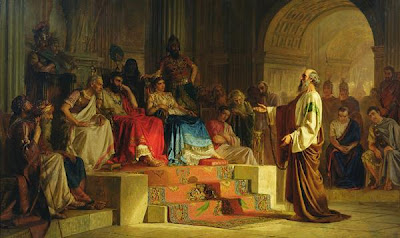
As Paul puts it ‘present your bodies as a living sacrifice, holy and acceptable to God, which is your reasonable act of worship’ And so Paul, as he makes his defence before Agrippa, roots it in the saving acts of God. His accusation against his accusers is in effect ‘they have forgotten whose people they are’, the accusation of the prophets down through the ages. It is not Paul who has got tangled up in some new and strange teaching, this great salvation in Christ is prefigured in the Exodus. This is the God who saves, the God who has never ceased form making himself known and calling his people into a relationship of loving obedience. Indeed this is so Obvioud to Paul, as clear as that shining light on the Damascus road, that he makes what on the surface seems to be the utterly ludicrous statement, that he wishes his hearers were as him in every way, ‘except for these chains’. The man in chains as been set free in joyful loving obedience – those listening are still chained.

At the heart of it is a lived apprehension of the One who is Alive for evermore. Any attempt to live in denial of this, to obey apart from faith only ends in us hearing the words – ‘Away from me you evil doers – I never knew you’. True obedience is never more and never less than moment by moment attentiveness and response to the One who speaks. Whose Command is Life to those who know him.

Through the Bible in a Year – February 19

The Scheme for January and February can be found here

Exodus 17-19; Acts 25; Psalm 66

There is the powerful theme of patience woven into today’s readings. On the one hand the tremendous patience of Paul, who seems to have been all but forgotten as the world continues to turn. Two years he has spent imprisoned waiting for a hearing, the governor Felix has been and gone and now Festus is the governor. But Paul continues is his faithful obedience, although seemingly invisible to those around him

On the other hand we see the impatience of the children of Israel and the foreshadowing of a deadly impatience in Moses. Moses is such a clearly written character in the Exodus narrative – fearful and fretful in front of Pharaoh and indeed the LORD himself – now frustrated at turns with the Israelites and with the LORD. On the surface much anxiety, little faith. This impatience is contrasted with the Patience of the LORD, who despite everything sees this people as his treasured possession and a priestly kingdom, a holy nation.

To our eyes this makes little or no sense, even if we did not know where the story was heading, the children of Israel surely have proved themselves to be in no way worthy of such treatment. They promise “Everything that the LORD has spoken we will do . . .” and yet we know that they are utterly double minded

Yet there is something here we do not see for Moses is later revealed as a hero of faith. Nowhere in the Exodus narrative is this shown – but the book of Hebrews includes him as an example of faith – one ‘who persevered as though he saw him who is invisible’

A deeper story is at play that we tossed around in the flotsam and jetsam of life can only guess at. Things happen for which there is no accounting. Amidst Moses anxiety – trying to hold the show together, comes his father in law, Jethro. Moses had obviously, somewhat like Joseph would many years later, to put his wife away. But she who has been sworn to him as a bridegroom of blood is returned along with his sons. God’s salvation is worked out in strange and wonderful ways and we see the life of God being fed back into the community by the outsider Jethro, who acknowledges the LORD and teaches Moses how better to administer his people.

Oft times our anxiety is rooted in the apprehension that we see all that is and yet something far more profound is going on. Discerning that this is the case we too are called to patience, a waiting on God. If he leaves us for two years in prison, so?? His ways are past working out – we are called to perseverance – which is at the last as we see in the book of Revelation, the hallmark of those called by God.

Our judgement of what is happening is so very dulled

The Salvation of God is such outrageous Grace that we can see no way to it – he works with that that is nothing in our eyes – the unseen, humble, the meek, the mourners and merciful – the undiscerned – embodied in faithless Israel – a nation  almost invisible in the annals of history – hidden away – God is working his purposes out, year after year. And so outrageous is God’s Final answer to humanity, that many will refuse to believe


Through the Bible in a Year – February 18

The Scheme for January and February can be found here

Exodus 15-16; Acts 24; Psalm 64-65

As the story moves on, we are shown what life with God means.

As we remembered yesterday, the Israelites are called to Remembrance of what God has done for them, and then as they walk with them, he provides – bread for the day. Not an excess, but what they need. Thus he reveals himself to be the source of their life, moment by moment. The bread is sacramental – as all food, it is more than a reminder of God presence. this is the food God has provided – we have it at his hand.

But for the rich there comes a double challenge. We have not learned our faith through such dependence – we forget where all we have comes from. God’s good creation is seen as a Right, rather than a daily gift. The connection is broken and often we will sit down now to eat without any thanksgiving.

We break bread to remember and in the remembering we are given life – but if we take more than that which God has given us, if we Grasp, if we seek to possess more, to take charge of our lives, to secure ourselves against tomorrow, that we might rest easy without faith – it turns to maggots in our teeth. For most of us in the West, the lesson of daily bread is one we have never learned. Perhaps this above all is why the church is so weak? For us, faith is not a daily act rooted in the material gift of God, now it is just a set of beliefs, little or nothing to do with the stuff of our everyday life, so ‘successfully’ have we secured this for ourselves

Sermon for Sunday February 17th – Evensong – Jonah – Life of God

Jonah under the gourd vine

Sermon for Sunday 17th February 2013
EVENSONG
Jonah 3
Luke 18:9-14

‘God, I thank you that I am not like other people: thieves, rogues, adulterers, or even like this tax collector. I fast twice a week; I give a tenth of all my income.’

And we all think, ‘God I thank you that I am not like this tax collector with his puffed up self righteousness . . .’ Jesus told this parable to some who trusted in themselves that they were righteous and regarded others with contempt.

Jesus’ parables have a habit of getting Us – we think that this one is about those dreadful people – those self righteous folk, and then it sneaks round the corner and comes up from behind, to undo us

Earlier this week I was in the company of a Saint – someone who offered me a cup of tea in the midst of a demanding day – not just a cup of water, but a cup of tea and some very unLenten cake – certainly, she will not lose her reward – but what marked this lady out was her pity, her mercy. As we talked of someone of a fair degree of notoriety, a real rogue – all that was in her voice and her demeanour was mercy and pity – no judgement – just mercy and pity.

Blessed, says Jesus, Blessed are the merciful, for THEY will obtain mercy – Father, forgive us, as we forgive others – the merciful receive mercy, the forgiving receive forgiveness. Those who reflect the image of God, receive the image of God in themselves.

At the heart of the Christian faith is God’s Urgent desire that his children once more reflect his image – become like him – merciful, compassionate, slow to anger and abounding in love. This is why Christ comes to die for us, that we might be restored to the fullness of the divine image, that that which was seemingly irretrievably broken and damaged, that that humanly speaking was beyond hope, might reveal the life of God in the world. He comes to Save us, and that Salvation is the full restoration of who we are.

To be frank, one of the reasons at root we make such a poor fist of the Christian life is actually a subtle rejection of this life. We’re quite happy by and large with continuing to be in charge of our own life – to judge those we think worthy of judgement, to withold forgiveness and restoration to those whom, well, ‘You have No idea of how they have hurt me!!’ – we remain hidden from the life of God – His way of doing things when we are confronted with it seems Outrageous – at one level or another, we Are Jonah

The book of Jonah is one of the great books of the bible for so many reasons – it is the absolute epitome of an hilarious Hebrew story, full of humour, full of wonderful detail – and it encapsulates the Gospel, the Good News. This story is all about the Outrageous Love of God . . . and the smallness of the unredeemed prophet who sits and sulks at God’s mercy.

It has a powerful parallel in the parable of the Prodigal Son – Jonah is the elder son, the one who does not live with the mercy and forgiveness of the father – who Will not enter into the joy of his master. God’s forgiveness is too much for him to swallow. As I’ve said before, Once in my time of ministry, I discovered someone who really Understood, the story of the prodigal. Telling the familiar story in a small group, someone exclaimed – ‘That’s not fair!’ – interestingly, it was an eldest child – the parable had snuck round the back and her defences were down and she was exposed to the recklessly abundant mercy of God – and it was too much for her – she couldn’t swallow it. She, like the elder Son and like Jonah couldn’t allow herself to live in a world where the love of God truly reigned, where all of a sudden she wasn’t the judge of those around her, where those she thought were worthy of getting their just deserts jolly well got them . . . I’m glad to say that my friend has made some progress in that area now, but it is a long journey, into the reality of the Life of God, his outrageous Love, his Utter mercy, and his Complete forgiveness, it is hard to swallow

Which is an appalling cue for the story of Jonah and the fish . . . Jonah as we know has heard God – the word of the Lord came to Jonah son of Amittai, saying, ‘Go at once to Nineveh, that great city, and cry out against it; for their wickedness has come up before me.’ Nineveh – in the story of GOd’s people a byword for wickedness and evil – out of the line of Cain was proud Nineveh built. It is like being sent to some dreadful city in Mexico or Columbia, controlled by the drugs gangs – full of Violence and hatred and death – a place beyond human redemption – And he does what any reasonable person would do – he flees – he runs off in entirely the opposite direction – But Jonah set out to flee to Tarshish from the presence of the Lord – Immediately we are confronted with the humour of the story – ‘where can I go from your Spirit?’ says the Psalmist
Where can I flee from your presence?
8 If I go up to the heavens, you are there;
if I make my bed in the depths, you are there.
9 If I rise on the wings of the dawn,
if I settle on the far side of the sea,
10 even there your hand will guide me,
your right hand will hold me fast.
11 If I say, “Surely the darkness will hide me
and the light become night around me,”
12 even the darkness will not be dark to you;
the night will shine like the day,
for darkness is as light to you.

Our hiding from God is perhaps the most ridiculous thing about us – but Jonah does what we all do – flee from the command of God – to Love, to show mercy, to declare forgiveness – but God as business to do with Nineveh and also Jonah – and Jonah is not let off the hook – another bad cue for the fish.

The fish is the place of repentance – deep in the smelly innards – Jonah is confronted with the reality of a life away from God. It’s one of those moments when the reality of our lives breaks in – like the prodigal we discover ourselves sat amongst the pigs, hungry for swill. The idolatries of our lives are revealed for what they are – the truth of a life separated from God hits us – we discover we are in hell and out of the belly of Sheol we cry to the Lord. So Jonah cries out to God from the belly of the fish As my life was ebbing away,
I remembered the Lord;
and my prayer came to you,
into your holy temple.
Those who worship vain idols
forsake their true loyalty.
But I with the voice of thanksgiving
will sacrifice to you;
what I have vowed I will pay.
Deliverance belongs to the Lord!’ And the fish spews him out – and so we pick up with the story this evening, The word of the Lord came to Jonah a second time . . . and of course we immediately see the grace and mercy of God, in not abandoning Jonah. Of course we maybe miss this – we think of being abandoned by GOd in the midst of our circumstances, which we never are – but here is something deeper – that God is working with Jonah through calling him to serve him.

When Jesus calls the disciples, they think that they are the centre of things – James and John want to call fire from heaven, Peter is continually setting himself up as the head of operations, even to the point of telling Jesus what he can and cannot do. They think that as his servants, they have made it – but actually in calling them to serve, to be involved in this Redemption, he is also working on them – God works his purposes out through his people, Through Jonah and Peter and James and John – but as he does this he also works out his purposes In his people. We need saving, every bit as much as those amongst whom we live and work and serve. God is at work through his church, he is also at work on and in his church, calling us also to the life we are chosen to proclaim

So Jonah, chosen to proclaim the judgement of God, and his mercy in the call to repentance – is also the object of God’s Saving love – this has as much to do with Jonah as it does with Nineveh. And Nineveh is converted – Extravagantly so! Jonah cried out, ‘Forty days more, and Nineveh shall be overthrown!’ And the people of Nineveh believed God; they proclaimed a fast, and everyone, great and small, put on sackcloth.
When the news reached the king of Nineveh, he rose from his throne, removed his robe, covered himself with sackcloth, and sat in ashes. Then he had a proclamation made in Nineveh: ‘By the decree of the king and his nobles: No human being or animal, no herd or flock, shall taste anything. They shall not feed, nor shall they drink water. Human beings and animals shall be covered with sackcloth, and they shall cry mightily to God. All shall turn from their evil ways and from the violence that is in their hands. Who knows? God may relent and change his mind; he may turn from his fierce anger, so that we do not perish.’  When God saw what they did, how they turned from their evil ways, God changed his mind about the calamity that he had said he would bring upon them; and he did not do it.
We are so distracted by the fish- is it a real fish – is it a whale – is it just a metaphor – Jonah and the whale is the story we tell in Sunday School – not God and the Repentance of Nineveh – this place of wickedness ad hate and death – and they repent.
AND God forgives – Jonah does not stick in the throat of the fish – but God’s forgiveness sticks in the throat of Jonah. And his heart is revealed. He has not come to Nineveh because he has pity on the people of Nineveh – he does not come to Nineveh because he has mercy, but as the utterly unwilling servant – he would call down fire – God has poured down pity and mercy and forgiveness. But this was very displeasing to Jonah, and he became angry. He prayed to the Lord and said, ‘O Lord! Is not this what I said while I was still in my own country? That is why I fled to Tarshish at the beginning; for I knew that you are a gracious God and merciful, slow to anger, and abounding in steadfast love, and ready to relent from punishing. And now, O Lord, please take my life from me, for it is better for me to die than to live.’
Jonah cannot accept the Love and mercy of God. He has worshipped God with his lips from the belly of the fish – but his heart is far from him. Like the elder son in the parable, he cannot enter into the Joy of the Lord – he cannot rejoice that Nineveh has repented – he is as yet Far from the Kingdom of God – far far more troubled over a withered plant, that had given him shade, than anything or anyone else. And God opens the door to him ‘should I not be concerned about Nineveh, that great city, in which there are more than a hundred and twenty thousand people who do not know their right hand from their left, and also many animals?’
People are caught up in wickedness and sin – and we don’t know why – but we try and separate out the worthy from the unworthy – God’s blanket forgiveness of Nineveh is voiced in terms of pity – ‘they do not know their right hand from their left’ – like the saint I was with the other day, all there was was mercy and pity – as there is from the heart of God revealed to us in Christ. ‘Father forgive them, for they do not know what they are doing – and we say – YEs they do, It’s obvious isn’t it???’ And so we judge others and in judging others judge ourselves, being unknown to ourselves guilty of the very same things of which we accuse others
We see the Pharisee in all his pompous self righteousness ‘I thank you that I am not like other men – and we think I thank you I am not like that Pharisee . . .’
Jonah’s outward actions were right, but his heart was all wrong – Jonah’s story is a great story for Lent – a time, not for outward displays or actions, but for opening our hearts to the inner work of God – soaking in the utterly unreasonable love and mercy of God. Allow this story to confront us – to question us. What is Our Nineveh? What work of mercy are We fleeing from? What is the plant we are more concerned for than 120,000 souls and many animals? What is the scope of the outrageous love and mercy of God, and where are we holding out on it?
We see the mercy of God, the outrageous forgiveness and Love, we see that we cannot forgive everyone for everything, that we do not love our neighbour as ourselves – in God’s mercy he shows us that we are yet far from the Kingdom of God, and then if we like the prodigal come to our senses – we say with the Publican, Lord have mercy on ME, a sinner . . . and finding mercy from God, we grow in that mercy and pity towards others – those who do not know their right hand from their left, finding the words of Jesus on our lips and in our heart, Father, forgive them, for they do not know what they do.
Amen

Through the Bible in a Year – February 17

The Scheme for January and February can be found here

Exodus 13-14; Acts 23; Psalm 62-63

One of the great challenges to living faith today is our all too easy discarding of history. We live in a culture where history counts for nothing, such are the apparent advances in technology and our seeming mastery of all things. What has history to teach US?

Yet we see in the instructions of Moses to the children of Israel, Remembering that which God has done is essential to continuing in faith. Precise instructions are given also, this is no mere retelling of a story – it is to be embodied in the continuing redemption of the first born, thus the story is told from generation to generation.

Of course in a sense the Israelites also lived in an ‘ahistoric age’ – no sooner are they free of the slavery of the Egyptians than they forget how things were and want to return – a constant theme of their story those next forty years.

Throughout God is present in the pillar of cloud and fire – a living presence amongst them – but they often will not allow the possibility of God’s future could be better than their known history. God calls them into a future of His making, much as Christ calls us to leave our nets and follow.

Of course it is clear here that it is not that the Israelites have forgotten the past in the way we readily discard it, but rather that they refuse to focus on what God has done in the past as a guarantee of the future.

The future is Always an unknown. The past is in truth all that we ever know.

The call of faith is to recall the mighty acts of God, or his daily small mercies. Thus we grow in faith and submit ourselves into his hands for the future. He has provided daily bread these many days, will he not continue to do so? We too readily discount the Goodness of God, which is both our Source and our End.

Sermon for Lent 1 – Year C – Sunday February 17th 2013

Sermon for Lent 1 – 2013 – Year C
Deuteronomy 26:1-11
Psalm 91
Romans 10:8b-13
Luke 4:1-13

“For we do not have a high priest who is unable to sympathize with our weaknesses, but we have one who in every respect has been tested as we are, yet without sin. Let us therefore approach the throne of grace with boldness, so that we may receive mercy and find grace to help in time of need.”

‘that we may receive mercy and find grace in time of need . . .’

Just this week I heard the story of a man who was in some dire circumstances in his life and went in search of help to a monastery. As is the custom, he was given a director for his time of retreat and he poured out all his problems to the monk, but the monk didn’t respond to them, instead he told him to spend the day meditating on a portion of scripture. Well the man went to his room and for the whole day meditated on the scripture – but nothing came, nothing happened.
The next morning her returned to the monk and told him and started to tell him all his problems again, after all THAT was what he wanted sorting out, but again the monk didn’t respond to anything the man had sent, and gave him a passage from scripture to meditate on – the same one. So again, the man went away and spent another day with this passage – and it was like a brick wall to him – it wasn’t giving him answers – it wasn’t solving his problem. Well the third morning he goes back to the director and the same thing happens, he tries to pour it all out to this monk who doesn’t seem to be interested in him and his problems and again the monk gives him the same passage of scripture, and about half way through the day, God broke through.

What this story illustrates is how distracted we are, how consumed with ourselves -the man was so tied up listening to his story and rehearsing it over and over again, it took God two and a half days to get through to him. And in many ways, distraction is the root of our problems. This past week I have been on retreat. Seven days ‘Away from it all!!’ Sounds wonderful doesn’t it. Seven days when you can leave everything behind and just concentrate on God . . . Well you only need to go away from everything else – all those things that you think are getting in the way of your relationship with God, to understand that they follow you – you carry them around with you. That the problem you have Isn’t with all those people and situations – it is the problem of your heart, that wants to pay attention to anything, rather than to God.

Put yourself in the situation of that man at the monastery – I wonder – could we meditate on a short passage of scripture for an hour, even . . . he has to sit with it for two and a half days, so distracted is he. The problem isn’t that the scriptures are unclear, it is that we are deaf ad blind and we need healing, we need the distractions stripped away. We don’t know how distracted we are from God, until God is all we have

Way back, in the Garden, the snake employs just this technique. The MAn and the Woman had their attention on God, and like a conjourer, the snake distracts them, and all of a sudden God has disappeared – Here ‘look at this tree, look how good the fruit is to eat, don’t pay attention to God . . . and they look at the tree’. And distracted, they forget whose children they are, they forget what the source of their life is . . . And here is the tragedy – we forget who we are – this is why we sin. We forget whose children we are.

And so we come to the season of Lent – it is a time when we follow Jesus into the wilderness – it is a time of preparing ourselves for Easter, and there is only one way we can do that, by dying to our selves – by refusing to make ourselves and our endless stories about our lives the centre of everything. And Lent to be properly observed needs to have Wilderness space in it – Empty space – Space where you are just left with yourself, without distractions – place where we discover that in general we have ordered the universe around ourselves not God

Jesus full of the Spirit, returned from the Jordan, returned from his baptism where God had declared him to be his Son and was led by the Spirit in the wilderness, where he was tempted by the devil for forty days. Tempted, tested – had that word from heaven, had that sense of who he was, had it sunk into the very fibre of his being? – or was it just another thought – ready to be blown away. Everyone of the temptations a distraction from the Life of God his Father.  – Everyone of the temptations to deny God – to deny who he was, cleverly dressed up as an opportunity to prove who he was, to make himself the centre of the story.

he was famished, and the devil said to him, ‘If you are the Son of God . . . an invitation not to faith but to doubt . . . command this stone to become a loaf of bread’ As Alexander Schmemann notes – the temptation involves food, just like the apple in the garden of Eden – food is a great distraction. We even eat to avoid things. Unlike Adam and Eve of course, Jesus is famished – they are so much more like us – they have Everything they could possibly need. Jesus is alone, with no food, and here he reveals how it is God, not the food that is the true source of his life. God my Father is the provider . . . I rest in his provision.

I am reminded here of the challenging words of Jesus in John’s gospel, my food is to do the will of the one who sent me – my life is found in humble obedience to my father, he will provide all I need. I wonder if we know what it is to feed on doing the will of God?

Again Satan comes to him – Shows him . . . how easily we are distracted by what we see . . . shows him all the kingdoms of the world . . .  ‘Just worship me and you can do whatever you want!’ ‘If I ruled the world, every day would be the first day of spring . . . If I was the king of the Jungle, I tell you we’d have this place sorted out in no time . . . how easily we think to ourselves that God doesn’t know what he is doing – how readily we seek to assume command . . . all this will be yours – turn your attention from God at the centre and then you will be able to put everything right – the Central delusion of modern life in a secular age – we can fix it

all you have to do . . . note how each of the temptations is carefully crafted – just turn the stones into bread, just worship me, just throw yourself down – the consequences hidden – just eat the fruit of the tree – you have everything to gain – the losses carefully hidden. The gain seems so great, the disobedience so small – after all you are Very hungry, after all surely to rule all things is what its about, after all it would be worth it, just to check that God’s word was sure, no? Just a little test??

This is the very nature of sin, small subtle distractions from God – generally none of us face temptations to commit adultery or murder or steal of go to court and lie about our neighbours – rather we’re just distracted – and gradually we are led deeper and deeper into the woods and then wonder – where is God. We’re distracted by what’s going on around us – all those people who are making our lives difficult, we’re distracted by things – and carefully we listen to those little rationalisations – after all, surely it can’t do any harm. NOt realising that we’re profoundly lost, we try and follow the most convenient track – This must be the way . . .

Of course we could then go out paranoid into the world, trying desperately to avoid all these tiny sins – another distraction – distraction from God.

Lent is a time not to try desperately live good lives, looking at the myriad possibilities to sin and fighting to avoid them – but rather a time to clear away distractions – to turn to God in faith. Faith at its simplest is this – to attend to God, to live in attentiveness to God. Jesus is tested, but his attention is on God. This is why prayer is the essence of faith – to pray continually as St Paul says, is to live in faith, with our eyes upon God in Christ. And down thorugh the years the church has called us to three disciplines of attentiveness in Lent. Prayer, fasting and almsgiving
Prayer first – the essential discipline. Just try sit in the silence in the presence of God, try to attend to God for an hour, and all of a sudden you will understand why you need to pray. Oh it sounds like heaven! But within a minute, this distraction or that comes flooding in and you relaise ten minutes later that you’ve been thinking about the shopping, or those people who are giving you a hard time, you haven’t been paying any attention to God. So for Forty days we are called to a special discipline of prayer – in large part that we might realise how much we need to pray. That we are actually permanently mentally distracted

Then Fasting. Here we learn what really drives us – Food is the most basic of our physical needs. And if we do fast, then we rapidly become aware of how controlled we are by it – and we realise that its not just our minds – our bodies are screaming for attention to and we realise how often we live unthinkingly in response to our physical needs – that our lives really aren’t as controlled by the love of God as we had fondly imagined

Then Almsgiving – always a thorny one. John Wesley’s dictum . . . if you want to be free of the power of money, give it away! It is often said the last part of a man to be converted is his wallet – I have to say I don’t know if it also applies to a woman 🙂 I know few if any people who believe they are no controlled by their financial security – few who belive the words of Jesus, that it is a straight choice – we don’t control money, it controls us. The voice of the snake . . . doesn’t scripture say that you should provide for the needs of your family, you will need a pension and all those sort of things – you can’t really expect God to provide for your needs . . . or more subtly, well of course God has given you all this money precisely as a sign of his care for you . . . Seriously if truly it IS God who has given you your wealth and it wasn’t your anxious hoarding that has accumulated it – your anxiety laden attempt to secure yourself against the future – if God really has given you it – then  it is for one purpose – that you might be a blessing to others

Well that is a fairly negative look at the three disciplines – the painful angle if you like – but as the verse at the outset reminded us – we find mercy and grace in our time of need from Christ. Mercy, severe mercy at times in his exposing what is really controlling us – but also Grace. If we follow in his path – in prayer we grow into a deeper and deeper apprehension that we are his children – the more we want to attend to Him, to listen for His voice. Fasting teaches us dependence on God – note how that sounds negative!! All he has is dependence on God – but THIS is to be fully ALIVE!!!! And when we learn that God our father really DOES provide, then we are set free in generous love – we attend to God in prayer – through fasting we learn the Joy of dependence upon him ad so enter deeper into his life of GEnerosity – more and more we remember who we are, that we are his children and that attention to him and dependence upon him and imitation of him is the most natural thing.

But none of this comes from us – it is only possible because there is one who Lives – one who has conquered death and sin, one whose life means that actually we don’t have to be distracted. Jesus goes into the desert to be tested – has his identity as the Son of his heavenly father taken root in his heart, and he emerges triumphant for he lives out of complete dependence upon God. God will provide, I will worship God, I have no need to test him – who could doubt the father’s love?

And so he is obedient even to death on a cross – for he entrusts himself to the one who even raises the dead – and so becomes the source of life and light to all who trust in him – who turn from their distractions, who repent – who attend to him and walk in faith. MAy God grant to us all a Holy Lent, and may we all grow in grace in the footsteps of Christ.

Through the Bible in a Year – February 16

Exodus 12; Acts 22; Psalm 60-61

Reading the Exodus narrative – one is struck by the sheer force of what is happening – that this Exodus is only brought about through immense cost, a cost that must perpetually be remembered in the redeeming of the first born.

Through the history of Israel, this night is to be remembered, for it is the night on which God said to them conclusively, ‘You are mine’, with everything that that means. As the prophets will remind the people many many years later, it is not through any goodness of their own tat God has done this, it is not a matter for pride. They do not choose Yahweh for their God. He chooses them, as at first he had called Abraham.

Over and over again in our faith, we make far far to much of our response to God’s call. Here in this Exodus passage it is laid bare – frail Moses, and doubting people are rescued. God creates a people for himself – as many many years later he will do conclusively in Christ.

As Israel was commanded to retell the story, so also Paul we note tells over and over again the story of his ‘conversion’. It is something which he had nothing to do with. It is the profound archetype of ‘becoming Christian’ – it has nothing to do with us – it has everything to do with God, and what is more it lays upon us now a duty, to live as dearly loved children.

Becoming Christian is not our choice – perversely we try to make it thus, but it is not – the only choice we have is whether or not we will live into the fullness of that calling

Through the Bible in a Year – February 15

The Scheme for January and February can be found here

Exodus 10-11; Acts 21; Psalm 58-59

So much of the apparent ambiguity of the life of faith is explained in God’s strange choice to work in and through his creatures. So often we may well ask, ‘Why does God not do something?’ . . . and upon observation we might discover that he has done something, but that something has been through the agency of frail human flesh.

And again we might say, ‘why did God do THAT??’, and once more the answer is to be found in God’s chosen instruments.

It is Moses, hot with anger who declares to Pharaoh the death of all the firstborn, and Paul who in stubbornness does not listen to those who speak guided by the Spirit not to go to Jerusalem. Paul seems in a sense to have some ‘heroic’ vision of his mission – ‘I am ready not only to be bound, but even to die in Jerusalem for the name of the Lord Jesus.’

And the scriptures do not hide this from us. The ‘Greats’ of faith are revealed to be all too frail – but more wondrous, God is revealed to accommodate himself to us – to work within the parameters of our frailties – to effect something beyond our ken.

Moses is still the same – he was fearful of Pharaoh, he is still ungrown and angry, an anger that years later will prove his undoing. Paul is almost seeking to die as a great hero – there are clear echoes here of Peter – but the Scriptures are silent as to their eventual death. The words of the risen Christ to Peter ‘But when you grow old, you will stretch out your hands, and someone else will fasten a belt around you and take you where you do not wish to go’ – ring true also for Paul.

In the end, this is not about us – it is about God – and for that we should be unutterably grateful.