Through the Bible in a Year – February 9

The Scheme for January and February can be found here

Job 38-39; Acts 15:1-35; Psalm 50

‘Then God answered Job out of the whirlwind . . .’

In the beginning of his travails, Job had sat in silence before God with his three friends for a week – as it were figure of creation groaning in expectation. In this his friends showed empathy for his great suffering and together they showed wisdom in not trying to explain the inexplicable. But the human mind is restless until it finds its rest in its maker and so the disputation begins as his three friends wheel out three of the ‘contemporary’ explanations – none of which is any comfort to Job, who knows that only God knows – yet it is not enough for him in his trouble and so he enters into the disputation. Continue reading “Through the Bible in a Year – February 9”

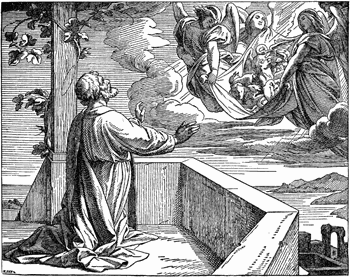
‘but they are like the Angels . . .’

Angel, coming into Being . . . ‘Now and not yet’ . . .

In the encounter of Jesus with the Saducees, He is told a story about a woman who had seven husbands, and then is asked,’at the resurrection of the dead, whose wife will she be?’.

Jesus tells them that they have no idea of the significance of the resurrection, or indeed marriage . . . but another time

What must be understood, is that the Kingdom IS amongst us. In and through the risen Christ it already is and also shall be, and that here and there we see signs of ‘heaven’. Put another way, there are those who live amongst us as angels – sometimes. That is, we may not know such people amongst us, and/or they live thus only for brief moments – their lives giving us a glimpse of the Kingdom of God.

What triggered this post is a story I have spoken about told in the Orthodox tradition. In it, a woman is in Hell. The Angels, whose every desire is to pull her out of Hell search the record of her life for just One act of love. Finally, they discover that once a passing stranger called at her door, hungry and asking her for food. She, rather grumpily it must be said, went to her cupboard, found an old onion and threw it to him, telling him to be gone.

There in that, the smallest of acts, with only the faintest echo of grace, the angels found their chance. And so took the onion which had a long stalk, and lowered it down into Hell, so to rescue the woman and save her . . . Well the rest of the rather sorry story can be found here

But what has come home to me these past days, is how Unlike the angels we are as yet. THEY anxiously seek for ONE flicker of light and life, ONE sign of Grace, ONE echo of the life of God and latch onto it. ‘Yes!’ they say ‘There!!’ There is a sign that the Goodness of God is present in that person, and so gently and carefully summon it further into Life, as they so carefully sought to draw the woman out of Hell.

So often we are NOT at all like the angels. Our view is So distorted that all we can see is their faults – to the point where we, utterly perversely Deny any goodness, any attempt to live in the Light. We see the splinter in the eye – it becomes our entire focus. We are not desperate that they should be drawn out of Hell. We are not like them, we are not searching anxiously for ONE sign of grace, however weak, however is comes from the wrong place. How unlike children of God, who will go to any length to save us.

He waits, He Watches, and he Runs for the Prodigal who has blown it all – who in human terms has no way back and he knows it – who comes crawling back because he is hungry, who is even now trying to manipulate the Father, who knowing this full well, doesn’t merely accede to his request to be a hired hand, he throws a party for him. In this the feeblest of returns home, the Grace of the Father is Overwhelming

Jesus, continually heals our sight, would we allow it. He teaches us to see as He sees, as the angels see, as the Father sees – constantly on the look out for signs of Life – anxious and ready to Save at the smallest flicker. Let us pray for that same grace, that we might truly be children of our heavenly father, ‘who desirest not the death of a sinner’. Let us be on the look out Night And Day for signs of Grace. And let us eagerly greet and encourage them, even the smallest Hint of Life, even from the very Worst of motives, like those angels with the woman, Like the Father with the child.

And let us pray that the Lord, who will not put out a smouldering wick, will also grant those around US, Grace to see us likewise.

‘Blessed are the merciful, for they shall obtain Mercy’

Amen

Through the Bible in a Year – February 8th

The Scheme for January and February can be found here

Job 36-37; Acts 14; Psalm 49

This Good News of the forgiveness of sins continues to bear fruit as Paul and Barnabas continue on their missionary journey. We may well wonder why such a glorious message receives such opposition. Once again and in utter perversity ‘unbelieving Jews stirred up the Gentiles and poisoned their minds against them’.

Setting people free at the most fundamental level is not something which for now will be universally acknowledged as a good thing. We live in a world in multiple forms of slavery – economic, emotional to name but perhaps the greatest impersonal and personal prisons. There are idols we are told we Must serve, and live in fear of, all of them Good things that have been distorted, yet whether they are ‘out there’ or deep within our hearts, we fear to let them go and live in freedom.

The person who is truly set free no longer participates in these fear laden idolatries, and their lives are difficult to comprehend. They forgive ‘the unforgiveable’, they are at work liberating the oppressed and welcoming them into the community of faith, where God is the one to be feared, the God who forgives sins. Indeed, entering into this Way, set free from captivity, their lives seem to be of a radically different order, and so Paul and Barnabas have to fight to prevent the people worshipping them as Gods. They so reveal the life of God in themselves, that those who have not yet received the message cannot see the difference.

This message of liberation is opposed. The powers that be have their slaves, who live in fear of the idols. There are others who continue to control others by withholding liberating forgiveness. To set the prisoner free will arouse opposition, the jailers have invested their being in their control over others. And so as with Christ, so with the Church.  “It is through many persecutions that we must enter the Kingdom of God”

As an aside, when we talk of the persecution of the church in this age, does this persecution have its roots in setting the prisoners free through the forgiveness of sins?

The few : make this your life’s work, for it is to co-operate with the work of Life in you

‘ In this lifetime, only a few will be saved. Only a few will live a life of self-emptying love. Only a few will endure the humiliation of honesty. Only a few will face the despair of hell and give thanks. Only a few will forgive everyone for everything.’ Fr. Stephen Freeman

The Narrow Road

Through the Bible in a Year – February 7th

The Scheme for January and February can be found here

Job 33-35; Acts 13:13-52; Psalm 48

‘With you there is forgiveness, therefore you are feared’ Ps 130 vs 4

What sets the God and Father of our Lord Jesus apart is the forgiveness of sins. And Christ when he comes, announcing the reign of God does so by forgiving sins. (We may be in awe of making a paralytic walk, but remember that Jesus only does this to reveal his even more breathtaking authority, to forgive sins)

Thus we may well say with the Psalmist, ‘Great is the Lord and greatly to be praised’ – that the dwelling place of God is a place of wonder and beauty.

So also, Paul, when he is called to speak in the synagogue in Antioch, when he comes to the culmination of his message says ‘Let it be known to you therefore my brothers, that through this man forgiveness of sins is proclaimed to you; by this Jesus everyone who believes is set free from all those sins from which you could not be freed by the Law of Moses’

And here is a small clue as to how we announce the gospel in our own day. Paul begins by rehearsing the story of Israel – and it is a story fundamentally of how they are trapped by their past. In many respects the Pharisees whom Jesus encounters embody this slavery to what has gone before, as they seek to reaffirm their national identity in the face of many challenges, they are clinging to a history of rebellion agains God.

All around us we are surrounded by people similarly trapped by their past. Let us be clear, our past is all we know for sure. For so many that past weighs heavy. Shame and guilt often threaten to overwhelm and so we hide. The Gospel of Christ is an invitation to step out into the light that we might be healed – set free from our past – given a new life.

But this life is no mere, new start. Those who know this forgiveness become themselves forgiving. The wonder of that release means that they want others to know it. If we do not forgive we as yet have not come to know Christ, we as yet have not known the true liberation he brings – we have not ourselves yet heard the gospel, the Good news of the forgiveness of sins.

Through the Bible in a Year – February 6th

The Scheme for January and February can be found here

Job 30-32; Acts 12:1- 13:12; Psalm 46-47

The church continues to grow despite at times fierce persecution – and in the midst of it there is a powerful sense of the community of the believers, powerfully engaged together in the mission of God.

James, one of the Boanerges is put to the sword. Herod seeing it gains him kudos with some of the people throws Peter into prison for good measure. And we read of how the church prays fervently for him. But their prayers are shown to be rooted not in some deluded sense that they have as it were found the key – as if prayer was magic. When miraculously Peter is released from prison [A contemporary story of God’s acting thus can be found in this book], the church do not believe it can be true – yet all the same they have been praying fervently. So their joy is multiplied.

What is clear is that we do not see the whole picture – that we pray for the Good but it is not always forthcoming. The point is not that we try to figure this out, as if prayer was a formula, but that together we pray.

They are given direction by the Spirit, but still enter fully into the work through fasting and prayer, and the work flourishes. When as the people of God we act as we are, the body of Christ, fasting and praying, worshipping and mourning, Together, we touch the edge of his hem. For most of us however in the modern western church, our questions about unanswered prayers are rarely those of the whole body. Our faith has become radically individualised.

Through the Bible in a Year – February 5th

The Scheme for January and February can be found here

Job 27-29; Acts 11; Psalm 45

Job now comes to the close of his disputation. Having had to put up with the naive arguments of his friends – having wrestled with the utter injustice of his situation, whilst the wicked heap up silver like dust – his final speech begins by declaring not that he, but God will be vindicated in the end. That the wicked will perish and then speaks an ode to Wisdom.

It is all too simple to think of Wisdom as great cleverness – or as something that only a few might aspire to. After all, says Job, you can dig up rubies and Gold and Sapphire far more readily than we can find Wisdom. But then wonder of wonders, he declares that Wisdom is attainable by all. The fear of the Lord is the beginning of Wisdom – her gate is wide open – she welcomes all who would come to her – and to shun evil is understanding. Wisdom is the life oriented towards God in humble obedience and the rejection of all that is evil.

And so as St Paul remarks, ‘he has become for us Wisdom from God’. As always all the attributes of God’s life have to take on flesh, be incarnated. Jesus becomes Wisdom from God as he devotes his life to the will of his father.

So it is that this word of salvation spreads and spreads – ‘even the Gentiles have been given the gift of repentance – the Gift of Wisdom – the Gift of Life

Through the Bible in a Year – February 4

The Scheme for January and February can be found here

Job 24-26; Acts 10; Psalm 43-44

It is hard to read the complaint of Job and not see how all he sees is to be seen around us in this day. Bildad rebukes him, but Job immediately reveals how Bildad has proved the words of Job. So ready with his answer, Bildad is the one who has failed to help the powerless or assist the one who has not strength. Bildad seeks to make of God, nothing but an idol – one who can readily be described. So it is with the powerful and wicked who live by their own rules.

Job will have none of it – this attempt to reduce the mystery of the one before whom Sheol is naked and Abbadon has no covering, to a neat and tidy answer which will give comfort in the night. His ways are past finding out, as even the infant church discovers.

As it moves on in the story, as the gospel has gone seemingly as far as it can to those apprently on the edge of God’s story, the Samaritans – so it is discovered that the world of grace is not flat, it is round. Peter sees the sail let down, and is bid take his ship over the horizon of possibility. The vastness of God’s mercy is past finding out. The discovery that the Gentiles are recipients of Grace is as unimagineable to those in the days of the Apostles as . . . ? What is our horizon? How have we limited the Living one, the thunder of whose power none can understand?

Sermon for Candlemas 2013 – WITH RECORDING

Sermon for CANDLEMAS 2013
Malachi 3:1-4
Hebrews 2:14-18
Luke 2:22-40

RECORDING OF SERMON – CANDLEMAS

The Lord is not slow in keeping his promise, as some understand slowness.
He is patient with you, not wanting anyone to perish, but everyone to come to repentance.
2 Peter 3:9

A little earlier this week I was reading a blog by my former bishop back in England where he strongly recommended a book on a theme about which I was very interested. Back in the times of monasteries, St Benedict had said that to enter a monastery you had to make promises, take vows – and there were four. You had to give up your possessions – a vow of poverty – you had to give up any idea of getting married – a vow of chastity – and you had to promise to do as you were told – a vow of obedience. These were the three classic monastic vows – but St Benedict added a fourth – you had to promise to stay – a vow of stability. You had to stay put – in the place you had been called to – not go gadding off and moving around – not flitting from one monastery to another. You know, if you didn’t like one – well you go and try and find another more suited to you. And it is that vow of stability in which I was particularly interested.

So I did what we all do when we want a book – I went to Amazon – only to discover that it wasn’t going to be released until February 21st!! Nearly a whole month!!! But then I found it was available on Kindle!! YES!! [Kindle – ‘start reading this book in less than a minute’] And I clicked on the link “ Due to copyright restrictions this Kindle book is not available to buy in New Zealand”!!!

But I want it NOW!!! I wonder how many of us have had that experience of driving a car and you’re stopped at lights, and for a moment you attention drifts away and you don’t notice the lights change – SUDDENLY the blare of a horn wakes you – my the light has been green for a whole two seconds!!!

We are not good at waiting [wishing our lives away – ‘can’t wait to go to School!’] – Waiting requires us to stay put, to stay in one place.’Oh I haven’t got time for that, I have to be here and here and here’ – but nowadays we can be quite still and yet not staying put. I wonder how many of us rather than sit down quietly for the evening with a good book, sit in the same place all evening with a laptop or a tablet and flick from place to place to place on the internet – Tumblr one minute, then Facebook, then back to Tumblr – checking your emails, or a friends txts. [Phone] Our bodies in one place – but our minds moving from place to place to place [And by the way – don’t say you’re multistasking – all the psychological evidence is that when we behave like this we are not paying attention to anything – it takes several minutes for our brains to move from one task to another – in other words as we move from one to the other to the other – we haven’t actually paid any attention to any of them!]

And because we are not patient, we don’t stick with something, we don’t attend to it – we can’t wait for something more. If something doesn’t deliver immediately we give up on it.

We’re not good at waiting and so we waste our lives and fritter them away. Jesus tells a story with which some of us are familiar – He tells a story about a young man who cannot wait – he cannot wait for his Father to die – because when his father is dead he will get all that belongs to his father – so he tells him. The father has two sons, and so he divides all he has in two and gives have to his impatient son – who runs off . . . and spends it all . . . and is left with nothing . . . because he couldn’t wait – he had His Life to live and he was jolly well going to get on and live it – and then its all spent, all gone . . . and Jesus say’s ‘the young man came to his senses’ What am I doing? BAck home even those people who worked for my dad had all their needs taken care of – they had plenty to eat and wear, and here I am with nothing . . . all because he couldn’t wait

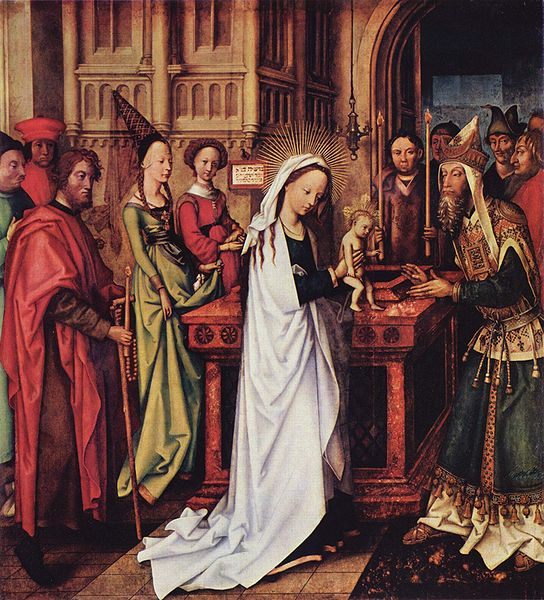
Today we celebrate the Feast of the Presentation of Christ in the Temple. The End of the season of Epiphany – it’s culmination, the End of Epiphany and the End of Waiting. God’s people have been waiting – in the words of the prophet Malachi, ‘The Lord whom you seek, will suddenly come to his temple’. The one you have been waiting for . . . he will suddenly come to his Temple.

Malachi wrote those words 400 years before!! 400 years – waiting for 400 years

And when MAry and Joseph bring Jesus to the Temple – there are two people waiting for them – Simeon and Anna – an old man and an old woman – who have been waiting their whole lives for this moment . . . waiting for the father’s gift

Can we begin to imagine what it might be that was worth waiting your whole life for? What would we give up our lives to wait for??

Simeon holds Jesus in his arms and utters an extraordinary prayer – Lord – you have allowed your servant to depart in peace, according to your promise. You promised and that was enough. I waited and although I waited my whole life, you have been good to your word – I have seen what I was waiting for. Anna and Simeon were waiting for the same thing – Simeon we are told was waiting for the ‘Redemption of Israel’ Anna sees the child and she goes out to tell everyone who is waiting for the redemption of israel.

What is this?? What is Redemption?? What does it mean to redeem something? Why is this so important??

Well it’s all tied up with that visit of MAry and Joseph to the Temple – when you had a child you came to the Temple to offer a sacrifice, a sacrifice of purification according to the ritual law. But in the case of a first born son – there was a second sacrifice, or payment to be made. According to the law, all the first born sons belonged especially to God and so you went to the Temple effectually to buy them back, to Redeem them. When someone takes something from you you can pay them and then they have to return it. So when your first born son came along, you paid 5 shekels to the Temple, to buy them back, to redeem them

But listen When the time came for their purification according to the law of Moses, they brought him up to Jerusalem to present him to the Lord 23(as it is written in the law of the Lord, “Every firstborn male shall be designated as holy to the Lord”), 24and they offered a sacrifice according to what is stated in the law of the Lord, “a pair of turtledoves or two young pigeons.” No 5 shekels. They made the sacrifice of the birds as required for the purification following the birth of a child – but no redemption price, for their son. They presented him to the Lord – they gave him to God – they did not pay the price for him, for He is the one who pays the price for us

Simeon and Anna were waiting for the one who would pay the price to bring us back to the one who rightfully we belong to God.

The young man in Jesus’ story had forgotten whom he belonged to – he had forgotten whom he was and he was utterly lost – he had lost everything, squandered everything, but he thought he’d cut a deal . . . so he walked home with a careful little speech – ‘You know I’m really sorry – I’ve done an utterly terrible thing – I deserve nothing’ Perhaps there are some amongst us who feel that way – I know from time to time I do – but here is the amazing thing – the son’s father had been waiting for him – watching out for him – longing to see him back – waiting for him to stop frittering his life away – waiting for him to come to his senses – to stop – to come home

When we think of impatient Sts – I am sure Peter comes to mind – but St Peter too, comes to his senses – he writes much later in life The Lord is not slow in keeping his promise, as some understand slowness. He is patient with you, not wanting anyone to perish, but everyone to come to repentance.

God’s people had waited 400 years . . . finally their redemption had come – the price had been paid – now as God in Jesus came to his home – the price was paid – anyone now could come home – the waiting is over. Our deepest need, the life of GOd which transforms everything is now available – we don’t have to wait – we can run home. He is waiting for us

As he waits for us today – as in the Eucharist we come to him – he has paid the price in his body and blood – he is pouring out his life for us. The waiting is over, so like Simeaon and Anna – let us come quickly – let us rejoice – let us run to him. The one who has been waiting for us ever since we left home