Through the Bible in a Year – February 8th

The Scheme for January and February can be found here

Job 36-37; Acts 14; Psalm 49

This Good News of the forgiveness of sins continues to bear fruit as Paul and Barnabas continue on their missionary journey. We may well wonder why such a glorious message receives such opposition. Once again and in utter perversity ‘unbelieving Jews stirred up the Gentiles and poisoned their minds against them’.

Setting people free at the most fundamental level is not something which for now will be universally acknowledged as a good thing. We live in a world in multiple forms of slavery – economic, emotional to name but perhaps the greatest impersonal and personal prisons. There are idols we are told we Must serve, and live in fear of, all of them Good things that have been distorted, yet whether they are ‘out there’ or deep within our hearts, we fear to let them go and live in freedom.

The person who is truly set free no longer participates in these fear laden idolatries, and their lives are difficult to comprehend. They forgive ‘the unforgiveable’, they are at work liberating the oppressed and welcoming them into the community of faith, where God is the one to be feared, the God who forgives sins. Indeed, entering into this Way, set free from captivity, their lives seem to be of a radically different order, and so Paul and Barnabas have to fight to prevent the people worshipping them as Gods. They so reveal the life of God in themselves, that those who have not yet received the message cannot see the difference.

This message of liberation is opposed. The powers that be have their slaves, who live in fear of the idols. There are others who continue to control others by withholding liberating forgiveness. To set the prisoner free will arouse opposition, the jailers have invested their being in their control over others. And so as with Christ, so with the Church.  “It is through many persecutions that we must enter the Kingdom of God”

As an aside, when we talk of the persecution of the church in this age, does this persecution have its roots in setting the prisoners free through the forgiveness of sins?

Through the Bible in a Year – February 7th

The Scheme for January and February can be found here

Job 33-35; Acts 13:13-52; Psalm 48

‘With you there is forgiveness, therefore you are feared’ Ps 130 vs 4

What sets the God and Father of our Lord Jesus apart is the forgiveness of sins. And Christ when he comes, announcing the reign of God does so by forgiving sins. (We may be in awe of making a paralytic walk, but remember that Jesus only does this to reveal his even more breathtaking authority, to forgive sins)

Thus we may well say with the Psalmist, ‘Great is the Lord and greatly to be praised’ – that the dwelling place of God is a place of wonder and beauty.

So also, Paul, when he is called to speak in the synagogue in Antioch, when he comes to the culmination of his message says ‘Let it be known to you therefore my brothers, that through this man forgiveness of sins is proclaimed to you; by this Jesus everyone who believes is set free from all those sins from which you could not be freed by the Law of Moses’

And here is a small clue as to how we announce the gospel in our own day. Paul begins by rehearsing the story of Israel – and it is a story fundamentally of how they are trapped by their past. In many respects the Pharisees whom Jesus encounters embody this slavery to what has gone before, as they seek to reaffirm their national identity in the face of many challenges, they are clinging to a history of rebellion agains God.

All around us we are surrounded by people similarly trapped by their past. Let us be clear, our past is all we know for sure. For so many that past weighs heavy. Shame and guilt often threaten to overwhelm and so we hide. The Gospel of Christ is an invitation to step out into the light that we might be healed – set free from our past – given a new life.

But this life is no mere, new start. Those who know this forgiveness become themselves forgiving. The wonder of that release means that they want others to know it. If we do not forgive we as yet have not come to know Christ, we as yet have not known the true liberation he brings – we have not ourselves yet heard the gospel, the Good news of the forgiveness of sins.

Through the Bible in a Year – February 6th

The Scheme for January and February can be found here

Job 30-32; Acts 12:1- 13:12; Psalm 46-47

The church continues to grow despite at times fierce persecution – and in the midst of it there is a powerful sense of the community of the believers, powerfully engaged together in the mission of God.

James, one of the Boanerges is put to the sword. Herod seeing it gains him kudos with some of the people throws Peter into prison for good measure. And we read of how the church prays fervently for him. But their prayers are shown to be rooted not in some deluded sense that they have as it were found the key – as if prayer was magic. When miraculously Peter is released from prison [A contemporary story of God’s acting thus can be found in this book], the church do not believe it can be true – yet all the same they have been praying fervently. So their joy is multiplied.

What is clear is that we do not see the whole picture – that we pray for the Good but it is not always forthcoming. The point is not that we try to figure this out, as if prayer was a formula, but that together we pray.

They are given direction by the Spirit, but still enter fully into the work through fasting and prayer, and the work flourishes. When as the people of God we act as we are, the body of Christ, fasting and praying, worshipping and mourning, Together, we touch the edge of his hem. For most of us however in the modern western church, our questions about unanswered prayers are rarely those of the whole body. Our faith has become radically individualised.

Through the Bible in a Year – February 5th

The Scheme for January and February can be found here

Job 27-29; Acts 11; Psalm 45

Job now comes to the close of his disputation. Having had to put up with the naive arguments of his friends – having wrestled with the utter injustice of his situation, whilst the wicked heap up silver like dust – his final speech begins by declaring not that he, but God will be vindicated in the end. That the wicked will perish and then speaks an ode to Wisdom.

It is all too simple to think of Wisdom as great cleverness – or as something that only a few might aspire to. After all, says Job, you can dig up rubies and Gold and Sapphire far more readily than we can find Wisdom. But then wonder of wonders, he declares that Wisdom is attainable by all. The fear of the Lord is the beginning of Wisdom – her gate is wide open – she welcomes all who would come to her – and to shun evil is understanding. Wisdom is the life oriented towards God in humble obedience and the rejection of all that is evil.

And so as St Paul remarks, ‘he has become for us Wisdom from God’. As always all the attributes of God’s life have to take on flesh, be incarnated. Jesus becomes Wisdom from God as he devotes his life to the will of his father.

So it is that this word of salvation spreads and spreads – ‘even the Gentiles have been given the gift of repentance – the Gift of Wisdom – the Gift of Life

Through the Bible in a Year – February 4

The Scheme for January and February can be found here

Job 24-26; Acts 10; Psalm 43-44

It is hard to read the complaint of Job and not see how all he sees is to be seen around us in this day. Bildad rebukes him, but Job immediately reveals how Bildad has proved the words of Job. So ready with his answer, Bildad is the one who has failed to help the powerless or assist the one who has not strength. Bildad seeks to make of God, nothing but an idol – one who can readily be described. So it is with the powerful and wicked who live by their own rules.

Job will have none of it – this attempt to reduce the mystery of the one before whom Sheol is naked and Abbadon has no covering, to a neat and tidy answer which will give comfort in the night. His ways are past finding out, as even the infant church discovers.

As it moves on in the story, as the gospel has gone seemingly as far as it can to those apprently on the edge of God’s story, the Samaritans – so it is discovered that the world of grace is not flat, it is round. Peter sees the sail let down, and is bid take his ship over the horizon of possibility. The vastness of God’s mercy is past finding out. The discovery that the Gentiles are recipients of Grace is as unimagineable to those in the days of the Apostles as . . . ? What is our horizon? How have we limited the Living one, the thunder of whose power none can understand?

Through the Bible in a Year – February 3

The Scheme for January and February can be found here

Job 22-23; Acts 9; Psalm 42

As Saul will himself tell us, when the scales fall from his eyes – ‘We are the body of Christ’. He who hears the voice saying, I am Jesus, whom you are persecuting, is under no illusions. The Church, full of the Holy Spirit is the One whom Paul persecutes. It strikes me that the Church shrinks in fear from this – as perhaps it should. It is only with fear and trembling that we can begin to comprehend the immeasurable and terrible significance of this. Christ’s identification with his church is total. If his church is persecuted, He is persecuted. If his church is reviled, He is reviled.

Throughout Acts we have seen the significance of the holiness of the church – most especially in the death of Ananias and Sapphira. This Holiness only finds its true parallel in the Holiness of God as revealed in the Old Testament – for example in the Ark of the Covenant, which Uzzah saw fit to touch.

Perhaps there is no greater need in our age, than to recover with fear and trembling that vocation, to be the Body and perhaps to cry out, to so thirst for God that he will refresh and restore us in holiness of Life. Perhaps in a dry and weary land, Psalm 42 ought often to be on our lips.

Through the Bible in a Year – February 2

The Scheme for January and February can be found here

Job 20-21; Acts 8; Psalm 41

Out of death comes Life. As the early church readily testified, the blood of the martyrs is the seed of the church. And at first it seems that everything is getting darker. Although the Life of the Risen one is so manifest amongst them, death is still a tragedy – loud lamentation is called for. The Resurrection stands before the tomb of Lazarus and weeps.

We live in an age which so seemingly devoid of Life, that often people will quote ‘death is nothing at all’, but this is chloroform to the senses and the Life in the Spirit.

And so the blood of the first witness (martyr), scatters the seed of the gospel – and as it is one of the seven set apart to serve at tables who has been chosen first to follow Christ in death, so another of the servants Philip who spreads the word in Samaria. In the early church, the ordinary table waiters are those who are also called to bold witness. And we have the dramatic encounter between Simon the magician and the apostles.

After the apostles discover that the word is bearing fruit Peter and John are sent and pray over those already baptised in the name of Jesus (perhaps those referred to in John 4:1?), that they might receive the Holy Spirit. But Simon is captivated by the signs – and money. For him money and magic are closely related as they are today – more precisely power and money. Money confers Power, money buys power – but the sharpest of divisions is drawn between the Life of God and that conferred by Mammon – Silver and Gold have I none. The destitute apostles are full of the Holy Spirit. As with Ananias and Sapphira, our values are so distorted by our culture that we find Peter’s response to Simon harsh. But Peter divines truly – those captivated by money and its power are still in chains of wickedness . . . there are perhaps few amongst us to whom the Lord would not say, ‘Unless you give up your possessions you cannot be my disciple’.

Through the Bible in a Year – February 1

The Scheme for January and February can be found here

Job 18-19; Acts 7:17-60; Psalm 40

As the anger of the High Priest and those around him is aroused by Stephen’s truthful description of those who would say ‘We have no King but Caesar’, so Job in his integrity, in his steadfast faith in the vindication of God arouses the ire of Bildad.

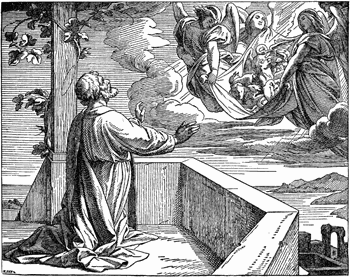
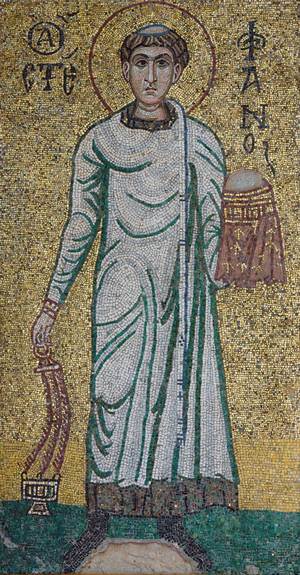
As the world hides in the death of deceit, so Truth and Light cannot but provoke a response. Stephen in recounting the story of the children of Israel speaks of their continual rebellion against God, speaks Light into the present darkness which surrounds him. Although to our eyes, his circumstances turn ever darker a remarkable transformation is seen in his vision. As Job in the midst of his suffering cries our in Hope ‘I know that my redeemer liveth and that on the last day he will stand upon the earth and that in my flesh I shall see him, I an not another – how my heart burns within me’, so Stephen increasingly is full of light. He is full of the Spirit. The Light and Truth of the whole creation is seen in him ‘and he gazed into heaven and saw the glory of God and Jesus standing at the right hand of God. He sees his redeemer – he Witnesses to Life and Light and at the Last as his Lord had done prayed forgiveness for those who slew him.

‘they threw their coats at the feet of a young man named Saul . . . and Saul approved of their killing him’ . . . the Light shines in the darkness, and the darkness has not comprehended it, the darkness has not overcome it.

Through the Bible in a Year – January 31

The Scheme for January and February can be found here

Job 15-17; Acts 6:1-7:16; Psalm 39

Although our reading scheme takes us through the Old Testament chronologically – [the book of Job is read after Genesis as it is impossible to date with surety, and many consider it to be amongst the oldest of writings] – reading a Psalm and the Old and New Testament together gradually alerts us to the ways in which all of Scripture refers back and forth to itself. It is all but impossible to pray Psalm 39, and not find ourselves praying with Job, who remained silent seven days but then burst forth in speech before God, who asks that the Lord withdraw his hand from him.

And to read of Job, who was righteous like no other, who seems to suffer through no fault of his own and therein also to see Stephen – one full of wisdom and the Spirit – also righteous, and also now suffering. Stephen then in his answer to his accusers draws us back into this story, all the time the text calling to us, ‘All of Life is here – here are words of Life.’

And Stephen himself, chosen to wait on tables, to see to the daily distribution of food. As a faithful disciple his very life directs us to the Living One. Once more, the word, this time enacted directs us to The Word – the one who is full of the Spirit and Wisdom – and who took the form of a servant and gave us the bread from heaven.

Through the Bible in a Year – January 30

The Scheme for January and February can be found here

Job 13-14; Acts 5; Psalm 38

It is interesting to note that Acts 5, in particular the story of Ananias and Sapphira does not occur in any lectionary of the church I have ever used for Sunday worship. As we so foolishly excise those ‘difficult’ bits of readings, Sunday by Sunday, either by dictat of the lectionary, or by skating over them in preaching – we seem all too ready to avoid the dark passages. We just want light

But what is Light, if we have no concept of the Dark

The story of Ananias and Sapphira comes crashing into the narrative of Acts as the most unwelcome of intruders – it is almost as if some vandal has cut down a favourite tree, or defaced a beautiful painting. Up to this point in the narrative all is well. There has been no persecution of the believers – their common life is a thing of beauty, and then all of a sudden two members of the infant church are dead, over what may seem to us to be a very small thing. We are shocked.

Like Job and his friends we argue over the ways of God, which seem unfair to us, and so too it may well seem is the incident with Ananias and Sapphira. ‘But they only told a lie!’

We want Light without there being any Dark – we want the blessing of God, but without any suffering. The treatment of Ananias and Sapphira seems to us unjust. Yet this is because of our failure to see the Light – our failure to apprehend what is happening amongst the believers, the enormity of the Resurrection Life.

It is the very Life and Light of the Living God, which flows through the veins of the early church, in whom there is no darkness at all. The very life of the Triune God is evident in the common life of the community of faith – wherever the Apostles go, there Life springs forth and the church grows and grows.

In Him, there is no darkness at all. Deceit, that hiding which was the outcome of the first sin of our forebears, has no place in the light. Ananias and Sapphira, as Adam and Eve, cover up. We must not miss the echoes of the ancient story. Deceit is in a sense The Sin. It is the Covering up that stops the flow of life. ‘If we confess our sins, he is faithful and just and will forgive us our sins’

To Live in the light is to be honest about our own darkness, and so be healed – to cover up is the way of death. Ananias and Sapphira find the way to the Tree of Life is barred to them. There is no Life – and without Life the end is inevitable.

Confession is a Vital part of living in the Light