Through the Bible in a Year – January 29

The Scheme for January and February can be found here

Job 10-12; Acts 4; Psalm 37:20-40

Over and over again we are staggered by the Life present in the church in Acts. I am privileged to be one of the founder members of a community which to this day sees such evidence of life. The disciples live without fear in the face of opposition to faith which is frankly unknown to most of us. But the opposition and the lack of fear have the same root, the presence of Christ amongst his people . . . something which we speak of, but which the quiet carefulness of our Christian lives, the agonized strategising of our church bodies denies.

Dare we with the apostles pray for boldness?

Soren Kierkegaard, the Danish prophet of our age saw our problem only too well – that we are all engaged in idle reflection, rather than risky commitment. Our commitments are to ideas, not to Life. Would we know the life of Christ present among us? Would we know once more a church which turns the world upside down? Then we too must commit to one another, our brothers and sisters in Christ. Only in this radical interdependence is is Life known . . . ‘the whole group of those who believed were of one heart and soul . . . and great grace was upon them all’

Through the Bible in a Year – January 28

The Scheme for January and February can be found here

Job 8-9; Acts 3; Psalm 37:1-19

From the unity of the fellowship of believers flows Life. How many of us in these days either dismiss these stories of healings in the church, or explain them away, as if they were only for the apostolic era. And yet to this day, where the people of God are one such things continue to happen, and Christ is glorified amongst them.

For us to speak as Peter does, ‘in the name of Jesus’, there must be unity, genuine fellowship which goes far far beyond the ‘social club’ mentality which passes for church in the West. Shared lives lead to the sharing of Life. ‘That which I have I give you’, says Peter. Do we have that to give? That Life? Would we see the lame healed, the deaf hear, the blind see and the dead raised? Would we see Life?

Jesus said that only those who lose their lives will find it – he invited the rich young man to leave his possessions and join the band of disciples following him if he was to inherit the Kingdom of God. It is the same invitation he offers to us – to see that truly our greatest possession is our shared life in him, and to sell everything we have to take hold of it.

‘Repent therefore, and turn to God so that your sins may be wiped out, so that times of refreshing might come from the presence of the Lord and that he might send the Messiah appointed for you, that is, Jesus’

Through the Bible in a Year – January 27

The Scheme for January and February can be found here

Job 6-7; Acts 2; Psalm 36

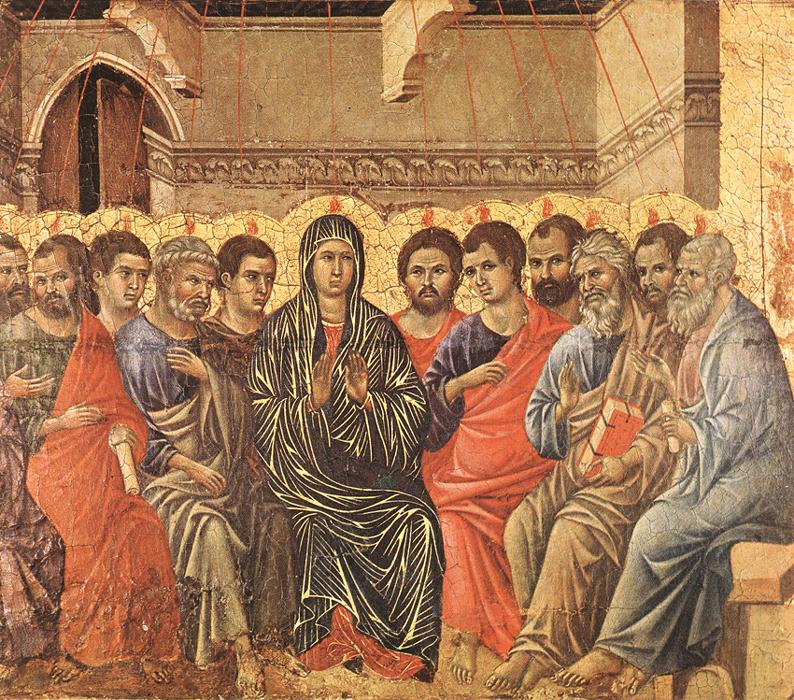
As has often been pointed out, the events of the day of Pentecost reverse the effects of that old deep story of Babel [Genesis 10]. Now diversity of language is given to the apostles that with one voice they proclaim God’s deeds of power, that the many might be one . . . as He had prayed. And so it came to pass and from diverse nations a new people, born ‘not of blood, or of the will of the flesh, or of the will of a man,’ but born of God. And as God is one so the people formed are one. ‘All who believed were together and had all things in common . . . day by day they spent much time together in the temple and broke bread at home’

As the Word became flesh and tabernacled amongst us – so the Spirit dwells in this new community, the body of Christ. ‘And day by day, the Lord added to their number those who were being saved’

The greatest contradiction of the Gospel, the scandal of the modern church in the West, is that we have not repented of the radical individualism of Babel. We refuse to be one. This in the end, not our fragmented theological differences, is our Unbelief.

FOR FURTHER READING

Through the Bible in a Year – January 26

The Scheme for January and February can be found here

Job 4-5; Acts 1; Psalm 35

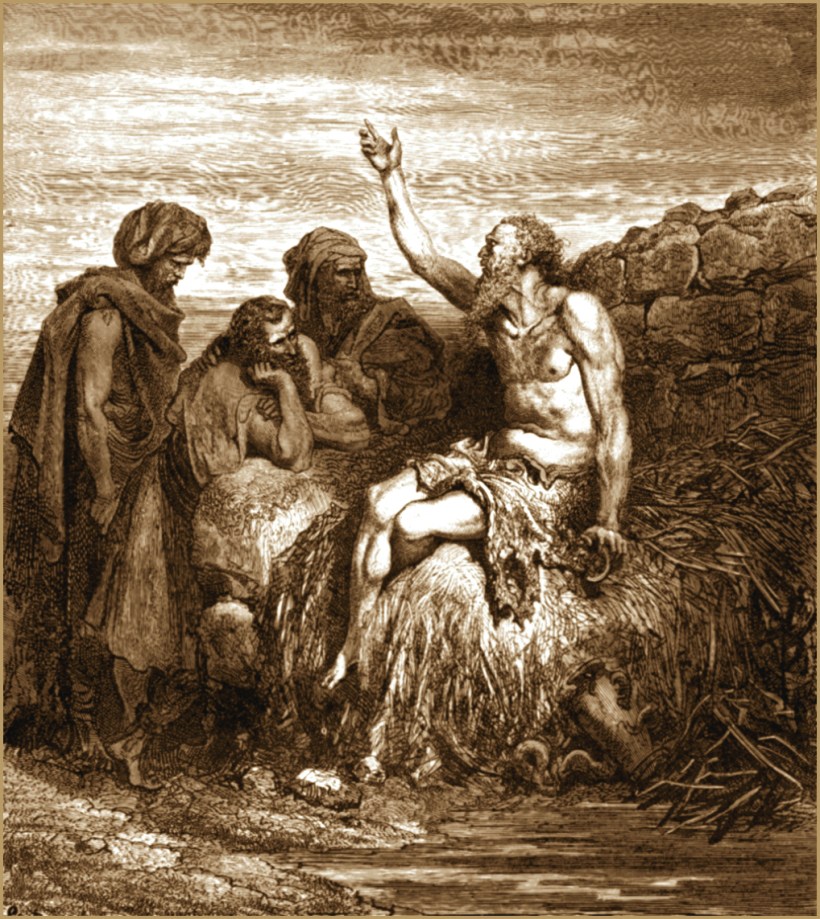
As modern readers, that is those who read texts primarily for their usefulness to us, the book of Job is a profound disappointment. We think that the text is there to answer our proud questions – but rather it exists to question us, to call our very existence into question and cause us to call out in faith ‘Save us!’

In our unbelief many of us it seems are consumed by the question of theodicy, that is ‘How can a God who is omnipotent and loving allow suffering?’. [Although moral philosophers have shown quite clearly that there is no contradiction and moved on] Job is not interested in answering this question for us. Rather here we see a suffering man for whom the one undeniable reality is God. Job will not curse God and die. He realises that there is far more at stake here than the answer to philosophical, for him his suffering is real, but as we read through the dialogue with his friends, we realise that for Job, God is far more real.

In a deep sense, the theme of the book of Job is not suffering at all, but the primacy of God, and of Worship as the fundamental disposition of the soul, in and through everything. It is not a text which gives us answers, rather it is one that redirects our gaze. As we have recently read in John, Jesus does not answer Pilate, rather he confronts him with the Truth in his very being. So God does not give us answers, rather he redirects our gaze from ourselves to Him. In Worship and Adoration our lives find their true meaning – everything else is secondary.

Through the Bible in a Year – January 25

The Scheme for January and February can be found here

Job 1-3; John 21; Psalm 34

The final chapter of John ties up a loose end, yet it is no mere coda. It expresses the Life that was and is and shall be.
the story of the reconciliation of Peter grows out of that old story in the Garden – but the outcome is dramatically different.

Here, perhaps more than anywhere else in Scripture is the Clue. Here we see that the death of Christ is no mere ‘fixing that which went wrong’. Peter, like our forebears of old, chose to know him not. Not to eat from the tree of Life, but that of knowledge of Good and Evil – not identifying himself with Christ whose Word is Life, but choosing a life for himself. And there are no tears of remorse. There is just the plain fact of his denial, a seemingly closed door.
Peter is naked, and ‘heard that it was the Lord’, and grabbed for his figleaves. We are too alert to that Old story – we too hide for shame, as we have always done, since the beginning. But Jesus reveals this is something New, or rather an alternative path that was always present in creation – although for a while the path to it was barred by the presence of the Cherubim – by the Presence of the Living God Himself – the way to that Tree, Life is opened, and no one will close it.
The way of Jesus is extraordinary to us. There is no call for sorrow, to prove we are sorry so that we might be ‘forgiven’, but with an eternal watch on our future behaviour.

Peter expresses no contrition, only that deep deep shame in the Presence of the Living One which the One who Lives for ever has come to Heal.
Peter comes to Christ. Christ asks him the Only question that matters – do you Love me?

Do you Love Me?

Through the Bible in a Year – January 24

The Scheme for January and February can be found here

Genesis 48-50; John 20; Psalm 33

And so we come once more to the beginning. A Man and a Woman in the garden – deep archetypes of Life and also Life giving. The Church with her ‘Rabboni’. But there is far more. Christian faith is often reduced to ‘a second chance’, a ‘new start’ – we tend in the words of the author Dallas Willard, towards ‘a gospel of sin management’ – but something of far greater significance is revealed here. This is no New beginning, starting over. If it were then what cause now two thousand years later would we have for any hope?
In our culture, dominated by the clock, we understand time ‘like an ever rolling stream’, progressing from ‘The Beginning’ and moving towards ‘The End?’. So talk of new beginnings are just that, of always going back to the beginning, in seemingly endless and increasingly hopeless cycles. (In a horrible irony, our culturally unique understanding of human progress is based on this assumption of how time works).
But ours is not the only way of Knowing time and this gospel reveals something far more profound. That the Life which is in Christ is Eternal. Christ in the garden with Mary Reveals all of our Chronological time in a moment. In the deep ‘past’ of Eden, the distant ‘future’ of The New Jerusalem, the Kingdom of God is Now – Present.
And we are invited to Life in that Present – Knowing God – Loving and Loved – One with each other and Him, Now. Eternally. The Life of Worship and prayer that we enjoy together, One in Him, is to inhabit that Life.

In a sense what this reveals is shown in the Parable of the Prodigal, where the younger son ‘came to his senses’ – to See things as they are, if dimly. When we inhabit the Eternal we come to Know as we are fully Known – our Home is Always with the Father. To Live in this moment is to come Home.

Through the Bible in a Year – January 23

The Scheme for January and February can be found here

Genesis 46-47; John 19; Psalm 32

Our Psalm today requires much by way of meditation – that prayerful ‘chewing’ upon the Word in prayer that brings forth Life. For it is a text of truthfulness. Scripture throughout bears witness to the Truth – sometimes it is veiled, the revelation of Christ does not lie on the surface for all to see – but occasionally it is seen in all its glory. In other places, as in this Psalm, we are led into truth. The Psalmist declares, ‘Happy are those whose transgression is forgiven’. He then speaks of his own experience which has led him to this happy realisation – how he was wasting away in trying as our forebears did of old in the garden, to hide the reality of his life from God. But then he comes into the Light – we may well say he comes to Christ – and learns the blessed release of Openness, of Truthfulness.

As we first meditate upon the ‘Proposition’ – happy are those whose sins are forgiven – it may well be alien to us. We may accept it as the Word of God, but it is alien. It is a Fact which we accept in trust, but we have not yet become acquainted with it – we have not ourselves experienced this truth. We may not yet have come to the point where the fact of our own existence in its sinfulness has been any burden to us. But as He comes close to us, this state of affairs cannot pertain, we must either come to the light or flee ever deeper into the darkness. As he becomes ever more clear the crisis comes to a head.

And so Everything is brought to the point of Judgement. We see in Pilate a growing panic as the one who Is the Truth stands before him – the conflict between Light and Dark is exposed – the Light is brought out once more and the darkness os revealed for what it is – a refusal to come into the light. “Crucify Him! Crucify Him!’ We cannot bear the light!!!

Pilate comes to see that for all his worldly power – he cannot do the right – he is given a choice – he is told where his authority comes from, but he refuses to step into it. He does not believe.

It is in this supreme revelation of the Truth of our existence in Christ, that the door to our forgiveness is thrown open wide. As Death is brought out into the open, Life is poured out.

As we wrestle ourselves with God, as had Jacob, who now in a most extraordinary turn, blesses Pharaoh, all this is brought to the fore in our lives. The Truth of Christ is made present to us, and we too have the opportunity offered to us of the fullest healing of who we are.

Truth is revealed to be Personal – a Person – the one who sets us free.

“Blessed are those whose transgression is forgiven, whose sin is covered.

Happy are those  . . . in whose spirit is no deceit – who have stepped out of darkness and into light

Who know Christ, and are themselves Known, Apprehended, and Freed by Him
 

Through the Bible in a Year – January 22

The Scheme for January and February can be found here

Genesis 44-45; John 18; Psalm 31

I hope that as we have journeyed thus far, I have encouraged you to seek the deep patterns in Holy Scripture, that this book is of a whole, that past present and future are found in a single line, or even a word.

John in particular is always most careful with his words – it is as though years of reflection upon the Glory of God in Jesus Christ, of resting upon his breast has enabled him to distill all of that Glory into almost every phrase. And so we come once more to where we began – to a garden – which Jesus and his disciples enter.

Of course That garden, the one of old had had set at it the cherubim and a sword flaming to guard the way to the tree of life.

So the one who Is in himself Life – the root of Jesse – who will be born upon the tree enters this garden. He enters The Garden – the path is not blocked – a Gate has been made. We note that He, with his disciples do not bring any torches, for the Light is still with them.

Then in ghastly parody, comes the betrayer, with soldiers and priests – with their own ‘flaming swords’ and there is a confrontation. One somewhat akin to that of Dagon with the Ark of the Covenant in Samuel – the Ark above which rose the cherubim – whose very presence threw the parodic god of the Philistines to the ground.

Thus the revelation of Glory which the darkness cannot overcome, the one who dwells among the cherubim, The one who Is and who watches over The Gate for the sheep, throws all the darkness to the ground. The darkness cannot overcome it, even in This moment..

Through the Bible in a Year – January 21

The Scheme for January and February can be found here

Genesis 42-43; John 17; Psalm 30

The seventeenth chapter of John’s gospel reveals the very heart of the gospel – that we might know the Father and the Son. We so often express salvation in terms of being ‘saved from’, like Lot’s wife we are to ready to look behind. That which we are saved from is not worth a moments consideration. Rather the work of Jesus is to reconcile us to God, not in some forensic sense, but to restore the realtionship which our first ancestor knew – of profound intimacy and love – “that the love with which you have loved me may be in them and I in them” And that as we are drawn into that by the love of God in Christ, so we are as his people drawn together in such love, ‘that the world may know’

Jesus at prayer – read this – meditate upon it – respond in praise and adoration – and abide in this Love

Through the Bible in a Year – January 20

The Scheme for January and February can be found here

Genesis 41; John 16; Psalm 28-29

The strange and mysterious story of Joseph now takes a dramatic turn for the better. Now even Pharaoh is troubled by dreams. We note how often in the Scriptures, the powerful are threatened by their dreams whilst the weak are given strength. And, the cup bearer remembers that there is one who can tell dreams, but he is no magician – of the sort which will one day deceive in order to imitate the plagues – no, Joseph would not deceive, “It is not I; God will give Pharaoh a favourable answer”. In Joseph’s continuing integrity and honesty, displayed in his faith in the one who alone lifts up the lowly, who exalts the humble and meek – is his story continued. Joseph throughout is one who sees. A prophet in the true tradition who is alert only to what God is about.  And in Joseph we see a foreshadowing of the one who will be exalted to the right hand of the majesty on high, precisely because he only does and speak of that which he sees his father doing.

The theme of Christ’s identification with his church continues and other themes are drawn in to the whole. We are reminded that the disciples are drawn into the closest association with their Lord. They, his sheep, know his voice – in contrast to the world which knows neither the Father, nor His Son. What is more, even though for a while they will weep and mourn – whilst the World rejoices – even though they will be scattered and leave Him to the way that they cannot now follow, they are to know that the Father is with him. Knowing he and the Father are one they may ask with confidence anything in his name, as he himself asked the Father to glorify his name, and the Father spoke to his request. It is asking in the knowledge that Jesus and his Father are one that is the source of the abundant Life and complete Joy which the disciples will know.

Here is no pale Christology. Here is Life and Hope. John would have us under no illusion about the relationship of Jesus of Nazareth to God. As the Prologue lays out the Cosmic dimensions of the relationship of the living Word to God, yet in intimate terms (It is God the only Son, who is close to the Father’s heart, who has made him known) – so over and over again Jesus speaks of the Father, His Father, and the Father of all those born from above. The intimacy of God and the only begotten is revealed in breathtaking detail, and as we read, and behold, we too are drawn into the joyous love of the Father for the Son