Sermon for January 6 – EPIPHANY 2013

EPIPHANY2013 [Link to recording of sermon]

EPIPHANY 2013 – YEAR C – Text of sermon as prepared

Isa 60:1-9
Eph 3:1-12
Matt 2:1-12

Latecomers

Well I hope that you have celebrated Christmas fully – the whole twelve days!! 🙂 As I noted a few days ago, my weighing scales seemed to be measuring out the twelve days pretty accurately, if you count out time in additional pounds! 🙂 As we’re often told, we don’t know the actual date of Jesus’ birth, although if Jesus was born six months after his cousin John the Baptist then we can say with some certainty that Jesus was born in September. John’s father Zecchariah was on duty in the Temple at the time of the announcement of John’s birth and thus, knowing when his family would have been on duty as we do – Luke tells us Zechariah was of the order of Abijah – it’s merely a matter of adding 15 months which brings us to September!! So we were ALL late for Christmas!!
However many Christians are even later than we were. For Orthodox Christians, who make up about 1/3 of the world’s Christians celebrate Christmas today – the Feast of the Epiphany – so if you like a good reason for some more celebration – then conversion might be a good idea 🙂

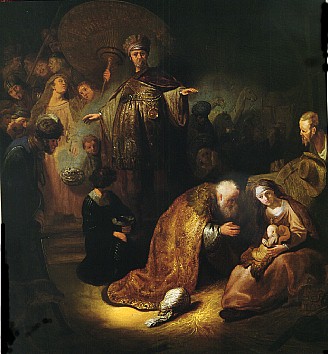
Of course the reason that the Orthodox celebrate Christmas today is because it is today – the feast of the Epiphany – we remember the Revealing of Christ to ALL nations. The Magi, the Wise men from the East being foreigners – outsiders on the story of Jesus – who in some regards represent Us. We are so used to being Christians, we forget that we are latecomers to the story of God’s people. That as of old, it wasn’t our story.

Even that first Christmas story isn’t really ours – no matter how much we try and domesticate it in Nativity plays. We pay little or no attention to the fact that the events around the birth of Jesus are all Jewish. The gospel is first announced to the Jewish people – and then and only then to the Gentiles – that’s us.  Not only is his birth announced in this order – the Shepherds coming to Bethlehem long before the Magi – Jesus himself says ‘I was sent only to the lost sheep of the house of Israel.’ and he sends out the twelve saying ‘Go nowhere among the Gentiles, and enter no town of the Samaritans, but go rather to the lost sheep of the house of Israel. and first to the Jews is the way that the Gospel is proclaimed. So on the day of Pentecost Jerusalem is full of Jewish people – yes from all over the known world, but all of them Jews. It is only following Peter’s conversion through a strange dream that the Gospel is then taken and announced to God fearing Gentiles in the household of Cornelius. And so Paul writes to the Ephesians – I Paul am a prisoner for Christ Jesus for the sake of you Gentiles – AND – Although I am the very least of all the saints, this grace was given to me to bring to the Gentiles the news of the boundless riches of Christ, and to make everyone See . . . !

Listen to the words of the prophet, Nations shall come to your light, and kings to the brightness of your dawn. 4Lift up your eyes and look around; they all gather together, they come to you; your sons shall come from far away, and your daughters shall be carried on their nurses’ arms. 5Then you shall see and be radiant; your heart shall thrill and rejoice, because the abundance of the sea shall be brought to you, the wealth of the nations shall come to you. 6A multitude of camels shall cover you, the young camels of Midian and Ephah; all those from Sheba shall come. They shall bring gold and frankincense, and shall proclaim the praise of the Lord. 7All the flocks of Kedar shall be gathered to you, the rams of Nebaioth shall minister to you; they shall be acceptable on my altar, and I will glorify my glorious house – These are words of promise for the Jewish people – ‘You’ here, is not us 🙂
If we remember the parables that Jesus told of the Kingdom being like a great feast, then Epiphany is a reminder that we weren’t on the original guest list! We are latecomers. And so perhaps celebrating Christmas at This time is a good idea. Not only because we have become so accustomed to Christmas Our way the comfortable way we’ve always known it, it is easy to forget that this message is not about Our ways. It is about God’s way. This Christmas story is as always meant to disturb us, to shake us out of our familar ways and to place us in the midst of something far greater – and to make everyone see what is the plan of the mystery hidden for ages in God who created all things

And what is that mystery?? Well our reading comes in a little late as well – it’s not just Christmas that is late – Paul puts it like this in the verses before our reading So then you are no longer strangers and aliens, but you are citizens with the saints and also members of the household of God, 20built upon the foundation of the apostles and prophets, with Christ Jesus himself as the cornerstone. 21In him the whole structure is joined together and grows into a holy temple in the Lord; 22in whom you also are built together spiritually into a dwelling place for God.

God’s secret plan – the mystery hidden for ages – is that he desires once more to have a place to dwell upon earth and as I said on Christmas day, reflecting on the words of John ‘The word became flesh and tabernacled amongst us, that place is in and amongst his people’ ‘With Christ Jesus himself as the chief cornerstone’ With Christ Jesus himself as the foundation – The foundation  – of everything . . . and as we know all too well here in New Zealand, mucking around with foundations brings buildings down – and so the house of Herod – the one who himself had tried to have himself made ‘King of the Jews’ by dictat – the house of Herod is shaken to its foundations ‘Where is the child who has been born king of the Jews?’ Such an innocent enquiry – and one that threatens everything – all that Herod had planned and built. But like any ruler always on the lookout for those who might usurp his power (partly why we can never expect grown up politics . . .) Herod announced himself ‘King of the Jews’ and ordered that his sons succeed him, but then had them executed!!1 When King Herod heard this, he was frightened, and all Jerusalem with him

And so the Magi come to offer their gifts – Gold Frankincense and Myrrh – and knelt down and paid Him homage. Not paying homage to Herod – homage to the one who is the corner stone for the dwelling place of God

And having been warned in a dream not to return to Herod, they left for their own country by another country . . . this is dangerous knowledge . . .

To know Him who is the cornerstone of the dwelling place of God is dangerous knowledge – as it remains today, at least where the church has retained the understanding that all knees must bow before him to pay homage . . . the understanding that actually We too are outsiders . . . that our obligations are not to the rulers and pricipalities of this age – but of those of the age to come

On an almost daily basis I receive from around the world news of the persecution of Christians – just this past week I read startling evidence that Christians are overwhelmingly persecuted for their faith over against all other faith groups. From our context here in New Zealand this must sound very odd – what after all is very threatening about being a Christian?? We don’t need to be warned in a dream not to tell folk about the one who has been born into the world to supplant all human rule and authority – we just don’t do it.

There is I think a very necessary strangeness in the visit of the Magi – those who come from the East. Whose focus is no human rule but one divinely revealed in the shining of a strange star. I think we too readily try to undo this story – try to make it make sense on our terms and when it doesn’t, then dismiss it – we fail to be troubled by it, in much the same way we have lost sight of the troubling idea that this Faith isn’t first of all ours – that we were only lately invited to become the people of God, and that the birth of Christ into the world really does challenge everything we are so accustomed to.

This is Not an easy story – and the life we are summoned to is not a life of ease. our reading from Paul stops at Verse 12. He continues I pray therefore that you may not lose heart over my sufferings for you; they are your glory. This Glory that the angels announce – and that the Wise men behold will come about only through suffering and on our part, the chief part of that is the knowledge that in being insiders to to the mystery that has been revealed in Christ – we find ourselves outsiders in the world in which we ha learned to be so comfortable

In a sense I think that this is the great adjustment we need to make at this time. Most of us have grown up with church being a very ordinary part of things one way or another – certainly I did. But that is rapidly changing – once more we are coming into an age where to Know Christ is, as it is for so many of our brothers and sisters to be in possession of dangerous knowledge – But Life giving knowledge. In the early years of the church Christians met as they do nowadays in China and PAkistan, in Iran and many other places, behind closed doors. There as in the early days of the church, the wider world’s hostitlity was shut out as God’s people met in secret – to worship and adore – to lay their treasures before him . . . and the church grew like never before as it continues to in those places – so that through the church the wisdom of God in its rich variety might now be made known to the rulers and authorities in the heavenly places.
Perhaps The great strangeness of Christian faith in this world today is that it is not primarily a set of ideas, an ideology, a way of life, it not about values. No it is about a person. We bleieve in Jesus Christ the only son of God eternally begotten of the father, God from God, Ligth from Light, true God from true God, begotten not made, being of one substance with the Father through whom all things were made. Our Faith is to Know ourselves to be His –  in relationship with Him, the Babe of Bethelehem, the King of the Jews, the Son of God most High. It is Only in and through worship and adoration that we like the Magi begin to comprehend what we are called into, and how Graced we are that we who were once far off have been brought home.

Sermon for Christmas

Christmas 2012 audio [Link to Recording of the sermon]

CHRISTMAS DAY 2012

JOHN 1:1-14

‘The Word became flesh and tabernacled amongst us’

One of the advantages of Christmas here in New Zealand is that we get Christmas first! I guess that that means we don’t have to wait as long?? 🙂 But as I’ve been keeping up with friends around the world this past few days, it’s been fun to see them half a day or more behind where we are in terms of their Christmas festivities – and so yesterday morning I heard from a friend in the UK who had just finished their nativity play – and the alarming news that with two minutes to go, they’d lost ‘the baby Jesus’!! The doll that was Always ‘the baby Jesus’ was kept amongst lots of others in a big cupboard of toys for the little ones and with two minutes to go before the service, someone noticed they hadn’t got the doll had gone to the cupboard . . . to discover that the cleaner had had a clean out and the doll had gone!!!

Well, fortunately a little girl at the service had brought her doll with her, and was more than happy for it to take the starring role!!

Yet for all we sing ‘Away in a manger’ and have our crib services, the gospels really aren’t written to have us cooing over ‘the baby Jesus’ – rather the text of the familiar stories as told by Matthew and Luke are far more concerned with telling us the story so that we might be drawn into it and allow it to address us. All these thoughts about the fragility of a baby, about his humble origins are not the concern of the evangelists – rather the way they tell the story is to get us asking the question ‘Who Is This child?’ – Who is this child that Emperors have restless nights because of – Who is this child whose coming requires God’s Spirit to move over the face of the deep as once of old he had Bringing Life out of nothing, a baby from a virgin? Who is this child who causes the angelic host to be seen once more – who is this child who is born in Bethlehem, the City of Old King David, and yet who finds the door of the inn slammed in his face (there is no kindly innkeeper in the narrative) – Who is this child whom Shepherds worship and herald?

And in a sense there is little point us reading Luke and Matthew’s’ account at Christmas – for they are telling the story of Jesus from its human beginnings – it is if you like the beginning of the biography. And at the beginning we cannot see the end – the whole. It is only Mary and Joseph who are told – Joseph is told that this child ‘will save his people from their sins’ – Mary is told ‘He will be great, and will be called the Son of the Most High, and the Lord God will give to him the throne of his ancestor David. He will reign over the house of Jacob forever and of his kingdom there will be no end’ It all lies in the future – Faithful Israel will ponder all these things in her heart, but Luke and Matthew tell the story from its beginning and cause us to ask the question which the rest of their gospels are written to answer – Who is this child?

John however, tells us it not only from the end, but from before the beginning and beyond its end. John, as we hear at our annual carol service ‘unfolds the great mystery of the Incarnation’

And so that is why as we the people of God gather to Celebrate Christmas – we read John. For John reveals all the breadth, the height and the depth of the reality of this child – when we read John we read the True meaning of Christmas – and It is So big it is like swimming in a vast Ocean of meaning and Truth.

What does John tell us about this child?
This child is the eternal Word of God – He is God’s Very Truth and Life and Light – This child has always been with God – This child is the one through whom everything that has been made was made – This child is the means of Life coming into the World – a Life that gives Light to all people, This Child, this LIght is overcome by nothing, not even death can hold This Child.

John of course knows the Nativity stories – he knows how there is no room for this Child – he came to his own – to the Very city of David – and his own knew him not – the World did not know him – Imperial Rome did not come to pay tribute – only to extract it

But to all who received him, He gave power to become children of God! John is So careful here in setting out what this means – children born not of blood – or of the will of the flesh, or of the will of man – children born not by biological process – not by human desire – but born of God. As John knows of the Virgin birth, so he points to the birth This child heralds. This child – ‘the baby Jesus’ whose birth we focus on – as we truly turn our hearts and minds to him – becomes the source of Our Birth

Perhaps this is why we want to sentimentalise the story – as I said a few weeks ago, we don’t want to drag in the evil Herod into our Christmas plays – we want to keep it safe – because in the end this child opens the door to the most dramatic and challenging possibility of all. A possibility that calls our very Life into question – that of our own rebirth as God’s children, born from above, born of the Holy Spirit – as that which was within Mary was conceived of the Holy Spirit.
This child – The one who fulfils the  impossible possibility of the LORD through the prophet Ezekiel – I will sprinkle clean water upon you, and you shall be clean from all your uncleannesses, and from all your idols I will cleanse you. 26A new heart I will give you, and a new spirit I will put within you; and I will remove from your body the heart of stone and give you a heart of flesh. 27I will put my spirit within you, and make you follow my statutes and be careful to observe my ordinances. As the Virgin Birth of Jesus heralds an impossible possibility, so too, perhaps even more so it heralds the impossible possibility of the transformation of our hearts – that we might be like Him – the Firstborn.

The birth of Jesus into our flesh, opens the door to our birth into HIs Life – this child

And the Word became flesh and dwelt amongst us and we have beheld his Glory, Glory as of the Father’s only begotten, full of Grace and Truth.

All through Advent we have considered how to be ready – how to prepare our hearts – yet aside from turning our hearts and minds to him there is nothing we can do – He is the one who when we contemplate HIm transforms our hearts. The Word became flesh and dwelt amongst us – literally tabernacled amongst us.
Of old the children of Israel had camped in the Wilderness – three tribes to the east, three to the South, three to the west and three to the north – all facing the centre – the tabernacle – the dwelling place of God, where the Glory of God dwelt above the ark of the covenant – the pillar of cloud by day, the pillar of fire by night. Now he dwells once more amongst his people – that we might behold his Glory and so be changed ourselves from one degree of glory to another

I guess we will all go from this place today to celebrate with much food and more – but I pray we will all take the time to Swim – not in the cold Southern ocean – but deeply into these words of John and into the Wonder of This Child – and so rejoice evermore deeply and truly in our celebration of His Birth. That our Christmas might be truly Merry and Happy and Full of Joy and Light and the Life of Christ.
Amen

Sermon for Sunday October 28th

Sermon Sunday October 28th

Sunday October 28th 2012 (AUDIO – different from text)

Job 42: 1-6,10-17
Psalm 24
Hebrews 7:23-28
Mark 10:46-52

‘So I saw in my dream that the man began to run. Now he had to run far from his own door, but his wife and children perceiving it began to cry after him to return: but the man put his fingers in his ears and ran on crying, “Life, life, eternal life!”
So he looked not behind him but fled towards the middle of the plain . . .’
John Bunyan: The Pilgrims Progress

Captivated by Bartimaeus

Every Sunday we publish the readings for the week to come on the news sheet, along with some study questions on my blog, which can be accessed through the church website, and my fervent prayer is that more and more people will join with us in contemplating the readings for the coming Sunday, that we might as it were come HUNGRY for Christ, the living word as we approach his table.

This past week as I have sat with the readings, my attention has been held captive by Bartimaeus, blind Baritmaeus, son of Timaeus, and I was strongly reminded of a friend of mine. I had been witnessing to Paul about Christ for some considerable time. One Sunday there was a visiting preacher at our church, Richard Bewes, and I took Paul along. He preached from Ecclesiastes – For everything there is a season, and a time for every matter under heaven:
a time to be born, and a time to die; etc. you know the passage.
I can’t remember anything about the sermon, it didn’t particularly speak to me, or better I was deaf to the LORD’s word that evening, for he is Always speaking. But my friend, as soon as the service was over leapt from his seat, I have to have that! he said and ran to speak with the preacher.

We have this short, almost unremarkable incident in the life of Jesus from Mark. We are so used to Jesus doing all these things – we come to church one week and we hear of him healing a haemorrhaging woman, another he raises Lazarus from the dead, another he walks on water. We have heard all these stories so often before and this week, well Jesus heals a blind man. And it strikes me that when we hear of these things, we are all too often  like I was listening to that preacher, or like the crowd in the gospel, still milling around Jesus – hey look another miracle! But perhaps waiting to go home, after all the excitement can’t go on for ever. And we go home too, and we pick up our lives as if nothing has changed. Perhaps we can be like the crowd – we’ve seen it all before – but have we?? What Have we Seen??
In our gospel reading, there as in all of Mark’s gospel is ‘the crowd’ following the miracle worker – looking for more signs, but uncommitted. Not mentioned today there are the disciples, those whom Jesus has called, but who don’t get it. And along the way Jesus encounters one individual after another, the woman with the flow of blood, the rich young man, the ruler of the synagogue, the syro phoenecian woman. These individual encounters with Christ are all as it were opportunities for us to step out of the crowd, to be confronted by Christ. And now it is Bartimaeus turn to come face to face with Jesus, and through him, another opportunity for us. And this week I couldn’t take my eyes of Bartimaeus.

There is the crowd, all milling around but Bartimaeus – he’s different . . . and as I contemplated this reading a very strange question came into my head . . .  ‘Why does Bartimaeus want to see . . .’

Exegesis

As Jesus and his disciples and a large crowd were leaving Jericho, Bartimaeus son of Timaeus, a blind beggar, was sitting by the roadside. There are many fascinating contrasts between Bartimaeus and the rich young man of two weeks ago. The man who had many possessions was entirely self sufficient – Bartimaeus was entirely dependent. He survived purely on the generosity of passers by. Indeed his blindness may well have been a help to him. With so many destitute and poor, his affliction would have driven some to pity him more than others. He would have been used to listening to what was going on around him, crying out for help – but this time is special 47When he heard that it was Jesus of Nazareth, he began to shout out and say, “Jesus, Son of David, have mercy on me!” 48Many sternly ordered him to be quiet, but he cried out even more loudly, “Son of David, have mercy on me!” Bartimaeus will not back off – like the Syro-Phoeneician woman, he will NOT be put off in his effort to encounter Jesus, and his persistence pays off. 49Jesus stood still and said, “Call him here.” And they called the blind man, saying to him, “Take heart; get up, he is calling you.” 50So throwing off his cloak, he sprang up and came to Jesus. His cloak would have been so valuable to him. he needed it to keep warm, he would have spread it on the ground to collect alms1, but it has to go, he Has to get to Jesus

Bunyan’s Pilgrim, runs from his family who would hold him back crying ‘life, Life. eternal life!’ My friend Paul had to have that Life he heard in the preachers words – Bartimaeus Has to get to Jesus. He is the blind man who sees. ‘Jesus, Son of David!!’ ‘Son of David, have mercy on me’ He is the blind man who sees. As Jesus told the pharisees, there are those who can see who are blind, and those who are blind See!
The rich young man doesn’t see who Jesus is – he asks the wrong question. He is So used to doing it for himself, he just wants to know the answer to the final question, what must I do to get eternal life., he says to Jesus. He sees Jesus as a means to his end, a means to fulfill his life. Tell me the answer and I won’t trouble you anymore He can see but is blind, he cannot see that Jesus IS eternal life. Bartimaeus cries out ‘Jesus, have mercy on me!!’  Jesus asks “What do you want me to do for you?” The blind man said to him, “My teacher, let me see again.” My teacher – Rabbouni! The cry of faith from Mary Magdalene in the garden of the resurrection on the lips of this blind beggar – My teacher – my all – my Life, my death my every waking breath. Bartimaeus Knows that Jesus IS his life

Application

Why does Bartimaeus want to see?? He wants to see Jesus. Wouldn’t we, Do We?? Have we yet awakened to that Burning desire to See Christ, to be with him, to worship him? Are we hungry for Him?

Martin Luther would say to his students, I wish I could get you to pray like my dog goes after meat ! ‘I wish I could get you to pray like my dog goes after meat!’ I don’t know how many folk have got dogs, but if you have one you don’t leave the Sunday joint lying around!! For the dog will go for it!! and it’s no good saying to the dog – don’t do that! be a good dog!! He IS being a good dog.2 That is what dogs do – they cannot contradict their dogginess – but WE can contradict our humanity. The crowd are all milling around Jesus, curious, wondering, perhaps getting a little bored, they will soon cry out CRUCIFY!! Their indifference is their sinfulness, they cannot See who Jesus is – Bartimaeus in contrast is becoming Fully Human – he Springs up – he Comes to Jesus, like a dog after meat is a man pursuing God in Christ – and having been healed he follows him on the way. The most Truthful human response to Jesus, is to go after him like a dog goes after meat.
Jesus called the rich man to follow, but he went. Jesus told Bartimaeus to Go, but he followed . . .

But where, where is he going?? It doesn’t matter, I have to be with him, says Bartimaeus. And where is Jesus going? We come to the end of our reading through Mark. When we return to it in a couple of weeks time we will have skipped the next chapter, where Jesus enters Jerusalem. Jericho which Jesus is leaving is just down the road from Jerusalem. When we imagine the crowds with Jesus as he enters Jerusalem, Bartimaeus is there crying out, Hosanna to the Son of David – giving Glory to God.

This week I have used Psalm 24 in our worship – it is the Psalm of entrance into the Temple – Christ comes to the Temple. The Psalmist Cries out as a herald
Lift up your heads, O gates!
and be lifted up, O ancient doors!
that the King of glory may come in.
The cry comes back, we might imagine from high on the ramparts?
Who is the King of glory?
The Lord, strong and mighty,
the Lord, mighty in battle.
Lift up your heads, O gates!
and be lifted up, O ancient doors!
that the King of glory may come in.
Who is this King of glory?
The Lord of hosts,
he is the King of glory.

We may imaging Bartimaeus crying out – ‘The Lord of hosts, He is the king of Glory!’ For as the Psalmist tells us
Who shall ascend the hill of the Lord?
And who shall stand in his holy place?
Those who have clean hands and pure hearts,
who do not lift up their souls to what is false,
and do not swear deceitfully.
They will receive blessing from the Lord,
and vindication from the God of their salvation.
Such is the company of those who seek him,
who seek the face of the God of Jacob. Who go after him like a dog after meat.

I began by speaking about how we are invited to prepare each week – to read the scriptures, to study them, that we might come HUNGRY to church – hungry for Him who says ‘Very truly, I tell you, unless you eat the flesh of the Son of Man and drink his blood, you have no life in you. Those who eat my flesh and drink my blood have eternal life, and I will raise them up on the last day; for my flesh is true food and my blood is true drink. Those who eat my flesh and drink my blood abide in me, and I in them.

Bartimaeus was HUNGRY for Jesus – he wanted to SEE! And Seeing Jesus he followed him, his teacher. ‘My teacher, let me see again’

I conclude with some words of an early teacher of the church, Clement of Alexandria

‘Let us open ourselves to the light then, and so to God. Let us open ourselves to the light and become disciples of the Lord . . . Let us, then, shake off the forgetfulness of truth, shake off the darkness that dims our eyes, and contemplate the true God – after first raising this song of Praise to him: ‘All hail, O Light!’ For upon us buried in darkness, imprisoned in the shadow of death, a heavenly light has shone, a light of a clarity surpassing the sun’s, and of a sweetness exceeding any this earhtly life can offer. That light is eternal life, and those who receive it live.’ ‘Let us open ourselves to the light then, and so to God. Let us open ourselves to the light and become disciples of the Lord’3

Life, Life, Eternal Life!

Sermon for Sunday 14th October – The man who had many possessions – Questions of Identity

Mark 10:17-31
Psalm 22:1-15
Job 23:1-9,16-17

For it is the Gentiles who strive for all these things; and indeed your heavenly Father knows that you need all these things. But strive first for the kingdom of God and his righteousness, and all these things will be given to you as well.

Over the last few months as we have made our way through the pretty stark territory of Mark’s gospel, Jo has twice helpfully pointed out how Mark tends to put two incidents side by side, that they might illuminate one another. Unfortunately, last weeks gospel reading had two pericopes which did not, I think belong together. If we remember last week’s gospel, we probably remember it for Jesus teaching on the nature of marriage and thus divorce. We may well have forgotten that the second part was the familiar incident of the disciples trying to keep the children from Jesus. This small incident forms a mutually contrasting pair with the story of the young man in our reading today. Jesus’ words ‘whoever does not receive the Kingdom as a little child . . .’ contrasting with the anguished words of the young man ‘What must I do to inherit eternal life?’ and Jesus’ declaration ‘How hard it will be for those who have wealth to enter the kingdom of God!” And, to the the disciples’ perplexity,  “Children, how hard it is to enter the kingdom of God!”

So let us first think about the little child and the little child’s perception of the world – and to do that I want to go back to our Psalm and the reading from Job. It might sound an odd place to go, these expressions of desolation and suffering when we are thinking of the perspective of a child, but they are words from the heart of the one who is like a little child. The Psalmist utters the words which will find their True expression on the lips of Jesus as he dies upon the Cross, ‘My God, My God, Why hast thou forsaken me’. As several commentators have noted, upon the lips of Jesus, the emphasis is upon the YOU – why have YOU forsaken me. Jesus in his life knows the rejection of all, even finally his disciples, but as he hangs upon the cross he knows something which is at once terrible to comprehend, and yet which is also disturbingly familiar. ‘Where have you gone?’

A little child in its early years finds its life centring around its parents and their presence. If for a moment we can begin to imagine, or indeed perhaps remember, there is little as terrifying for a child (and indeed a parent) to discover you are lost. Where have you Gone??? My God, My God, why have You forsaken me?

From everything we know of Jesus, we can not imagine this anguished prayer from the cross as some philosophical musing at the hour of his death. Jesus in all things only did what he saw the father doing – I an the Father are one – he tells his disciples. How much like the life of a small child, their sense of Identity is wound up with that of one or both of their parents. The Father gives his identity to the Son, and now as Jesus’ life ebbs away, the Father is not to be found. ‘O my God, I cry day by day, but you do not answer, and by night but find no rest’

So also Job who in his suffering complains ‘“If I go forward, he is not there; or backward, I cannot perceive him; 9on the left he hides, and I cannot behold him; I turn to the right, but I cannot see him.’” Where have you gone, God? But there is no sense of ‘there is no God’ For Job, for the Psalmist, for Jesus upon the Cross, God IS!  The very centre of the Universe – the unshakable reality, whose absence is not the cause of some existential angst, but more like a living Death. For Job, for the Psalmist, for Jesus – Their Identity, Who they are is Known to be in God the Father.

So whoever does not receive the Kingdom as a child shall never enter it. To receive the Kingdom as a child is to accept God as the very epicentre – the heart and soul of one’s life – not in some vague philosophical way, not as a tenet of faith, but as such a concrete reality that the most terrifying prospect is that we might find ourselves somehow estranged from Him. To Know Him as Father in the depths of our being. ‘How much more will he clothe you?When Jesus cries out from the cross, this is no collapse of a belief system, it is the realisation that the utterly unbearably thinkable has occurred, His father appears to have forsaken him and he is Utterly alone. Jesus the Son receives the Kingdom like a child, and thus knows the Hell of separation from God. ‘Where have you gone??’!!!

Jesus, the Psalmist and Job all reveal to us what it looks like when someone obeys the first and great commandment, to love God with all our heart, soul, mind and strength – that is to hang our entire existence upon Him, to see the world and our existence in his light and that his absence is like the most terrifying thing that could happen to us – for He is our Father and we are his children. Knowing oneself to be the child of God gives us an utter security which nothing can shake . . .

How unlike the young man, who rushes up to Jesus with what can only be described as an anxiety laden request, What must I do to inherit eternal life?’. The man Runs up –  he is in earnest. He flatters Jesus ‘Good teacher!’ There is hardly any mention in the Rabbinic literature of ‘Good teacher’ , it is phrase that is not used because it should not be, and Jesus Rebukes him ‘Why do you call Me good? Only God is good!’ He then tells him it straight – man to man. [Notice that Jesus responds to the little children as children ‘He took them up in his arms and blessed them’ – a sign of receiving the Kingdom, being received by He who embodies the Kingdom – but the man, he treats as a man] You know the commandments – no murder, no adultery, no theft, no lying, honour your parents’ “Teacher this is what I’ve been doing since my youth . . . ever since I left childhood, I have kept all these. I know that as a man I am responsible for my life, I have to do it, I have done it!! ‘All these I have kept from my youth. And here comes the punchline . . .

Why does the man come to Jesus? Except he does not Know he has eternal life. He is uncertain. Yes he has kept the law . . . or at least most of it . . . but he is insecure. Everything Externally seems fine. In his own terms has made a success of life, he has met the goals he set for himself ‘All these I have kept from my youth’ . . . but Deep down inside he is troubled . . . and Jesus looks at him and loves him and tells him the truth. He Loves him, He Sees him as he really is – he speaks Truth to him –  ‘You lack one thing’ The man’s heart Leaps!! Yes, I knew it – deep down I knew there was something missing!! What is the One thing??? ‘Go, sell what you own, and give the money to the poor, and you will have treasure in heaven; then come follow me.”
And his heart goes to his boots – the man who lacks one thing is called, as we all are to let go of everything else to lay hold on that one thing – He was shocked and went away grieving . . . for he had many possessions. Contrast the Man with the child, whose Identity is tied up in the Father – the man’s identity is tied up in his Respectable life and his possessions.

There used to be a TV programme called ‘Thru the keyhole’ – in it a camera went into a famous persons house and a panel were asked to guess whose home it was, in the light of their possessions. Thus a Deep truth was revealed, that our possessions are a mark of our sense of self – our Identity. This Man had built up a Huge picture of who he was, he had Many possessions. And Jesus says to him, if you want to discover who you really are, you need to let go of all that stuff, stuff doesn’t tell you who you are, God your Father does. Your Identity is as his child.

Today so many many people are on a journey ‘to discover themselves’, or like the young man ‘to buy an identity they feel comfortable with’ clothes, a home, possessions that express who you are. Advertising plays remorselessly on this unease with ourselves – saying in effect, you haven’t really found yourself until you have these things. As Jesus puts it, whoever wants to save his life will lose it, whoever loses his life for my sake and for the sake of the gospel will find it. The one who is prepared to let go of the false picture he has built up for himself and instead receives as a free gift that which was always their own, their identity as a child of God, will not be disappointed. Let go of the life you have made for yourself, sell your stuff, give to the poor, then come, follow me

To all external indicators Religious and material the man is secure, yet inwardly he is insecure – he is now called to reverse that, to be outwardly insecure in things, in order that he might know the security of the child. To let go of his adult security, to be born again, to start over, looking to God for all he needs, for daily bread. It is The Crisis encounter with Jesus. Jesus looked at him and loved him. Jesus could not have cared more for this man than to tell him the truth – you want eternal life? One thing you lack

And so the Risen Christ speaks to us today through this word. As we are sat here today, I wonder – to whom do we relate here? The child who has nothing yet Knows the unspeakable Joy of security in God their father – or the man, who has everything and yet Knows deep down that something is awry.

The child finds their identity in their relationship with their parent. The childlike find their identity in the love of God. We may well know in our head that God loves us, but do we know the Love of God in our heart, that we are his children, the unshakeable security we can only know as we find ourselves in the Life of the only begotten son? Are we secure in it? It strikes me that the future of the church lies in the hands of those who know that security.
For the future of the church to external senses is most uncertain. The external indicators – those things that give false security, large congregations, money, religious respectablility, charismatic leaders even – – – if we are like the man in the story, putting our faith in these things, then we will go away grieving. As I said a couple of weeks ago and in the parish magazine, I find it troubling that we are not calling out, My God, My God why have you forsaken us – or O God make speed to save us. ‘Where is God in all this?’ is Not some metaphysical conundrum, it should be an anguished cry, Where IS God in all of this?? It seems we are still putting our faith in ourselves, like the man.

But as always following Jesus is the only way – the man turns away. He has so learnt to trust what he has and what he does, that he is frightened to take the risk of faith. But what Jesus then goes on to show is that Yes – he is calling him to radically renounce his security in himself – BUT that something wondrous happens when you do. Peter says ‘Look, we have left everything and followed you.’ And Jesus replies, ‘Truly I tell you, there is no one who has left house or brothers or sisters or mother or father or children or fields, for my sake and for the sake of the good news, 30who will not receive a hundredfold now in this age—houses, brothers and sisters, mothers and children, and fields, with persecutions To know HGod as our Father is also to know His provision which is ALWAYS more than we can make for ourselves – the Life he offers makes the life we make for ourselves look infinitely impoverished by comparison, To follow Jesus, is to discover ourselves as part of the community of those who follow Jesus. As we seek to discover what it means to be the people of God here in this place, we will have to let go of a lot of stuff, BUT to do so joyfully to follow Christ, is the door to True community. Whilst we cling onto the old things that always gave us hope, we shall not know the amazing depths of community in Christ. Those who leave behind . . . shall in this age receive an hundredfold. It is as we commit ourselves to Christ wholeheartedly and thus his people, we discover Life, Now.

The man faced a Crisis – eternal life was being offered him – it was a gift, he only had to let go of the life he had built for himself to receive the life Jesus offered him. I wonder if anyone knows that call here and now? I wonder if we hear it as the church here, Jesus speaking to St John’s Roslyn. Some I know do find their true family here, they have discovered the truth of Jesus words, ‘Truly I tell you, there is no one who has left house or brothers or sisters or mother or father or children or fields, for my sake and for the sake of the good news, 30who will not receive a hundredfold now in this age—houses, brothers and sisters, mothers and children, and fields, with persecutions’ My prayer is that we all will

I was reminded earlier this week of the words of Tim Smit – Tim is the founder of The Eden Project – a quite stunning Ecological attraction constructed in disused Clay pits in Cornwall, in the South West of England. He recalls his grandmother saying to him – ‘when you die, be sure you can say ‘I am glad I did’, rather than ‘I wish I had’”  And I couldn’t help but think of the young man in our gospel reading, the young man who is offered the Kingdom, for it is always a free gift, but who is unable to accept it, for he had many possessions. There are not just individuals who have many possessions, there are churches too. HOw does this word speak to us as individuals? HOw might it speak to us as a church?

What holds us back? Would we too rather not say “I am glad I did’, than with the man in our gospel say ‘I wish I had’

Let us once more hear in our own hearts those words of St Augustine “God, you have made us for yourself, and our hearts are restless until they find their rest in you”

Sermon for Sunday September 23rd, 2013

Sunday 23rd September 2012

Sermon Recoding 23-9-12

Proverbs 31:10-end
Psalm 1
James 3:13-4:3,7,8a
Mark 9:30-37

‘A good tree cannot bring forth bad fruit – the neglect of Christian Character??’

“Who is wise and understanding among you?
Show by your good life that your works are done with gentleness born of wisdom.”

One of the, to my mind disturbing changes in the way the history of the last century is viewed, especially in Europe, is the way in which we all stopped talking about ‘the Germans’ with respect to culpability for the Second World War. Instead we just referred to the Nazis. I found that change disturbing, not because it was about blame, but because it moved the spotlight away from a deeply uncomfortable question. The National Socialist Party was numerically not that large, but it mobilised many many German people in its cause. Feeding on deep resentment and a sense of injustice, a sense that Never again should the proud German people suffer a humiliation like the Versailles settlement and all that flowed from it, a large part of the population was caught up in the moment, and lived to regret it.
Although there were many who saw through the Nazi rhetoric to an even darker and more sinister heart, many more were caught up in it, and afterwards found themselves implicated at some level or other. It was as if they were in some sense helpless in the face of what was happening, somehow swept along like chaff driven by the wind. The unremitting fascination in England with the history of the Second War saw endless TV documentaries, and all too many interviews with ordinary Germans who clearly couldn’t come to terms with their own involvement, their inability to Stand against it. By only talking about the Nazis, we were deflected from the troubling fact of the capacity for great evil that lies within each one of us, something which can spring up in a moment as people are as it were swept along

For this goes on all around us. Not thankfully, at least for here and now, in the rise of terrible totaliarian regimes, but in the moments of all our lives. People get caught up in something and before you know it others are hurt, relationships wrecked, words said which cannot be taken back. Or smaller steps taken unthinkingly which lead towards these things, guided as James puts it by ‘cravings within’, towards an external and permanent stain on the record. ‘We do those thing we ought not to do and we have not done those things which we ought to have done’, as the words of the Prayer Book general confession have it. And the things we do lead towards more things we ought not to do, at times, seemingly inexorably.

Last Sunday morning, whilst you were engaged in the worship of God, I had a too personal insight into that at Synod. It was a moment of realisation about this reality and about myself. In the midst of the business of the morning I too found myself caught up. I did something that on reflection I should not have done, and I did not do something I should have done.  It happened in a few brief moments, and I was not ready for that moment.  ‘Be on guard’ says Jesus ‘ . . . so that day does not catch you unexpectedly, like a trap.’ I got something very wrong and it has been a chastening experience. I was caught unexpectedly, and acted unwisely

Of course it would be all too easy to say in my case as in many millions of others, ‘There there, we’re all human you know, these things don’t matter all that much’, but as Christians we really do not have that luxury – for we believe in the one who ‘alone from first to last our flesh unsullied wore’, we believe in The Human – Jesus of Nazareth. Whenever anyone says to us – ‘well, we are all human’ as a way of salving our consciences, we should respond, ‘no we are not – but in the Risen Christ we are learning to be so’

As to these things not mattering, well again we know better. This is why we call such erring and straying, ‘Sin’ – we realise the damage these things do, fracturing the realm of Existence. It is why in the church we are to exercise the disciplines of mutual accountability, of confession, repentance and more. Those good practices which like the Person blessed in our Psalm,  move us away from being like the chaff which the wind drives away, blown hither and thither as we are ‘caught up in the moment’, and instead directs our being towards the stability of trees, planted by streams of water, which in the moment are not blown away but rather bear fruit. I realised in that moment last week, I was like the chaff – my lack of rootedness was revealed. It was a moment of Judgement  – the tree fell.

Life comes at us, ‘stuff happens’ as we have it – nowadays as fast as it ever has. We live in an age of rapidly accelerated change in which life offers us almost on a moment by moment basis choices to make, decisions to take. Many of them seemingly inconsequential – to ‘Like’ something on Facebook, to reply to an email, to answer the phone, to buy a new pair of shoes, to stop . . . that it seems is the one thing we are NOT encouraged to do – to Stop -to reflect – to ask ‘is this really the way?’ ‘What sort of a Life am I building by my myriad of momentary choices? Or. . . are my choices the result of a carefully built life?’

Moving here to New Zealand has of course resulted in an even greater variety of new experiences – more new things which all have the capacity either to enrich or diminish life, requiring discernment, or Wisdom. In particular I am getting used to a new language, not only New Zealand English which is subtly different to the language I grew up with, but also of course in the Maori tongue.  So I am learning new words, and my new word this week was ‘Mana’. A friend used it and though I had heard it and had a vague idea of what it meant, I went and did some further research. For those, probably few of us who don’t know, Mana when translated out of the Maori into New Zealand English might mean something along the lines of deeply rooted good character – that rare quality of a certain Weightiness and Authority in and of themselves. I’ll come back in a moment to the Maori sense, but first that idea of ‘Character’.

My sense is that we live in a culture which understands that character is in a sense something almost accidental, that you ‘just happen to be’ a person of character. That how we act in the moment is just who we are, or that who we are is a given, we have lots of traits and a very few have these traits which identify them as people of Mana. We think little if at all about if it is possible to develop our character – less about HOW we might build our character. In this regard, as in so many others we are crippled by a lack of sense of times past, when Development of Character was actually of great significance in society. People thought much about how character was developed – and indeed education was primarily seen in these terms. Not in terms of teaching a set of facts, but in terms of teaching a disposition towards the world, a way of being human. Our forebears would I think have had little time for those words ‘ah well, we’re only human’.
A sign that things have changed is perhaps the way we receive the phrase, ‘a character building experience’  – such a thing is increasingly understood as a negative. A child is sent away to boarding school – ‘it will be character building for him’ – the putting side by side of the Negative aspects of life away from home and the building of character, throws a negative light on the latter. Be Yourself!! is today’s mantra. But who says, ‘Become yourself’, as if Life was not in truth a covetous amassing of experiences, but rather the lifelong project of developing character, that when the testing comes, when the winds blow and the seas rise, the resulting house might not collapse as if built on sand.

Now of course such a view of character building is very much along the lines of the self sufficient rugged individualist way of doing things. We may leave this place and think ‘Mana’ – right  – I am going to pull up my bootstraps and build myself a life.
Perhaps we might think of that reading from Proverbs, about the ‘capable wife’ There indeed is what we might call Mana. As we read of this woman, she is awe inspiring in the integrity of her life, she has Mana, yet right at the end, there is a little note that the Western Individualist way is Not how she has built her life. What the word Mana carries with it in Maori culture, is that Character is somehow rooted in something spiritual beyond our own grit and determination – it is at once a work and a gift, and here it draws much closer to the truth revealed in Christ. As the writer says of the capable wife,  ‘Charm is deceitful, and beauty is vain, but a woman who fears the LORD is to be praised’.  Proverbs is if you like a manual for a young man in living life and here in finding a good wife. What is her defining character out of which all else flows? That she fears the LORD. Her exceptional character is rooted in a living apprehension of God
For indeed it is hard to read the scriptures for very long to realise that this work of building a Life, Who we are, is one that we are given. Yet that in this work we are totally dependent upon Christ. ‘Take my yoke upon you and learn from me’, is the way that Jesus puts it. The Yoke is the symbol of obedience – the yoke of obedience – yoked to Jesus.

The saying goes, ‘it is all to easy to be wise after the event’ – wide and easy is the way that leads to destruction, but as Jesus tells us we are living in the times of the End, momentous times, times when our lives are put to the test – things happen one after the other after the other, our work is tested as if by fire on an almost moment by moment basis. It is easy to be wise after the event, but then it is too late. The deed is done, and the door is closed – we find ourselves on the outside, whilst the discerning and wise who were ready, go into the banquet. The question is ‘How are we to be wise before the event?’ How are we to be ready? How do we develop Christian character which is sufficient. How are we to become Wise before the event? Only in being Yoked to Christ – the Living Word, who is for us Wisdom from God, and thus growing into the fulness of who we are in Him.

Think again of the Psalm, Blessed is the one . . . whose delight is in the law of the Lord, and on his law they meditate day and night.They are like trees planted by streams of water, which yield their fruit in its season, and their leaves do not wither. In all that they do, they prosper. Meditating on the law of the LORD, paying attention to the one to whom we are yoked through baptism. How do we become the people we are meant to be? By entering into training with Christ in conscious obedience day by day by day. And at first this is difficult – this yoke seems to chafe – obedience to Christ is Not second nature, and we all too readily give up – we do not reflect on our mistakes and what Christ the gentle one is teaching us. We go back to trying to do it for ourselves or not bothering and resorting to the complacent – ‘ah well, we are only human’. As the writer to the Hebrews says ‘No discipline seems pleasant at the time, but painful. Later on, however, it produces a harvest of righteousness and peace for those who have been trained by it.’

‘Who is wise and understanding among you? Show by your good life that your works are done with gentleness born of wisdom’ says James, ‘But if you have bitter envy and selfish ambition in your hearts, do not be boastful and false to the truth. Such wisdom does not come down from above, but is earthly, unspiritual, devilish. For where there is envy and selfish ambition, there will also be disorder and wickedness of every kind. But the wisdom from above is first pure, then peaceable, gentle, willing to yield, full of mercy and good fruits, without a trace of partiality or hypocrisy.’ Character  is in the end is the outflow of our hearts – envy and selfish ambition in the heart produces disorder and wickedness.

The character of the disciples, their hearts, were shockingly revealed in their actions. ‘What were you arguing about on the way?’ asks Jesus. Well at least they had learned enough to be shamed into silence . . . Jesus called these twelve men and said to them, “Whoever wants to be first must be last of all and servant of all.” Jesus does not primarily call us into a whole new set of things to do – that is secondary. Rather he First calls us into a whole new way of being.
Before setting out the actions of the sermon on the Mount he describes in the Beatitudes the type of people who can live in obedience to his teaching – the poor in spirit, the meek, those who mourn, the pure in heart We can only begin to live the Life Christ has called us to as we begin the work of developing the life that is capable of living that Life. . . Christian character building comes before the Test, Wisdom is garnered before the event as grain is gathered before Winter – when the test comes it is Always too late to do the work of character . . . but fear not we have the very best teacher – one who loves us utterly and has given himself up for us – as he has given and continues to give himself to us, let us likewise offer our lives to him, that he might take them, discipline them, mould them more and more into his likeness, to the glory of God the Father of us all. Amen

What sort of a Life am I building by my myriad of momentary choices?
Or, are my choices the result of a carefully built life?
Lord have Mercy

Sermon for Sunday September 2nd, 2012

Sermon for Sunday September 2nd, 2012

Song of Solomon 2. 8-13
Psalm 45. 1,2,6-9
James 1:17-27
Mark 7.1-8,14-15,21-23

‘The Life of Slavery and the Life of Liberty’

LINK TO AUDIO RECORDING OF SERMON

So we are now coming to the end of the weekend of prayer for the Diocese in what is without doubt a time of exceptional challenge. Not that it is unique in any sense. A document suggesting possible structural adjustments regarding arrangement of parishes and clergy has been circulated to clergy and vestries also will get a look. Not unlike many such documents I saw in my time in England it states that the purpose of the document is to enable Mission, yet it is all about arranging parishes together, – something which we called ‘managed decline’ back in the Church of England. No matter how glossily it was all dressed up, that was the driving rationale behind it all.
And, also as in England, there is little or no self criticism in the document – which suggests a disconnection from the deep roots of our faith. For throughout the entire Old Testament, whenever things turned bad, the community of faith through its prophets always had one explanation, and one alone. Not the times are changing, not people today they are different and we need to adjust. No, the consistent reason given was ‘you have abandoned God’.
When things got tough for the Israelites, they didn’t hold colloquia on the changing nature of society and ‘the need to adapt our methodology’ for a new era – they didn’t go into lengthy discussions of how the technological advances in the Assyrian chariot design had left their puny foot soldiers left behind. No, as it is written ‘These people honour me with their lips, but their hearts are far from me. In vain do they worship me teaching human precepts as doctrines’ If things had turned sour, the Israelites did not look for reasons ‘out there’ – they did not focus on the externals and a need to adjust themselves to new circumstances – they looked inside, to the state of their collective hearts – or at least that was where the prophets commanded them to look. ‘These people honour me with their lips, but their hearts are far from me’

And of course that looking at the externals rather than the internals was precisely the focus of Jesus’ criticism of the Pharisees – whom he accused of abandoning the commandment of God and holding to human traditions. (We may well in that context think of how our church has itself abandoned the commandment of God and rather, looking to the wider world, shaped itself a faith more in accordance with mere human traditions, but another time). But it is instructive to discover what the command of God it was that Jesus used as an example. Unfortunately, once again the lectionary has cut out the key verses so I will read them to you because they hit right on the root of the matter  Then Jesus said to them, ‘You have a fine way of rejecting the commandment of God in order to keep your tradition! For Moses said, “Honour your father and your mother”; and, “Whoever speaks evil of father or mother must surely die.” But you say [Note here in a reversal, that Jesus who says ‘You have heard’, ‘but I tell you – and who always Intensifies the meaning of the Law, here accuses the Pharisees of diluting the Law – ‘You say ] You say that if anyone tells father or mother, “Whatever support you might have had from me is Corban” (that is, an offering to God)— then you no longer permit doing anything for a father or mother, thus making void the word of God through your tradition that you have handed on. And you do many things like this.’
All this respecting Father and Mother then as now was a very hard call, so the Pharisees had invented what amounted to a religious tax avoidance scheme. The Law was stringent on honouring father and mother – to curse your parents was punished by stoning to death, but the Pharisees had abandoned this commandment to honour father and mother and had established a tradition whereby they could withhold financial support for their parents by declaring the money set apart for God.

But you might say – those words of Moses which Jesus repeats, ‘whoever speaks evil of father or mother must surely die’ – they are terrible!! Are they?? Why honour your father and mother – because humanly speaking they are the source of your life – without them you have no life. This is made patently clear in the parable of the prodigal, where the son wishes the father dead – he wants him out of the way,and then discovers that apart from the father he has no life – life without the father is no better than eating pigswill. And so when the Israelites discover that their life is pigswill, they know why, ‘they have abandoned the Father who gave them life’ – whose commandments are Good and life giving – ‘that implanted word which has power to save your souls.’

The Pharisees were obsessed with the externals – Israel was to be preserved by rigid adherence to external signs of faith, but signs which had no interior reference, no inward glance, no suggestion that the Salve for their suffering was not by lives that were consciously ordered with respect to the world around them, but by repentance and faith. And one way or another too much in the modern church is exactly the same as the Pharisees – except we go in exactly the opposite direction – The Pharisees thought that their salvation depended upon their distinctiveness from surrounding society – today many in the church think that our salvation depends on our adapting ourselves better to the world in which we live. We are concerned with Relevance, the Pharisees couldn’t care less about relevance, but we are the same for their is no inward glance – no suggestion that we may be where we are because we have abandoned our heavenly parent. We have become like earthly children, living lives of utter independence.
There is a spirit alive and well in the church that thinks that we have in a sense ‘come of age’ as human beings, that we can now make our own plans, carve out our own paths – we can live without reference to the Commandment of God. ‘We know better now’ is the mantra of our age – we are free! So we would like to believe. But we are not – rather we are slaves, slaves to the desires of our hearts. We believe we have an absolute right to happiness and fulfillment on our own terms, and there are many who would abandon the commandment of God and take hold of enticing human traditions that promise us something elusive, not hearing the words of St Augustine, that we are made for God and that ‘our hearts are restless until they find their rest in thee’. We are made For God, and that to seek happiness or meaning elsewhere is in fact a form of Slavery, slavery to our own desires, slavery to Externals to the detriment of our hearts

Our first reading this morning may well have cause one or two to blush – My beloved speaks and says to me: “Arise, my love, my fair one, and come away; 11for now the winter is past, the rain is over and gone. 12The flowers appear on the earth; the time of singing has come, and the voice of the turtledove is heard in our land. 13The fig tree puts forth its figs, and the vines are in blossom; they give forth fragrance. Arise, my love, my fair one, and come away.

We may well ask what is such poetry doing in the Bible, and I might say – ‘that’s nothing! you should read the rest of it!!’ or, less flippantly ‘well of course the Bible is about all of human life, so why not’ – but rather I want to put it to you in line with the tradition of the church down through the ages, that the Song of Solomon stands here as testament to the passionate love that is betwixt Christ and his church and between God and the soul of the individual believer. That here figured is the glorious liberty known only in and through an all consuming love of God for his creatures and their response of love to him.

Christ says to his church as he says to us each as members of that church, ‘Arise, my love, my fair one, and come away’ Come away from what we may ask – to which the answer is ‘that slavery to your own desires, for I have set you free – why do you live enslaved in Egypt when you could dwell with me in the land of Promise. And these desires that we are enslaved to are So puny . . . as CS Lewis puts it in ‘The Weight of Glory’

“If we consider the unblushing promises of reward and the staggering nature of the rewards promised in the Gospels, it would seem that Our Lord finds our desire not too strong, but too weak. We are half-hearted creatures, fooling about with drink and sex and ambition when infinite joy is offered us, we are like ignorant children who want to continue making mud pies in a slum because we cannot imagine what is meant by the offer of a vacation at the sea. We are far too easily pleased.”

Put another way we were created for something far far greater than the love of those things which our hearts desire all to readily, that which the Bible calls ‘Idols’ – we were created for the Love of God. How many of us I wonder can read the Song of Songs – put ourselves in the place of the beloved and gasp with wonder and delight to find ourselves not only the object of such love, but the giver of such love in return – that we love God with all that we have and all that we are.
I must admit I search for signs of such passionate ardour for God in Diocesan documents and the like, and I search in vain – for the mark of a body that loves God with all its heart and all its soul and all its mind and all its strength.
But perhaps that is unsurprising. Bernard of Clairvaux, the C12 founder of the Cistercian monastic order gave a lengthy series of sermons on the Songs of Songs. In it he says that in order to love God we must be free of our false loves, we must reject all our false suitors. Put another way we must stop our restless searching anywhere else for our Life than in God himself. Bernard tells us that we are not ready for the Song of Songs, we are not ready for that love, until we have fully learnt the lessons of the two books which precede it in the Scriptures. Firstly Ecclesiastes, which details the search of the wise man for meaning in his work, in pleasure, in all the things of the world, which after extensive enquiry he declares to be a chasing after winds, Vanity, futility. Such is the Life that seeks its meaning in the world, such is the way of a church which seems to make itself relevant and reasonable, like a rather pathetic lover, seeking to please the object of its affection.
Then freed from the love of the world, Bernard says we must learn from Proverbs, we must stop learning to trust our own wisdom, but as James tells us, we must ‘welcome with meekness the implanted word which has power to save our souls’. Freed from the tyranny of slavery to pleasing the world, from the tyranny of our own opinions and desires, we are set free – truly free, free to Love God with heart and soul and mind and strength.

Such poor teachers has the church had down through the years that this fundamental aspect of our faith is all but ignored. We hear so many many sermons on loving neighbour, we may hear many about how we are loved by God, but how many on the our Love For God – the first commandment – that we might utterly Love our heavenly parent, that we might wait patiently and with great desire for his word of command – for we live and Love to do His will. For here is the great Paradox, that it is in our complete submission to God our Father that we know what it truly is to be free. And if I have lost sight of prayers for the Diocese in all this? My prayer for the Diocese is that we would turn back to the great lover of our souls, the only source of our life, and I end with a prayer – again of St Augustine – Let us pray
O Thou,
who art the light of the minds that know thee,
the life of the souls that love thee,
and the strength of the wills that serve thee;
help us so to know thee that we may truly love thee;
so to love thee that we may fully serve thee,
whom to serve is perfect freedom.
Amen

Sermon for Advent 2, Year B, 2014. ‘Waiting . . . for the redemption of our bodies’

Advent 2 2014
Samuel Marsden
Isaiah 40
2 Peter 3
Mark 1

Waiting for the redemption of our bodies

As you can’t fail to have noticed this morning, we are celebrating ‘the best Good News since 1814’ – which raises to questions, one general one – what IS the Good News?? If a friend asked you, What is that sign on the Church drive all about? What would you say?? And secondly – waht is Anything does the Good News have to do with our bodies???

I was recently reading an article by a man who had lived through the 1930s in England. His family had been coal miners and to say his existence was harsh would be putting it fairly but perhaps also mildly. Children all sharing the same bed – a lavatory outside the house shared with several other families – poor and sometimes non-existent food – and of course disease, taking children in infancy and leading to life expentancies much much shorter than those we have come to take for granted.

When we consider the collapse of participation in the life of the church, particularly since the 1960s, one factor that I rarely hear mention of is how comfortable our lives are nowadays. After all, IF the big theological problem is ‘Why does an all loving God permit suffering?’ surely when we suffer far far far less than even our parents generations – and we do – then church should be packed with folk giving thanks to God? Surely??

And of course church has itself become  less demanding and more comfortable, as well . . .  and herein might be part of the issue. Back in England many many churches went through the business of ‘re-ordering the church’, at least when financial circumstances were better. By and large that meant making the building more ‘comfortable’. The installation of better heating and of course that perennial bane of a Vicar’s life – the removal of pews to be replaced with ‘comfortable’ chairs . . . but of course does not Isaiah 40 verse 1 say ‘Comfort ye, O Comfort ye my people . . .’ 🙂

Not long before coming here I chaired a Diocesan committee which had both the Archdeacons on it. One evening we met at one of their houses, and as the second Archdeacon came into the room he said to his colleague ‘Ah! that must be your prayer chair!!’ He was pointing at one of these.

poang-armchair__0117277_PE272441_S4

And he was right! How did he know?? Except for the assumption that one must be comfortable to pray . . . Imagine being sat on that  or indeed your own favourite comfortable chair – losing all sense of your body, its aches and pains – almost for a moment leaving the material realm and entering into the pure realm of the Spirit . . .

This turn is one of the most ancient heresies of the Church that of Gnosticism, a retreat into the realm of pure Spirit – the denial of our bodies. Which is fundamentally a denial of the heart of our faith. Our bodies are the very realm of our Life as Christians. And as we shall see the Heart of the Good News.

This Gnostic turn is seen in what happens when we pray – together as a body. When I was young it was unthinkable that one might not kneel to pray. In other words without naming it – we were bringing all of who we were before God, and in material terms almost all of who we are is our bodies. Kneeling is of course very Anglican – Other traditions stand to pray. Again very physical and perhaps more demanding. Until very very recently, not to adopt some bodily posture in prayer would be thought most odd. Why leave so much of yourself behind when you pray?

Our Faith is at its heart Embodied. Physical and Spiritual irrevocably woven together – put another way, it is Sacramental.  And thus it cannot be disembodied. Only those who think that there are two realms, one of the Spirit an one of the body could imagine otherwise. Our bodies matter – they are the Realm of the working out of our salvation – as St Paul reminds us ‘‘do you not know that your body is a temple of the Holy Spirit within you, which you have from God, and that you are not your own? For you were bought with a price; therefore glorify God in your body.’ What we do with our bodies is of ultimate significance. they are no mere shells for our ‘selves’ We are our bodies, perhaps more than we are minds in that we might lose our minds yet still live, yet we have no life apart from our bodies

Thus the central outworking of our faith – Worship and Prayer must fully involve the body for us to be present – we eat bread – we drink wine – we are baptised by our bodies being immersed in water – we annoint the body with oil after baptism, for healing and in preparation for death. We stand we kneel, we turn to face the Gospel – for in this Jesus is speaking –  As we enter the Holy of Holies at the Eucharist we change our dress. We HEAR the word with our ears, we respond in speech with our mouths – we SING and action which brings so much more of us bodily into the picture – the body resonates literally with the praise of God. We confess our sins OUT LOUD. This too is why marriage is a Sacrement, because it is Known in the BOdy, the two become one flesh

One of the disciplines of faith I have been teaching our Baptism class has been to read the Bible out Loud even when you are alone. One of the marks of our disembodied existance has been ‘reading in your head’ . St Augistine once found  the Saintly Bishop Ambrose ‘reading without moving his lips’ and thought it so odd that he mentioned it in his writings and tried to explain this Strange behaviour. But as anyone who has ever read out loud and paid attention will note – it is a very different practise. the words are embodied they resnote – all of who we are in involved rather than the very very limited part of our neural pathways involved in reading in our head – ie to read in your head is barely to read at all – indeed such practices as research shows largely shut us down. In this increasingly virtual, unreal world there is a very real sense in which we need to get out of our heads in worship. Not in the Gnostic sense of contemporary charismatic worship wherein people are enjoined to lose sense of their bodies – this is no different to praying in the comfy chair. no we get out of our heads to get our faith into our bodies.

Today as we move through Advent in this the bicentennial year of the announcement of the Good News in these lands we remember Samuel Marsden. Here on Friday, the children from Kaikorai School re-enacted that story as a means of telling the story of Christ’s birth amongst us. Earlier this year with the other members of General Synod I was privileged to visit Oihi Bay. What struck me forcibly was the sense of exposure – of the harshness of what life must have been like for Marsden and his family. Few if any of us know what it is to live in dependence of the hospitality of others. Imagine literally coming ashore in acute dependence for your physical needs, your bodily need for safety, your bodily need for shelter, your bodily need for food and water. As we have lost sense of these needs, so our apprehension of who we are has shrivelled to a point where for all we say the Self is writ large in contemporary society, we have in effect made ourselves disappear, and where is The Good News in that?  Perhaps in no small part we have lost any sense of our faith, of what the Good News is, precisely because of this bodily denial?

So John the baptizer appeared in the wilderness, proclaiming a baptism of repentance for the forgiveness of sins. And people from the whole Judean countryside and all the people of Jerusalem were going out to him, and were baptized by him in the river Jordan, confessing their sins. Now John was clothed with camel’s hair, with a leather belt around his waist, and he ate locusts and wild honey.

The people left the comfort of home to meet this strange figure in the wilderness and to be immersed in the water of the baptism of repentance

one cannot help but be struck by the sheer physicality of john the Baptist. There he is in the wilderness, the place always of God’s salvation, the place of physical dependence upon God, the place where the LORD provdes the manna, the daily bread. And dressed in what he could find – camels hair – perhaps an echoe of those skins that the LORD provided for our first parents, Adam and Eve. Living on a diet of what he could forage . . .

Announcing what?

Mark wastes no time in announcing the content of the Good News. Mark Chpater 1 and verse 1 – The beginning of the good news of Jesus Christ, the Son of God. The Good News comes to us in a body, that of Jesus. The eternal word of God of which Isaiah spoke becomes FLESH. Born in humility, having family, having nowhere to lay his head, being hungry and thirsty, whipped and scourged, brutally nailed through sinew and bone to a rough wooden cross – the Sphere of our Salvation hope is indisputably the body of Jesus. As St Paul puts it when he is asked what is the message he preaches, ‘it is Jesus Christ and him crucified . . .’ The Good News is known in a body, and in that body God in Christ reconciles the world to himself. And through faith, God raises Jesus from the dead, not as a ‘spirit’ but as a living breathing, fish eating, walking talking living breathing human.

Both Isaiah and Peter speak of the transitory nature of our lives – But the day of the Lord will come like a thief, and then the heavens will pass away with a loud noise, and the elements will be dissolved with fire, and the earth and everything that is done on it will be disclosed. The physicality of our lives laid bare

All people are grass, their constancy is like the flower of the field. The grass withers, the flower fades, when the breath of the Lord blows upon it; surely the people are grass. The grass withers, the flower fades;    but the word of our God will stand for ever. And therein lies our Great Hope – for all the frailty of our bodies, our great hope is that in the eternal Word bodily raised from the dead, we too are raised. That Christ’s triumph over death was no mere ‘vague ongoing existence’ as so many of the comfortable ‘modern’ Christians would like to think. That beyond the vagaries of mere beliefs, even our bodies are caught up in the Salvation purposes of God. So we prepare by Worshipping in our bodies, by Praying in our bodies, by fasting in our bodies, by baptising bodily,

Comfort ye, comfort ye my people, saith your God . . . the word rendered comfort means better Strengthen!! Get ready – prepare yourself, body and soul for the coming of the one who Saves us, Soul and Body