Sermon for Ordinary 7 – (Epiphany 7) – Sunday February 23rd.

Sermon for Sunday 23rd February, 2014
Second before Lent, Year A (Ordinary Time 7)

Leviticus 19:1-2, 9-18
Psalm 119:33-40
1 Corinthians 3:10-23
Matthew 5:38-48

‘Do you not know who you are?’

Many of us, I am sure spend little or no time reading the book of Leviticus. Being in the Old Testament some of us have been led to believe that it is somewhat primitive, a heresy the church has had to combat ever since its earliest days. But listen again to these words we have just heard. As you listen hold in mind also the words of Jesus’ Sermon on the Mount which we have also heard announced to us.

You shall not go around as a slanderer among your people, and you shall not profit by the blood of your neighbor: I am the Lord. You shall not hate in your heart anyone of your kin; you shall reprove your neighbor, or you will incur guilt yourself. You shall not take vengeance or bear a grudge against any of your people, but you shall love your neighbor as yourself: I am the Lord.

‘You shall love your neighbour as yourself’ – Jesus introduces no new teaching when he declares this – He is reminding his own people of their roots, of their identity. We cannot understand who we are as Christians without a profound understanding of where we have come from – our Roots,  of Who we are. It is not possible to live as Children of God in the World without great confidence about that identity.

And knowing deeply who we are helps us better to grasp what seems to be the impossible teaching of Jesus. We listen to the words of the Gospel – ‘Do not resist an evil doer’ – ‘turn the other cheek’ – ‘Love your enemies and pray for those who persecute you’ – and almost always, almost without fail we qualify them. We hear the words of Jesus and either, as so many do, we dismiss them as a hopelessly unrealistic counsel of perfection, that doesn’t address our lives. Or hang grimly onto them in a horribly legalistic sense, but to fully comprehend, to grasp in the deepest sense the meaning of Jesus teaching, we need to know who we are.

And when I say ‘Who We are?’ I want again to emphasise that First We are the Body of Christ, and Only Secondly, individually members of it. That our Primary identity is as the people of God – again, if we do not understand this, then these texts become oppressive to us and they are not meant to be, indeed they are words of Liberation of an unimaginable order. For this is Always the truth of the words of Jesus.

But first I’d like to turn to Paul’s letter to the Corinthians where he is profoundly concerned with this question of identity, realizing that in truth everything springs from this. When he says ‘Do you not know . . .’ he is asking ‘Do you not know who you are?’ And Paul’s concern is for the Church, and how the church is built up as a body. This of course is a concern for us – building on the foundation which has been laid, how do we in our generation continue to build the church.

Paul has laid the foundation – he has made known the person of Jesus Christ, who is the Gospel. This is a matter of literally fundamental importance. The foundation is Jesus Christ. There are churches which say ‘we stand on the Bible’; or ‘we are a church of social action’; or ‘we are a spirit led church’. All of these good things, but secondary – they are not the foundation – the only foundation for a church can be Jesus Christ, crucified and Risen. We must even be careful when we say, we are a church founded ‘on the gospel’, for even in Paul’s time, there were many ‘gospels’ doing the rounds – not particularly written ones, but messages. Even the Roman Emperor proclaimed the Gospel of his reign. So saying ‘we are a Gospel church, a Good News Church’ is problematic as it then requires someone to ask ‘what is your Gospel?’ For The Foundation is no mere message, it IS Jesus Christ, Crucified, Risen and Ascended, who sits at the right hand of God and in whom all things hold together. He is the foundation of our Life – HE is the Vine – we are the branches. Apart from Him, apart from this foundation we are not a church. And in large part that is why we come together each Sunday – to hear His words, to share with him in the Feast of the Kingdom – his very life in bread and wine.

So then – knowing that foundation we go a LONG way to knowing who we are. As we build, our reference is always to our foundations – is our work True to the Crucified and Risen Lord of Creation? Like a master builder we build in such a way as Always in reference to our foundations. If we do not, well the building will eventually collapse. Imagine if you will the leaning tower of Pisa – the building is not out of line from its foundation – it cannot stand except it is externally propped up – and indeed it may well be the case that through Christendom the church has survived in large part because it was propped up. But Society has no interest in the church now, and here and there churches fall as societies ‘support’ withers. As we look together at our common life through Lent, continually we will be asking about our foundations in Christ, and this I pray will be the focus of our ongoing work and life together.

Well of course Paul knows that not all builders are careful – some understanding the nature of the work they are involved in build with gold and silver and precious stones. They spend themselves in building in such a way that the testing of Fire will reveal its true worth – but others take little care – they cast around for whatever comes to hand – wood, straw, hay – ‘Aw, she’ll be right!’ they say . . . ‘The rain fell, and the floods came, and the winds blew and beat against that house, and it fell—and great was its fall!”’

Why this care? Why? Paul answers this saying ‘Do you not know who you are?’ We build carelessly when we lose sight of who we are – we might say the more we lose sight of our foundations, the more the building is likely to be out of line. Paul reminds the Corinthians of something which he is concerned they may have forgotten. Do not forget, Paul is addressing folk he has spent time sharing the Good News of Jesus with, he has taught them. What he says is meant as a reminder of his teaching. ‘Do you not know that you are God’s Temple . . . and that God’s Spirit dwells in you? If anyone destroys God’s temple, God will destroy that person. For God’s Temple is Holy and you are that temple.’ Even a few minutes quiet meditation upon this teaches us that carelessness in building the church is a truly terrible thing.

At the opening of the Great Thanksgiving we declare, The Lord is here, GOd’s Spirit is with us’. I recently saw someone suggest that this was terribly presumptuous – that it was safer to say ‘The Lord be with you, The Lord bless you’ But that is only ‘safe’ in the manner of the man who hid his talent out of fear of his master!! In the end it is utterly unsafe – we Must stand in the confidence of what God has done and is doing amongst us and at once in boldness and Holy Fear, declare ‘The Lord Is Here, His Spirit is with us’

Well there are of course those who dismiss all this – those who think themselves wise in this age – in Paul’s day as well as ours, but this is not the time to concern ourselves with them, indeed too often in the church we expend ourselves on such tilting at windmills.

To conclude, let us return to the words of Jesus – who is our foundation. More specifically, how do the words of Paul, reminding the Corinthian church of who they are, help US to inhabit the words of Jesus in the Sermon on the Mount, neither dismissing them as hopelessly out of touch with the realities of our lives, nor allowing them to become heavy burdens, which at first sight Jesus’ words ‘Be perfect, therefore, as your heavenly Father is perfect’ Is not this after all the Ultimate counsel of perfection???

First those verses about turning the other cheek, about not resisting an evildoer, about giving more than just your coat, about walking the second mile. Our response to this usually falls into one of three categories. Firstly we speak in the abstract ‘Well, if I gave to everyone who asked me I’d have nothing!!’ To which the only answer is – ‘I suspect you have never tried to follow this counsel . . .’ Seriously, just for a moment consider, are you constantly harangued by the needy? Are they bashing your doors down? We respond in the abstract, and indeed reveal our own lack of generosity – Oh yes, we say, We are generous, on our own terms. And for some of us this is how we see God – a reflection of our own paltry generosity, who grudgingly gives himself to us, who demands lots of things in return, who will only give you presents if you are good . . . The second response would be . . . but people are rogues and can’t be trusted . . . and of course We can??? Sometimes to hear folk talk I think we would rather let 9 genuinely hungry starve so to avoid the mistake of feeding that one who can feed himself . . . How Unlike Jesus who cleanses ten lepers even though only one shows gratitude, who feeds thousands without running a check over their deservingness, How unlike God who would have spared Sodom and Gomorrah if only there were ten, or rather One righteous family within its walls. For the sake of such a few Good he would show mercy to thousands . . . and Jesus forces the point home, ‘do not resist an evildoer!!’ Even if you know them to be of bad character, see to their needs, Love them, pray for them, so that you may be children of your Father in heaven, for he makes the sun to rise on the evil and on the good, and sends rain on the righteous and the unrighteous . . .

‘Ah!’ we say, trying to play a trump card over Jesus’ words ‘but this can become an abusers charter’ . . . and of course there are many who live in such abusive relationships . . . but I want to suggest that to participate in the Life of Christ, to live fully into who we are requires a daring act of renewed imagination, for in regards to abuse, and the effects of living in obedience to the words of Jesus we only ever think of these things as they relate to us as individuals. We need to change our very way of thinking about ourselves, we need a fuller and richer understanding of who we are.

What might it mean for us, understanding that we are the holy Temple of God, the we are the very dwelling place of God’s Spirit, that we are children of the one who loves and indeeds dies for his enemies, indeed who has loved and died for us whilst we ourselves were yet his enemies . . . what might it mean for us together to share with one another in living out these commands of Jesus? What might it mean for us together to understand that ‘all things are ours, either the world or life or death or the present or the future – everything belongs to us, that we belong to Christ, that Christ belongs to God and nothing can pluck us from the hand of our Father in heaven.
What might it mean for us as a people to be literally captivated by this understanding of ourselves, set free from our fear of others – set free to love as God in Christ loves us – set free to be his children in truth and Light.

As together over the coming months we explore our shared life, may God in his infinite Goodness and mercy draw us ever more deeply into the apprehension of who we are in Christ – The Home of God, and the Children of God.

Amen

Sermon for Epiphany 3 – Year A – ‘Follow me!’

Sermon for Epiphany 3 – Year A
Sunday January 26th, 2014
Matthew 4:12-23
1 Corinthians 1:10-18

‘Following Jesus’

‘For those who want to save their life will lose it, and those who lose their life for my sake,
and for the sake of the gospel, will save it.’ Mark 8:35

One of my, as yet unrealised, dreams is to teach in a Seminary, a place where men and women are trained for ordained ministry in the Church. Of course dreams are deceptive – they promise much and even should they deliver, the reality never matches the dream. In my imagination I see a community of committed prayer, 100% harmony, and total dedication to the cause of the church. I have in mind of course the Seminary I attended in England – and those of my former tutors who might be reading this may well chuckle at my rose tinted perspective. Yes it was a Good time, a good place to be, but Not a place of total harmony!!

I was alerted to this almost violently one morning as I sat with the rest of my class awaiting our tutor. One of if not the best preacher it was ever my privilege to be challenged by, a man of literally passionate faith, tried in the field of mission, with a quiet but steely desire in all things to follow Jesus Christ, he was, probably unbeknownst to him one of the greatest influences on my life and ministry. In dark and difficult times his memory still inspires Faith, and his occasional messages of prayerful support do more than he can know. He was, unusually late – I think the staff had been in a meeting and obviously it had not been easy. He stormed in – quite clearly far from happy – threw his folder down on the desk and asked rhetorically of us all ‘What is this ‘Spirituality’?? Whatever happened to discipleship?!!’ The question was left to hang – we didn’t explore this, it clearly wasn’t the time, but it has stuck with me these past 17 years.

Another small incident also stuck with me. Sarah and I for many years hosted a church small group. One year our Vicar asked me to write a course on discipleship for all the small groups to follow through. Most everyone in the church belonged to such a group. So I worked hard to come up with a ten week course exploring discipleship – to be met by the oddest comment at our first meeting. Cath, a wonderful Christian lady, who’d been brought up in a rigourous tradition, who knew her bible better than anyone else in the church probably, said ‘Oh I don’t think we should be studying this. We’re not all called to be disciples, you know.’

One has to ask, ‘Why the avoidance of Discipleship?’ Why do we increasingly spend far more of our time and energy studying ‘spirituality’? Why do some think ‘discipleship’ only for the few? Why, when the last words of Jesus to his followers is to make Disciples, is this at best reduced largely to ‘making converts’ – which is not the same thing at all. Perhaps our Gospel reading today confronts us with the answer. Discipleship costs us everything.

John the Baptist has heralded Jesus as the one who will baptise with the Holy Spirit and with Fire. Jesus has been baptised at the Jordan – a baptism which as I have said is our baptism too. He has been declared to be the Beloved of God, and we in Him are also so declared. But then, before any rose tinted dreams are allowed to intrude, he is led, or indeed driven up into the wilderness to be tried, as gold in the furnace – to have Everything called into question in that repeated phrase of the devil ‘If you are the Son of God . . .’

Which is where we come in today. Jesus returns from the wilderness – Luke tells us he is ‘filled with the Holy Spirit’ – he hears that John has been arrested (already we see that the gospel is hugely costly) – and he withdraws to Galilee – the place of almost all of his preaching and enters into ministry.
And What an Entry!! Matthew moulds the words of the great prophet Isaiah to declare that God is powerfully at work “Land of Zebulun, land of Naphtali, on the road by the sea, across the Jordan, Galilee of the Gentiles— the people who sat in darkness have seen a great light, and for those who sat in the region and shadow of death light has dawned.”

From that time Jesus began to proclaim, “Repent, for the kingdom of heaven has come near.” John, the Herald of the gospel, has proclaimed this same message – but now in Jesus, the Good News has taken on flesh and Nothing can be the same. Now Everything is up for grabs – there is No allegiance which can stand up to this gospel proclamation. Jesus walks onto the stage and all of a sudden, all that was fixed, all that was certain is thrown up into the air. Life is Revealed to us – and the call comes to abandon all else.

Imagine if you will, the scene. There on the shores of Galilee, the people had been fishing since time immemorial. From father to son the business had continued, generation to generation – one generation learning from those that went before. It was all they knew, it was their livelihood in the strongest terms it was their security. Jesus walks into the middle of it and they abandon it all.

Like the Servant of the Lord that he is, Jesus’ face set like flint. There is no gentle dialogue – he strides into the midst of the fishermen by the sea and seeing Peter and Andrew casting their nets, he walks up to them and Commands them – it is an order – Follow me! And I will make you fish for men. They abandon their nets – the precious tools of their trade which they had tended, fixed, looked after – the source of what meagre income they could make – just dropped – scattered on the shore.
Jesus casts around, the net of his eye scans the crowd. He breaks in through to another boat – perhaps a larger concern ‘Zebedee and Sons’ – You, James, John!! Immediately they left the boat and their father and followed him.
He became their life.

Why Spirituality – why not discipleship? Why do some think we are not all called to discipleship? To Obey his call to follow Him? Because being a disciple of Jesus will cost us everything we have. We give up our life and follow him. I can think of more than one person of my acquaintance who has seen this quite clearly – who has seen that it is all or nothing – who has found clear descriptions of the life of Discipleship to be utterly terrifying. And Jesus doesn’t as it were ‘sweeten the pill’.
A little later on in the journey, Peter will declare, Lord we have left everything to follow you – homes, husbands wives, parents, – and Jesus doesn’t suddenly stop and say ‘hmmmm . . . I think I may have overdone this . . .’ He doesn’t suddenly turn round and say ‘Hey I didn’t mean you to take this stuff literally!! It’s all metaphorical!!’ Put another way, Jesus doesn’t say – ‘you don’t need to follow me, just sign up to read a few books on Spirituality and do some daily spiritual exercises . . .’ The first disciples set the pattern for those who will follow. They find their Life in him alone . . .

SO we can of course think of a thousand reasons why we should ignore the call of Jesus – Family and work commitments being right there at the front of the queue – and indeed the world is full of those who claim to follow Jesus and at the same time have devised clever schemes and rationales for avoiding following Jesus disguised as obedience to His call. Ways of making it Jesus AND . . . But it cannot be thus. His call is Everything. Something we have lost sight of. But this was not always so.

For the first three hundred or so years of the life of the church – followers of Jesus were terribly persecuted, not least because their way of life together was seen to be so destructive of all that the world held dear. The early Christian apologists found it an almost full time task to rebut suggestions that their way of life in following Christ was not sending the world ‘to hell in a basket’, but actually was the way God was using to save the world from itself. St Augustine’s City of God is in part a significant part of that rebuttal.
But nowadays who would accuse Christians of this? Who would look at Christians now and see anything but a reflection of their own lives? Where is the critique of family or work or indeed a way of living together that those first disciples obedience created?
No-one now can accuse Christians of the foolishness of leaving everything to follow Jesus, as following Jesus has been reduced to some ‘inner journey’, in opposition to simple obedience to his command.

For Christian faith became the religion of Empire – and whenever the Gospel is accommodated to the World it is no longer the Gospel. The Roman Empire and every power since required stability if its goals were to be met. ‘Family values’ were and are often trotted out in defence of the status quo. As we are all taught to fear that God ‘Economy’ – then there are those who will write and speak at length of the value of ‘Work’.     But all such speech and writing, almost entirely coming from those with most invested in the world as it is – the rich and intelligent and powerful – can only do its work by avoiding the words of Jesus; by making a special case of those first disciples; by making out that only a few are called to this path; by turning concrete obedience to Jesus into an inward journey or ‘spirituality’.; By avoiding the Word made flesh, and the Cross which is obedience to his Command. We have all largely grown up in a church which is much more to do with the preservation of the things we have been taught to hold dear, rather than a church committed to taking Jesus at his word. And so much of so called spiritual writing takes this as its starting point. God as chaplain to the world and the hope of heaven at the end, as opposed to God as Saviour of the World in Jesus Christ, calling men and women to follow him, that Light might shine in the darkness. This is very clear when we consider Jesus definitions of family and work.

For the disciple of Jesus, ‘family’ is the community of brothers and sisters who have been called by Him. Work is what we do to put bread on the table – to support the community in its desire to follow Jesus. Of course for those with nothing, then family is whoever you find yourself with and work is what you do to feed. The poor, those who are blessed by Jesus have neither the time nor often the deceitful sophistication, or ‘eloquent wisdom’ to impute more meaning to them than Jesus did . . .

A couple of brief reflections to conclude. This call of Jesus will persist until he returns – the Risen Christ still calls men and women to follow him, and as a model of Church largely founded on accommodation of the Rich and powerful with Empire turns to dust, his voice is once more heard. The call to follow – the call to the church to once more become what it truly is, a community of disciples of Jesus, who live for him and through him alone.

Yes, Seminary wasn’t perfect – the church never has been – but there was amongst us a very real sense that we knew what we were about. In the early days of the current obsession with ‘Spirituality’, my tutor’s anger rang a lot of bells. We were part of a community called to follow Jesus in costly discipleship, recognising that to those who clung to the things of this world the way of the Cross was foolishness, that Jesus meant what he said – that it wasn’t clever metaphors for ‘the spiritual journey’

And secondly, I don’t know if you remember your first Bible? When I was very young I remember reading my fathers old ‘National Service Bible’ – lacking a sense of irony it was stamped with the stamp of Empire – the Insignia of the Royal Air Force. But the first Bible that was given to me was by my godparents at my confirmation. It was unusual in that it was a ‘Red Letter Bible’. That is, all the words of Jesus were in red.
As the church in the West stumbles out of the ashes of Christendom, one of the bright lights are those Christians who have once more heard the call to discipleship, who sometimes are called Red Letter Christians. In other words the focus of their life together is the words of Jesus, as opposed to those who wish to maintain the Status Quo, who can only do so by ignoring Jesus and his words.

As we seek a way forward together as the community of those called by Jesus to follow him in this place, to rediscover what it means to be a community of Disciples, the words of Jesus seem as good a place as any to start. After all, Simon Peter, having left his work, and his family behind discovered, ‘To whom else shall we go? You have the words of eternal life. We have come to know and believe that you are the Holy One of God’ Jesus Was the Life of those first disciples – and He desires to be Our life also.

Let us together seek to Respond to his Word to us ‘Follow me!’

Sermon for the Baptism of Christ – Year A – 2014

baptism-of-christ-1483

Sermon for The Baptism of Christ – Sunday January 12th, 2014 – Year A

Isa 42:1-9
Acts 10:34-43
Matthew 3:13-17

The Baptism of Christ, and The Church

And so the ‘House of Pain’ is all but gone. Carisbrook Stadium reduced to rubble, with a bright new shiny stadium in its place. But it isn’t the same . . . Although I never watched a game of rugby at Carisbrook, I knew something similar. Whilst still at school I managed to obtain tickets for the Calcutta Cup match at the Old Murrayfield stadium in Edinburgh, before it too went the way of the bulldozers. Stood on open terracing amongst thousands and thousands of others, prey to the elements – Edinburgh’s weather is often a match for its namesake, Dunedin – it was my first powerful experience of being part of something which was much bigger than myself. We shouted ourselves hoarse, as what were to me in those days legendary names in British rugby put on a grand show.

To stay with the rugby reminiscences for a moment, and indeed who wouldn’t at the memory of that great Liverpool winger Mike Sleman putting the Scots defence metaphorically to the sword, I was fortunate to have been there that day – Tickets were like Gold Dust and The Scottish Nationalists were on patrol, trying to eject from the ground English supporters with a Union flag. Fortunately for me, my school was affiliated to the Rugby Football Union and I’d ‘borrowed’ my  church’s St George’s flag especially for the occasion (being head choir boy had its perks 🙂 ). [Of course at this stage I was not as powerfully aware of my Scottish heritage as I am today! :-)]

Those  themes of ‘Identity’ and ‘being part of something much bigger than ourselves’ find their true home in our baptisms. However in our times, the way in which they do has changed to the point where their true meaning is in effect denied. With regard to Identity, it’s meaning has become the opposite of that which Classical Christianity taught, and as a result there is little or no sense of our baptism being about being caught up into something much larger than ourselves. And like at Murrayfield on that Saturday in 1980, Entry has become a contentious matter. Particularly as for so many, blinded by the modern World, Baptism is no longer seen as Costly Privilege, Costly Grace, but as yet one more choice.

Child of the modern world as I am, I remember for many years wastefully wrestling with the issue of Adult vs Infant Baptism, not least at theological college where some of our classes were shared with Baptists and one or two of my fellow Ordination candidates revealed themselves to be more Baptist than Anglican in their thinking! If for the sake of this sermon I pretend that modern ways of thinking are helpful [Let the reader understand!!] I might say ‘There are of course arguments to be made both ways, but there are two powerful arguments which support the baptism of infants, arguments which are of particular import in this culture.’

Firstly that we believe it to be true that the Grace of God s far bigger than anything we can imagine and is far more important than Our decision or indeed the faith we bring as individuals to Baptism. It is Not Our Choice which is Sovereign, it is the Merciful Grace of God. And a young child cannot be anything other than a Recipient – this is not a matter of their own ‘responsible Self determination’. Indeed it is not unreasonable to suggest that the Right to Choose for ourselves whether or not we are baptised is in itself willfully sinful. For God in his Mercy Welcomes us to a feast of Life and we stand there and wonder whether or not we shall Deign to oblige Him with our presence . . .

Our forerunners in faith, the faithful Root of the Jewish people from which Jesus sprung forth, did Not choose to be God’s people. They were Chosen, and that wonderful passage from Ephesians we heard last week said the same of us – that we were chosen before the foundation of the world.

But this is so very hard for us to swallow in our contemporary culture where that perverse caricature of the human, the Self determining and Self actualising Individual, who in his or her pride surveys the choices before them . . . note this is the way we’re pretty much all brought up . . . and decides out of THEIR grace to become a follower of Christ.

So, to follow secondly, that Baptism is Not Primarily about You! Or to put it more inclusively, Baptism is Not primarily about Us and Our Salvation – and the theologically alert amongst us will not doubt be wondering if I haven’t fallen right into the trap of suggesting that it is. For today, the first Sunday in the season of Epiphany is the Feast of the Baptism of Christ! And here I am speaking about our baptisms . . . and I will come back to that, but it is not primary, indeed in the light of the Baptism of Christ it would seem utterly self aggrandising to think it is even secondary.

We consider the Baptism of Christ, because THAT is the only lens though which we can begin to consider what it means for us to be a baptised people . . .  not the meaning of your or my baptism, no, what it means to be a baptised people . . . for I suggest that to spend time at all considering, and indeed agonising over our own individual baptisms is to attempt to undo what God has done in Jesus – to Undo Salvation, to break apart. To try and justify ourselves!

Jesus first public appearance in all four gospels – slightly nuanced in John, is at his baptism. And Matthews account contains the discussion between Jesus and his cousin at the Jordan

Then Jesus came from Galilee to John at the Jordan, to be baptized by him. John would have prevented him, saying, “I need to be baptized by you, and do you come to me?” But Jesus answered him, “Let it be so now; for it is proper for us in this way to fulfill all righteousness.”

John has come preaching a Baptism of Repentance towards God – and many were being baptised Confessing their sins and being baptised. However there is something John cannot yet see in Baptism – for he has not seen the Cross – he has not known the Resurrection. The true meaning of Baptism is Only revealed in the Baptism of Jesus, the Crucified and Risen one, the One who Is the Truth. Apart from Jesus we cannot know the Truth. The True significance of Baptism is revealed in the Baptism of Jesus. And that is the self offering of faithful Israel to God, the revealing of the Servant of the Lord. Necessary to fulfil all righteousness.

And that self offering is Answered! In the Baptism of Jesus there is a dual move – down into the waters of Baptism as self offering to God, and God the Father’s response, the annointing of the Holy Spirit, God’s self offering to Man.

So too the Cross and Resurrection, down into the waters of death, and raised to new life.

And that is necessary for Us – for in our baptism we are included in Christ’s work upon the Cross – we die and are raised to new life – His Life. We die, We are Raised – We are included in HIs Baptism. The Baptism of Jesus is the Baptism of faithful Israel both those who have gone before and those who will follow . . . Follow Me says the annointed one – come after Me. Jesus Is faithful Israel, and We are His Body also. And this is why this isn’t about you! Or I 🙂 It is about Christ, and it is about Us.

When we are baptised we are included in Christ’s baptism – indeed at a Baptism in the Orthodox Church the priest prays “That the Lord our God will send down the blessing of the Jordan and sanctify these waters . . .” That the waters of the Baptism of every new Christian Are at once the waters of the Jordan – for there is only One Baptism. When we think of second baptisms we tend to think of rebaptism – not our own!!!

So We are included in Christ’s Baptism, HIs Righteousness, His Life His Death, His Resurrection. And so we are made One with the children of God. This is Our identity. As we cannot understand our Baptism Apart from that of Christ, so also we cannot understand it apart from the other members of the church. We become through baptism as St Paul says, ‘Members one of another’ – to be a child of God can only be understood in terms of our paricipation in the life of the body of Christ. That our Identity, who we now are is known only in our shared life in Christ. That who I am, and who you are is now a secondary characteristic as our primary identity as members together of Christ. Just a moments reflection reveals how radically we have reversed this and indeed how our sense of self is assaulted at the thought that this might possibly be true, but it is.

Our shared life is primary, and that our ‘individual’ life of faith is derivative of this. Put another way, one might say “ I am a Christian by virtue of being baptised into the Body of Christ. Here I think that the parallels with God’s ancient people the Jews are significant. Identity was GIft, and resided in being part of the whole. So one might say I am Jewish because I am part of the Chosen people. And we might say, I am Christian because I am made part of the Church through Baptism. To use Paul’s analogy of the body – you may be a part of the body, a finger or a knee, but that means nothing apart from the body.

This it must be said is the complete opposite to what in effect our Individualistic culture has taught us about what it means to be a Christian, in which belonging to the body is secondary to our identities as Christian. And it is for the Church a fatal error. In a sense because in our arguments over baptism and in many other ways we have tried to be gatekeepers for the grace of God, we have sidelined the significance of the Church – the centrality of the body of Christ, and thus unwittingly have displaced Christ, who we are foolish to believe we can comprehend in isolation from the church, from the centre of our faith, replacing him with a weak reflection of ourselves, as many critics of Christians see only too clearly.

This is very hard for us to accept because of the hyper individualism of the age, with is the air we breathe and of which we have only the merest grasp of how it has infected our Lives. It is also why in many regards the future of the church looks uncertain humanly speaking for more than ever it is composed of ‘Individuals’, that is who understand their own life and faith as primary and ‘membership’ of the church and its life and worship as in a sense subservient to it.

So we might ask whether Church ‘serves my needs’. We may look for a church to my liking – thus we remain at the centre. ‘Is my participation in the body of Christ helpful to my personal faith?’ is not only a modern question which our forebears of the Classical era would not have understood, it is also a blasphemous question for it denies that we are joined one to another In Christ. In truth it is the question of one who is outside of Christ.
As we consider further our life together here at St John’s, and that is on my mind and heart my every waking moment – it is this aspect which is the most challenging, for it is this that the World would have us deny under the guise of ‘faith’: that it is in our Life together that Christ is known; in shared worship that we are most truthfully ourselves; in praying together that we truly pray – for then the body of Christ prays, for then the body worships – that our Common life is our Christian life and that wherever we are, we are in our essence and by virtue of our baptism part of the body.

As I said, being part of the rugby crowd was this experience of being part of something much bigger than myself. An Experience in which I was present, but at the same time lost. I was a necessary part of it – but it was only because we were joined together that I experienced what I did. My ‘I’ was only known in the context of the greater whole. I could not have known that ‘something greater than me of which I was part’ in isolation. In a sense this is precisely how church Is. It is just that we are trained  from the moment of our birth in the modern world to seeing things so much on our own terms we miss this. We are too ready I think to be as it were standing apart – judging the body of which through baptism we are an integral part.

Of course the other big debate about baptism was about the method – immersion or sprinkling – well again I don’t offer a conclusive answer – but we DO need to be immersed in our common life, and an occasional sprinkle does not do justice to who we are and our inclusion in something far greater than ourselves – that in Christ, as part of His body we are part of something Far bigger than ourselves. Indeed we become participants in God’s Salvation of the World in and through Christ. We were taught that Baptism was all about us – it’s not, it is about Something far far greater, in which our lived find their true meaning and purpose, caught up as members together of Christ in the Life of Christ, to the Glory of God the Father.

Amen

Sermon for Christmas 1 – Year A – Keeping Christmas

Sermon for Sunday December 29th – First of Christmas – Year A

Matthew 2:13-23

‘Keeping Christmas’


Sing lullaby!
Lullaby baby, now a-dozing,
sing lullaby!
Hush, do not wake the infant King.
Soon comes the cross, the nails, the piercing,
then in the grave at last reposing;
sing lullaby!

I wonder how we kept Advent? In what way did we make of Advent a time of preparation for this season of Christmas? How are whatever means we used affecting the nature of Christmas for us this year?

A lot of questions to start with, but note the last one – How are whatever means we used to keep Advent affecting the nature of Christmas for us this year? How is Christmas different because of our preparations? How Is it? For we are of course only a few days into the twelve days of the Feast of Christmas. And being only a few days in, we may well ask, How are we keeping the season of Christmas? What practices are we building into our days to keep our attention on the Word made Flesh?

Of course it almost goes without saying that we live in a culture where it is far from easy to Keep Christmas. As I saw someone in the church say – ‘Christmas trees are very odd here, for come Boxing Day we throw them on the fire and set off on our summer holidays’. The Christmas of out imaginings doesn’t seem to work here in the Southern hemisphere . . . but then the Christmas of our imaginings is by and large a thing of myth, a powerful and controlling myth and Here in New Zealand we might say, ‘A northern hemisphere myth’. Rooted in ancient pagan practices based around midwinter festivals which the church transformed to announce the birth of Jesus – we sing of Holly and Ivy, and ‘Snow on Snow’, we put up fir trees, which are all that grow in cold Northern climes at this time of year . . . It is all too easy to make our own Kiwi Christmas – except it too would no doubt be a thing of myth, and little to do with the birth of Jesus.

I have to say I rapidly tire of those well meant but trite comments seen on FB and elsewhere, ‘don’t forget, Jesus is the reason for the season’. It falls into the category of ‘don’t forget to say thank you for the gift of electricity when you sit down to your dinner’. I’d like to make the perhaps painful suggestion, that as Christians, our Keeping of Christmas, is not much better than that of those around us to whom the name of Jesus is at best incidental to ‘the holidays’. And that our inattentiveness to Jesus is in no small part because of how peripheral the church has become in our own lives.

Let’s just come back to my opening barrage of questions? How did we keep Advent? In what way was Advent for us a time of preparing a space in the depths of our being wherein Christ might find a home? Where had our focus been those few weeks, outward on the ‘many things’ which pressed in on us as we sought to get what we think of as Christmas together? Or was it inward? Did we take the opportunity the church gives us in the season of Advent to preapre our Selves for the coming of Christ? Did we go to work on our habits of Attentiveness to him? Spending time in prayer, asking him to show us how our hearts needed to be changed that we might be fit vessels for the Holy Spirit?
A good test of the quality of our preaprations in this regard would be ‘what difference did you notice in your heart on Christmas day?’ Was there a different quality to the Joy, or the Peace that that celebration brought? The Church gave us Four Sundays with this one focus – preparing to meet Christ? What did his coming reveal in us of our preparations? And now we are in the season of Christmas – how are we keeping that? How Do we keep Christmas?

There are a couple of suggestions I’d like to make as to how we might do this – how we might train our hearts and minds in Attentiveness, that like Mary our Parent in faith, we might ponder and treasure these things in our hearts.

Firstly, play carols around the house! There is no doubt that the deep tradition and faith of our traditional carols work a deep magic when it comes to learning our faith better. Now you may note I said ‘Traditional’ carols. Not modern ones 🙂 And there are two reasons for this. We live in a culture, which is particularly sharpened here in New Zealand, which is continually seeking the new, the novel, and to use a word which should always be treated with healthy scpeticism, The Relevant 🙂 This focus diminishes the value of our roots.

As we demonstrated in Advent through the JEsse tree – we are people whose faith comes to us from the past. Part of the sickness of our age is that we fail to see that we are midgets stood on the shoulders of giants – we tend to see things the other way round, and our lack of appreciation for History and Tradition bears this out. So as to carols . . . are they a hundred years old?? They haven’t stood any tests, they are not deep rooted, they may have sprung up with joy – but will they survive the heat of day? – leave them be – go to that which is tried down through many years.

The second reason for going to the older carols is that they are the ones which speak in the fullest terms of the significance of the birth of Jesus. Over and over they speak of the one born to die. Of late I have been studying contemporary carols, from here in New Zealand and from further afield, and almost without exception they do not speak of the suffering and death which lies ahead of the infant King. That this is The reason He is born into the world. They speak all too readily of Emanuel, GOd with us, not recognising anywhere in their lyrics that this is a word of judgement – that the coming of God into the world is at once his Saving act of Judgement and Mercy. Christmas carols which miss this have not been rooted in the preparation of Advent. They see Christmas as separate, not the culmination of the time of preparing. And they are not Carols which are rooted in the Christmas season.

If we would Keep Christmas then the Church’s calendar gives us Profound and RICH resources to keep us from those myths of Christmas which are not profoundly inculcated with the significance of the birth of Jesus. Firstly, and here it would help if we might speak Christianly, Christmas day is Not followed by Boxing Day, but by The Feast of St Stephen. Of course Old Carols help us here to keep this in mind 🙂 Immediately we see how deeply a mythical Christmas has intruded into our consciousness. How Jarring it is to awake on the day after Christmas Day to read of the death of the church’s first martyr! Like Marley’s ghost it is an unwanted intruder. Yet the Church in her wisdom would have us meditate upon that on December 26th.
Then of course a day which is of Huge significance to us here, December 27th, our Patronal Festival! The Church Keeps our Attention upon Christ in calling us to meditate upon the one who lay upon his breast at the last supper, the beloved disciple who in many ways IS the Church founded at the Cross where Jesus gives John, His Mother. In my household like I am sure in most if not all others, there are no unopened presents under the tree, but there are SO many unopened presents which the Church would give us from her treaure trove of deep tradition. I was recently preaching at St Nicholas, Waverley, asking them to take time to address Nicholas in prayer, seeking his intercessions before the throne of Grace. I wonder if we also have some unopened treasure of Grace?

And Then we come to todays gospel reading, another fundamental tradition of the Church, Helping us to Keep Christmas, not the mythic fake which consumes us.  For hot on the heels of St Stephen and St John, on December 28th the church remembers the slaying of the children by Herod in his Wrath. The Feast of the Holy Innocents. Here just a few days into the season we hear the dramatic words of Jeremiah, “A voice was heard in Ramah, wailing and loud lamentation, Rachel weeping for her children; she refused to be consoled, because they are no more.” Keeping Christmas holds this before our face. The birth of Jesus, sees the eruption of evil into the world, it has always been there smouldering under the surface content to remain quiet when the myths of Christmas do its work for it, But where the light that gives LIFE to all comes into the world, Darkness strives with all its might to extinguish it. In the profound depth of the winter of the human soul, gripped by fear the desperation of our human plight is laid bare. Our deepest need, for One who will save us from our sins.

I’ve spoken throughout of the ‘Myth’ of christmas – Myth is capitalised and in inverted commas – christmas is in lower case. Every year I see example after example of how still the darkness fights against the Salvation that Christ has wrought for us, put another way I see evidence that we as Christians need to live far more deeply into The Myth – THe Story of Christmas. For the dark distortion of Christmas continues to try and undo the work of the Cross. I see it in carolsl which expunge the Cross, and I see it in encounter after encounter with people, where a sense of unreality sets in. I think for example of a man who would spend Christmas day alone, although he had family locally, for he was very ill and felt intrusive if he asked to be collected for the day ‘I don’t want to spoil their Christmas’. Such a Christmas, a sentimentalised ‘time for families’ is a powerful Myth which needs shattering, that those for whom Christ comes, the lost and the lonely, the poor and the sinners might know his salvation. The Church by its insistence on keeping infront of us the harsh realities of Witnessing to Christ exemplified in The Feast of Stephenm by reminding us that the Darkness does not comprehend the Light, through our own St John the Evangelist, and that fear still rules the hearts of those in authority at the coming of Christ with catastrophic effect, in the story of the slaughter of the Holy Innocents, The Church will not have us rest easy in the ‘Myth’ of Christmas.

our forebears who were all poorer, whose lifes were usually of far greater suffering than many of us will ever know, knew this. They wrote Carols about the significance of the one who was coming into the world, of the final conflict upon the Cross of the babe of Bethlehem – and through observance of the 12 days of Christmas, of Saints and martyrs and evangelists Kept Christmas Wholly.

At the outset I asked how our obsevation of Advent had impacted upon our clebration of Christmas – may our Keeping a Holy Christmas – meditating in our hearts upon all that happens in and around the birth of Christ – transform our lives in the weeks and months that by the grace of God lie ahead of us. Christ is Born to die for us. Alleluia! Amen

Sermon for Advent 4, 2013 – Year A

WES67069

Sermon for Advent 4 – Year A 2013
Isaiah 7:10-17
Romans 1:1-7
Matthew 1:18-25

‘Chosen – Righteous Joseph’

School, on the whole is not good for the soul. Often as I took parties of youngsters onto the hills of Northern England I would reflect on how much more humane were our encounters away from the classroom. Schooldays we were told  were the happiest days of our lives. Many, indeed in all probability most, would beg to differ.

Amongst the many humiliations of my early schooldays, one endured by countless youngsters over the ages was the weekly football. (I have two left feet, dances find me lurking in the kitchen or indeed the bar, trying to escape the horror of the invitation to dance and the inevitable disappointment of my partner.) But probably worse than the humiliation of playing Football, of endless freezing cold afternoons in the bulk buy nylon Wolverhampton Wanderers strip – the details are etched in my mind, as with an iron tool upon lead – worse than all of that was the ritual of picking the team.

Week by week the two best footballers would take turns to choose their team. Some of my gifted classmates would jump up and down saying ‘pick me, pick me!!’ and find themselves as the glamour boys, the strikers, then there were the not outstanding, but not incompetent ones who would pack the midfield, then finally the scrapings. Week in week out, without fail. Being chosen carried nothing glamourous – I was amongst the ‘no choice’ candidates – to occupy the Defence. Picked for standing around doing nothing if your team was doing well, and being shouted at by the rest of the team when, as was inevitable, the Good players ran past you as if you weren’t there and scored a hatful of goals. The PSychotherapy has been expensive and only partially successful!

Of course, the idea of being chosen usually carries with it a certain kudos. Being chosen to be head boy or head girl at school, Being chosen first for a sports team. You are Wanted – You are special, and ‘the chosen ones’ at my High school – the First XV rugby team wore their chosenness as many do – corridors cleared ahead of them – we were taught to live in fear, an almost Holy Awe of these chosen ones, who did not wear their election lightly, but KNEW they were Special.

Being chosen is also an integral part of the story of our Common Life and faith. Last week we rehearsed the story of ‘God’s Chosen people’, the Jews, as we built up our Jesse Tree, but this is chosenness of a different order. (Indeed although my spellchecker does not recognise ‘chosenness’, if your Google it – every hit is a reference to the Jewish people).

A Substantial part of the story of Israel, was the constant stream of humiliations visited upon them when they forgot that their being chosen did NOT mean that they could behave like the first XV. The focus of their faith was not that they were chosen, it was the one who had chosen them. Not WE have been called by God, but ‘we have been called by GOD’ Called not to be full of themselves, rather to be empty of themselves, and quite literally full of God, as revealed by the Temple in the midst of them. A chosenness which was not a vehicle for self regard, a cause for pride – a chosenness which required Absolute attentiveness to God, expressed in Faith Full Obedience.

Now there is One way of telling this story which goes like this. God Created the world full of goodness, chose Israel and they screwed it up, they weren’t up to it – therefore God had to put into effect Plan B. Jesus as it were as an afterthought – a second try, and indeed we might then look around us and hope that God has a plan C. But like joining the dots, its always possible if you have enough dots to draw whatever you like. So whilst there are elements of truth in the story that so many tell, it is wrong in two key elements.

Firstly that Israel was Chosen to be the bearer of the very Life of God, in the Word made Flesh – in Jesus Christ. That was Always the plan, that God himself would dwell amongst his people, and that through them All the nations of the world would be blessed.

That was what the faith of the Patriarchs in particular Abraham, ‘the father of many nations’.

And the ‘Jesus was God’s plan B story’ is also told wrongly, because it says ‘Everything had gone to the dogs – there were NONE who were righteous, none whose attention was still on God and his promise.

Yet the story of the people of Israel is throughout the story of a faithful remnant, even though the people as a whole go astray.  As Advent moves to its climax, the hopes and fears of all the years are coming into sharp focus in two of these remnant of faithful Israel. Mary, who without realising why ‘has found favour with God’ – When our attention is on God, even the fact that we are attentive to him is hidden from us, and , oh yes Joseph . . . also chosen . . . like Mary, like faithful Israel, chosen for obedience.

Joseph is overlooked from the earliest years of our Christian walk. ‘I’m going to be Mary in the nativity!!’ is a far more joyous cry in households, than ‘I’m going to be Joseph’ – so peripheral in our imaginations to the Incarnation is Joseph, that it’s not much above being picked to be a sheep . . . ‘Mary. . . and of course angels :-)’ – ‘Joseph and the sheep’. [I’m not for a moment suggesting there are certain gender imbalances which need to be addressed here . . . ;-)]

In Year A we focus on Matthew’s gospel and thus the account of the birth of Jesus is told through the story of Joseph – not his perspective mind you. We get little or no insight into the workings of Josephs mind. I remember once seeing a wonderful stage play which was in effect an extended dramatic monologue of Joseph in his carpenters shop musing on being ‘chosen’ in this way. We like to do this – to put ourselves in Joseph’s place – but really when we do this we are dragging Joseph into ours. We project how we would feel onto him. None of us know how Joseph would have felt. And such flights of fancy distract us from what Matthew tells us.

Joseph we are told discovering that Mary is pregnant ‘being a righteous man and unwilling to expose her to disgrace, planned to dismiss her privately’ – Joseph ‘being a righteous man’ . . . Sadly and I think to our almost infinite loss, the word righteous as an adjective for a man or woman, has become horribly devalued. Because of our focus on Jesus and his encounter with the Pharisees – because of our own experiences of some people with whom we rub shoulders, because of a failure to understand properly what it means to be a sinner, or a saint, indeed to totally misunderstand the Work which Jesus comes to accomplish, we do not think the word Righteous can be a truthful life giving adjectival modifier of ‘Woman’ or ‘Man’. And it has slipped from our speech. If we read someone was a ‘Righteous man’, we tend to think they are at best unutterably dull, or at worst a hypocrite – usually a combination of the two. But this is not the witness of Scripture. Indeed if we have been attentive to our Advent readings we read of ‘A righteous branch to spring up for David’ – Jeremiah’s version of the Jesse Tree.

Joseph is a righteous man – that is he is of the type described in Psalm 1 – to be righteous is to be attentive to and obedient to God Happy is the one who does not follow the advice of the wicked, or take the path that sinners tread, or sit in the seat of scoffers; but his delight is in the law of the Lord, and on his law he meditates day and night.
They are like trees planted by streams of water, which yield their fruit in its season, and their leaves do not wither. In all that they do, they prosper. – These are the ones who are marked as Righteous in the Scriptures. There is nothing of Self Righteousness in them – they are not absorbed in how they appear to others, they are absorbed in and absorb like Water from a stream, the Life of God. In a Very important sense they are the chosen – Called AND chosen – responsive to the Call of God – He is the focus of their faith.

One of the deepest mysteries of our faith is how God puts himself into our hands – he is in a strange sense reliant on those he has called. And this is VERY important for how we understand Jesus. Jesus is both utterly divine AND utterly human. It is all too easy to imagine Jesus as a ‘special case’ in his humanity – as if his humanly obvious righteousness, his life of prayer and fasting and obedience to what God says to him, is entirely a one off. But to do that is to as it were see his human life as nothing more than a veil for his divinity. It is as if we say – Jesus can only be attentive to the Father Because of his divinity. It is to say that it is Not human. But precisely because Jesus IS fully human, that Righteousness we see in him is not only divine but humanly transmitted, through Mary and to the external observer, through Joseph as well.  The Righteousness of Jesus is utterly divine, but also though MAry and indeed Joseph, utterly human. The scriptures take with full seriousness our human nature and how our life towards God is transmitted humanly as well as through the waters of rebirth.

And Because Joseph is righteous, he is receptive to what God wishes to say. Faith revealed in obedience. The Christian life, the life of the Righteous, is a life of faithful obedience to what God is saying.

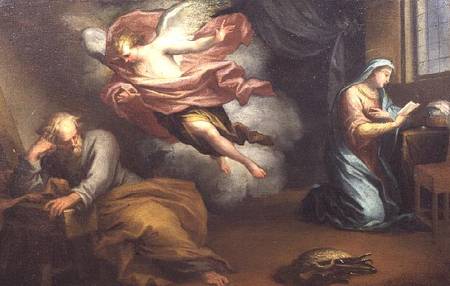
Of course Joseph at first tries to protect Mary – from the shame but then attentive, righteous Joseph is spoken to by an angel through a dream. ‘Joseph, son of David, do not be afraid to take Mary as your wife, for the child conceived in her is from the Holy Spirit. 21She will bear a son, and you are to name him Jesus, for he will save his people from their sins.’ Joseph, son of David – Joseph is announced as part of that Righteous branch of David that Jeremiah spoke of, the faithful Remnant. And he is given work to do ‘Do not be afraid to take Mary as your wife’ You Watch over her – and a tremendous privilege – and you will name him ‘Jeshua’ – which literally means God Saves. And BECAUSE he IS righteous, because He is Attentive and desires Only to do what God desires of Him, He Is Obedient.

When Joseph awoke from sleep, he did as the angel of the Lord commanded him; he took her as his wife, . . . and he named him Jesus.

Exemplifying the obedience that comes through faith of which Paul speaks as he introduces the Gospel of Jesus Christ, The Obedient One, The Righteous One. And this is why as we draw ever so close to the birth of Christ, we rejoice and give thanks for Joseph and Mary – who are chosen for faithful obedience, and pray for the grace to be similarly God attentive, and obedient to what He requires of us – to his eternal glory. Amen

Sermon for Sunday Evening, 17th November 2013 – ‘Daniel in the Lion’s Den’

‘His mercy is on them that fear him, throughout all generations’

Jesus puts a high premium on childlikeness – indeed he goes so far as to say that only the childlike can enter the Kingdom of Heaven. Childlikeness has many dimensions, which as the father of five I know all too well – and not all of those things which make up childlikeness are comfortable to live with. In particular the child’s Perception, their clear sightedness. They may not understand the world – but they clearly see it! As embarassed parents can only too well testify. Indeed if you really want to know the truth about an adult, ask their offspring. How often have I known children who have seen their parents far better than their parents see themselves – and indeed I’m sure this is true of me also. I’m frequently reminded of some of my deepest flaws by my children.

This is unsettling. It is Not the way we largely assume things are. We assume that as we get older we see better, that we understand more clearly – yet in truth what we often do is to Rationalise, to ignore so much of what we See in order to make those judgements which keep us secure in the worlds we carefullly construct for ourselves. We mistake knowledge for Wisdom,  a few facts for genuine insight. As we age we trade clarity of Vision with all the confusion this brings for ‘Answers’ a form of Security against the Overwhelming nature of Reality, of Light and of Life. We trade deep encounter with Life for what we sense is Power over it. And we mistake our power for maturity. Because we can drive a car, or do higher mathematics we assume we have as it were developed into something better. We smile at childrens’ insights but have lost our way, substituting power and Mastery Over life, for Wonder, Awe and indeed genuine ‘fear’ in the deepest sense of profound Respect for all that Is – that which children apprehend all too well.

This is of course not only true for us as individuals, it is also true for societies. I remember once spending a day with a colleague and friend walking the hills of the Lake District. John, my friend had one of those enviable physiques which meant he just kept going and on the day in question we’d walked nearly 40 miles over the highest hills in England, so as we descended into the valley of Borrowdale it was dark. Without torches the tiny hamlet of Seathwaite beckoned and I cried out – “Ah! Civilisation!” John without a moment’s hesitation replied- “I wouldn’t call it that”.
Not that he longed for the big city lights. No John had worked as a mission teacher for many years in Malawi. Apart from a charming Zambian wife, he’d returned with a deep apprehension of reality having been immersed in life in a way that comfortable modern westerners have never known. He’d only ever had two shirts whilst working in Malawi. One in the wash and one to wear. And that, had been luxurious living in the eyes of some folk amongst whom he lived – but on his return to the UK, he didn’t buy any more, unless they wore out. He didn’t take Western Civilisation’s own story of Advancement and Maturity as self evidently true. For him, the culture he had left, for all its privations was far more Grown Up. Wisdom flourished in amongst the harshness

Mistaking Power for Maturity, Knowledge for Wisdom we might look at this evenings reading from the Book of Daniel – ‘Daniel in the Lions Den’ as we like to call it – and declare “That’s all nonsense for babies!” “Why?” we might think “are we advanced sophisticated mature folk sat here at Choral Evensong, a place for the cultured in the church 🙂 , listening to what we’ve been taught to think (and unless we learn to think we will always be taught to think, unthinkingly) – what we’ve been taught to think are children’s stories?

Those of you familiar with the Narnia books may have recognised that expostulation – “That’s all nonsense for babies!” It comes from Prince Caspian, where the young Caspian is in conversation with his Uncle, Miraz, King of Narnia. Miraz wants to prepare Caspian for ‘the adult world’ – like so many adults, fearful of vulnerablility he projects that fear onto those weaker ones around him – but Caspian is not weaker in one vital respect – that of imagination. Whilst Miraz is encouraging his young charge to learn the way of Horse and Sword, Caspian wonders out loud – [quote from p42-3] – “Oh, but there WERE battles and adventures in the Old Days” and there was much more. Miraz, the adult has taken away from what was the Terrifying Wonder of all that is – and reduced it to a set of skills for getting on in the world – for controlling it
Miraz in his Anger – and how we bully children with our anger – finds out that Caspian’s Nurse has told him these tales. So the nurse – the symbol of childhood is sent away and a Tutor, the symbol of knowledge is employed in her stead – except that unbeknownst to Miraz – his tutor is a dwarf. And in secret he tells Caspian the truth – that Yes, the Old times were as his nurse had told him, but it was his own people, the Telmarines, who had [Quote p50.]

CS Lewis was accused by those who knew him and many who didn’t of doing precisely what Miraz scorned – the Narnia Chronicles seen, as they largely still are as ‘stories for babies’ – at the best somewhat clumsy allegory for the Christian story. Yet in this passage Lewis subtly answers his accusers 🙂

And there are powerful parallels between Lewis’ work and the book of Daniel. Not least in that both are subtly written to Reveal a world of breathtaking richness and yet simplicity, a world which we apprehend in experience and then fearfully and tentatively seek to understand, without reducing it out of fear. So we come to Daniel and this tale, a tale for our times – not because we perhaps live in an age where ‘the end of the world’ is perhaps something towards which one need not be thought mad to envisage – but because Apocalyptic is primarily a Revealing of the Reality of things, it is a tale for all times

For what is unveiled is the arrogance and the blindness of so called ‘Mature Civilisations’. ‘Grown up’ Worlds we create through our own power rooted in fear –  the brutal power of a world where we think we understand pretty much what is going on, and act as authors of our own lives. [A reason why we should be far more critical of Science than most would begin to allow – but for another time] In this essentially Secular world, created by Emperors, are thrown Daniel and his three friends – in some traditions interestingly referred to as children . . .

Firstly we note the huge historical sweep of this book. It teaches us – Empires come and Empires go! When Daniel and his friends are first brought from Jerusalem to Babylon Nebuchadnezzar Rules – and his Power appears to be absolute – he appears to have power over life and death throwing the three friends into the fiery furnace. It is he who demands that his courtiers not only tell him the meaning of his dreams but the actual dream itself! But Nebuchadnezzar is brought low – he is utterly humbled.
Of course we might think we live in a different time, but still the powers that be exercise the power of life and  death. Multinational corporations and Governments conspire to take decisions which lead to the death of many. Just this week it has come to light that Nestle has used its economic muscle to buy up lakes for bottling its water to sell to wealthy westerners – the lakes are in Pakistan – where annually thousands die for lack of clean water. Indeed such ruthless power is now written into international law . . . But Nebuchadnezzar IS brought low . . .Then his Son Belshazzar takes to the throne and holds the famous feast with the writing on the wall – the feast where he has thought nothing of the Sacred things of the Jerusalem temple and has drunk from them – so comes the writing on the wall. and overnight in sweep the Medes and Persians, and Babylon falls. It does not recognise the Sacred . . . a message for our times if I ever heard one. Finally comes Darius King of the Medes and Persians

Note that Daniel has been a fixture throughout all of this – Emperors and their Empires rise and fall – but the Word of the Lord embodied in the Prophet Daniel abides. Immediately we see how the text calls into question our vision of the way the world is – it invites us to see Empires rising and falling – they come and they go – they are as nothing. How the Empires of this world Consume our vision with their promises of being ‘everlasting Kingodms – bringing endless peace and prosperity! My forebears grew up and went to school where the Dominant colour was Pink – The British Empire stretched out across the globe – yet that Empire had passed by about the time New Zealand was being settled by Europeans – Over the past 150 years The American Empire has been seen to dominate world affairs. The American Vision for the world being espoused like the Pax Britannica and the Pax Romana before it as one of prosperity and peace for all – but now we see the clay feet of that ‘civilisation’ as China powers forward, if only perhaps for a brief while. Empires come and Empires go, and the message of Daniel is that they are as nothing. All of them confusing Power for maturity. Ignoring the one who dwells amongst us in Humility and Truth

Darius is like the ‘adult’ – he has enough knowledge to imagine he controls things – but he is trapped in his own conceit – as are all Emperors. From within the world as he sees it he reigns Supreme – he seems to have absolute power, so when the satraps and Presidents come to him in an attempt to trap Daniel, he sees it as not at all unreasonable that people should be required to pray to Him above all gods or people. He sees himself as the centre of the Universe. After all he has built a life for himself – a gilded life, like so may of our contemporaries – but it is a cage, albeit a gilded cage. The only security against the reality of Life is a prison . . .

So Darius is undone. For all he has is his own power – he sets the Law ‘the law of the Medes and the Persians, which cannot be revoked.’ When The Emperor declares a Law, it is the Law! He is trapped in the world he has made for himself and so, like others in scripture who foolishly bind themselves he is trapped by the internal logic of the world he has made for himself lIfe – Daniel MUST be thrown to the Lions

But Daniel is a child before Darius – he is as one who sees – he sees the Empires are but dust – he has seen two Emperors come and go – he has seen a new Empire rise – but in his dreams, his foolish dreams – he has seen these empires themselves turn to dust. The Emperor is not the one who rules over all – he is not the one who grants Life – Although Daniel knew that the document had been signed, he continued to go to his house, which had windows in its upper room open toward Jerusalem, and to get down on his knees three times a day to pray to his God and praise him, just as he had done previously. Yes Daniel Saw – like a child seeing an adult he saw the deeper reality of the world of Nebuchadnezzar, and Balshazzar, and Darius – he Saw the reality of Empires – and he saw that they were but men, that all the Empires have clay feet – and he SAW God, before whom all these empires and emperors were as nothing – even though it might lead to his death, he would Live in the Truth of the vision of God. And so he went three times a day to pray . . . and God heard his prayers and rescued him from the jaws of death itself

Jesus is the one who comes before us in childlike humility and utter vulnerability – day by day he preached his very being – day by day he spoke Words which gave life. As with Daniel, the presidents and satraps, or the Pharisees and Herodians, plotted – they took Him before the Imperial throne in the person of Pilate – and sent him to his death – but no power could hold him. His Life is Life.

Jesus taught them a parable – his Life giving word was given to all an sundry – some had no ears for it – some received it with joy, but the business of saying no to the Powerful apparently all encompassing stories proved to hard, when trouble or persecution came, they withered – some was just overcome because it tried as it were to have it all – the cares and worries of this world – the lure of the good life held out to us crowds it out . . . but as for what was sown on good soil, this is the one who hears it and understands it, who like a child is captivated with wonder and awe and deepest fear or respect for the Life it sees in Jesus – ‘His mercy is on them that fear him, throughout all generations, all empires, all ages . . . the word of the Lord stands forever’ Amen