Receive the Holy Spirit – Sermon for Easter 2, 2015

Sermon for Easter 2 -2015

Acts 4:32-35
1 John 1:1-2:5
John 20:19-31

‘Receive the Holy Spirit . . .’

‘the whole group of those who believed were of one heart and soul, and no one claimed private ownership of any possessions, but everything they owned was held in common. With great power the apostles gave their testimony to the resurrection of the Lord Jesus, and great grace was upon them all’

As I’ve said on occasion, those who set the lectionary readings for Sunday at times refuse to treat the Church like adults, carefully chopping out passages which may offend our sensibilities and in the process infantilising the church. Well that hasn’t happened today, although if we were to attend to what we heard perhaps it might call into question the reality of our faith andn common life . . . but this reading from Acts comes immediately before a reading you will never hear on a Sunday, that is the story of Ananias and Sapphira. No sooner have we heard of the revulutionary life of a community which is filled with the Life of God, than we are told of a couple in the church who chose not to live out of that Life of God.

They too sell a piece of property but choose to deceive the church and suggest that they have given the Church all that they have. Having received the forgiveness of sins and Gift of the Holy Spirit in the name of Jesus, they choose to continue to live in the old life of sin and deceit. Except, as our Easter liturgy dramatically announces ‘The Age of Sin is Dead’ – . One after the other they lie to the Apostles, and one after the other they drop down dead.

As we said last week it is the events of that first Easter day which should be far far more troublesome to us than those of Good Friday. The world is a world of endless Good Fridays – there seeming to be no other way. The Life of God and With God we thus put off until after we die – the message of Easter is as it were put off until we complete the cycle of Good Fridays. Nothing is disturbed if the Life of God is for after our earthly bodies expire. But that is not the case.

As St John puts it We declare to you what was from the beginning, what we have heard, what we have seen with our eyes, what we have looked at and touched with our hands, concerning the word of life— 2this life was revealed, and we have seen it and testify to it, and declare to you the eternal life that was with the Father and was revealed to us— 3we declare to you what we have seen and heard so that you also may have fellowship with us; and truly our fellowship is with the Father and with his Son Jesus Christ.

The Church has but one proclamation, Life in the name of its Risen Lord Jesus in the power of the Holy Spirit. This Life has been revealed and it is the testimony of the Church, n word and action. The Church has no business living out of anything else, for she has discovered that there is nothing else to live out of, but the Life which is made known to us in our Risen Lord

5This is the message we have heard from him and proclaim to you, that God is light and in him there is no darkness at all. 6If we say that we have fellowship with him while we are walking in darkness, we lie and do not do what is true; 7but if we walk in the light as he himself is in the light, we have fellowship with one another, and the blood of Jesus his Son cleanses us from all sin.

Everything else is darkness and death – and here we must gently but firmly insist on one thing, that God is Light and in him there is no darkness at all – we know what is Good and True and Beautiful only in so far as we have fellowship with the Father and with His Son Jesus Christ. THis is Life – all else is darkness and death.

Which is why Ananias and Sapphira disappear so dramatically from the story of the early church. They choose death rather than Life – they elect to walk in darkness and deceit, a life which has been declared Death by the resurrection of Jesus. In what we are confidently told over and again is a world of infinite choice, a story which is steering all of creation into destruction – the Resurrection of Jesus reveals the One Way – there is the Life of God and nothing else, all else is death

So we live in the lIght which means complete light regarding ourselves – no longer living in the self deception of saying we are without sin – freely confessing our sisns one to another, living in the Light of Christ, not the darkness of self deception. Those who live in fear of being known fully for who they are still do not know the Love of God in Jesus Christ for His Love drives out all fear. 8If we say that we have no sin, we deceive ourselves, and the truth is not in us. 9If we confess our sins, he who is faithful and just will forgive us our sins and cleanse us from all unrighteousness. 10If we say that we have not sinned, we make him a liar, and his word is not in us.

The endless Grey of Good Friday is dispersed by the Light of the Risen Christ, brighter than a million suns burning with full force. Darkness flees in his presence, there is only Life. All else is Death.

And so Jesus comes to his disciples, to cast out Fear “Peace be with you.” 20After he said this, he showed them his hands and his side. Then the disciples rejoiced when they saw the Lord.

And then commissions and empowers them to Walk in the Light – empowers, not force. There is no Coercion in Love. Life has been revealed but Death is still  choice “Peace be with you. As the Father has sent me, so I send you.” 22When he had said this, he breathed on them and said to them, “Receive the Holy Spirit. 23If you forgive the sins of any, they are forgiven them; if you retain the sins of any, they are retained.”

Receive the Holy Spirit – now that which Sin made impossible for you I make possible. humanly speaking who can forgive Sin but God alone? Receive His Life – and Live out of it! Whosoever Sins you forgive they are forgiven! As the Son of Man hath authority of Earth to forgive sins, so those who Live His Risen Life are also empowered so to do . . . but it is choice – it is not coercion.We can still choose death ‘Whoseover sins you retain, they are retained’

God in His superabundant mercy has freely given us all things – to hide, to live in the dark, to choose not to sell what we have for the sake of the hungry, those are our choices, the Way of Life and the Way of Death having been put before us. The early church full of the Spirit knew no poor amongst them, for whenever someone saw someone else in need and had the means to feed clothe did so. As John puts it elsewhere in his letter How does God’s love abide in anyone who has the world’s goods and sees a brother or sister in need and yet refuses help?

And of course it is obvious. Someone is hungry, we have the means to help and we do not – we are clearly outside of the life of the God who superabundatnly and freely hath given us all things. There is no more dangerous myth to the health of our souls perhaps than ‘I have earned all I have’ and those weasel words  ‘I did what I could . . .’ no – God has put it into our hands and we are utterly responsible to Him for it. As St Vincent de Paul puts it – when we give to the poor we do not do so with any sense of ‘doing good’ but rather asking their forgiveness for having closed our hearts against them.

There is no worse understanding of Spiritual than that which is not rooted in the Holy Spirit – the Life of the Living God made known to us in Jesus Christ. Jesus the Son breathes the third person of the triune God into us – the Divine Life. This is no warm glow feeling, no mountain top experience – this is the very life of The Living God who has called everything into existence who is the source of all that is Life, before whom even the nations are as grasshoppers, His Life!

So too the frequent warnings about forgiveness – ‘if you do not forgive your brother or sister from your heart, God will not forgive you’ – Jesus in giving his Life and breathing upon us the Holy Spirit – releases the forgiveness of God into the world – ‘Father forgive them for they do not do what they are doing. We in mercy freely forgive all people for everything – but we are not robots – we are still responsible agents. We receive the Holy Spirit in fear and trembling – this is why it is SO important that we are truthful about our own sinful condition – for it is that which will cause our downfall. If we hear the words of Jesus ‘Whoseover sins you retain, they are retained’  and think anythiong other than ‘Why on earth would anyone retain the sisn of another – why on earth would one not forgive??’ we are in mortal danger. Because LIFE has been set free in the Resurrection of Jesus and the world is not as it was

The Resurrection of Jesus means that at last, Life is Loose in the world. We as those who are indwelt by the Spirit KNOW that we can only live in this life – that all else is death.

Freely you have received
Freely Give
Lent Course 4 – The Jesus Prayer – We do not know what we are doing / The Jesus prayer as the culmination of prayer

A Lent course – for St John the Evangelist, Roslyn

Praying in the Name of Jesus

‘The Jesus Prayer’

  1. We do not know what we are doing

The Jesus prayer as the foundation and culmination of prayer


Then Peter, filled with the Holy Spirit, said to them, ‘Rulers of the people and elders, if we are questioned today because of a good deed done to someone who was sick and are asked how this man has been healed, let it be known to all of you, and to all the people of Israel, that this man is standing before you in good health by the name of Jesus Christ of Nazareth, whom you crucified, whom God raised from the dead.

This Jesus is

“the stone that was rejected by you, the builders;

it has become the cornerstone.”


There is salvation in no one else, for there is no other name under heaven given among mortals by which we must be saved.’

Acts of the Apostles Chapter 4 vs 8-12

“Lord Jesus Christ, Son of God, have mercy on me”

Lent is perhaps one of the most helpful seasons to us in discerning our predicament, that which calls us to cry out ‘Lord Jesus Christ, Son of God, have mercy on me’.

For Lent is not a season which can readily be hijacked by our Passions, those desires of which we learned briefly last week, which have been distorted so that their focus is not God, but ourselves. Lent, doesn’t attract, and in this world where ‘everything and everyone has their price’ it is (almost) impossible to commercialise. Like our Saviour, there is nothing in Lent’s appearance that we might desire it . . . yet we notice two trends. Firstly that the classical disciplines of Lent, that is those rooted in The Tradition, have all but disappeared. ‘Fasting’ is largely reduced to ‘giving up things’. Recently someone told me of all the things they were giving up, and after a moments reflection said ‘I suppose that none of them are things I should have picked up in the first place’! In itself a lesson

Secondly that giving things up has been replaced by picking something up . . . and yet Lent was always a time for both. We fasted AND prayed AND gave alms. And we might note, like perhaps giving up things that we shouldn’t have picked up in the first place, these things we pick up are perhaps those things in which we should be engaged all of the time – feeding the hungry, clothing the naked, visiting the lonely.

These practices of Lent should take root, change us – better ‘HEAL us’. It is after all a time for that most fundamental changes Repentance which is the Heart of the Jesus prayer, it is our responding to his presence and his command to ‘take up our mat and walk’. But what does that repentance mean? Why is the continual praying of the Jesus prayer understood as so central to that?

[Jean-Claude Larchet says this of The Jesus Prayer ‘[it] occupies an essential place in Orthodox spirituality and is considered as the most complete form of prayer, containing the qualities of all other forms of prayer. the Fathers designate this type of prayer as prayer in the strict sense, setting it above the other forms of prayer and, notably, above psalmody. . . Yet, a the same time as occupying the apex of spiritual life, this prayer appears as one of the latter’s foundations and as one of the principal means that allow man, by God’s grace to be purified of his sins and healed of his passions and to acquire the virtues. As SS Callistus and Ignatius Xanthopouli state, it is “the beginning of the whole beloved work of God” ’][1]


Let us take a moment to consider a well known, but perhaps oft misunderstood passage of scripture.

Now as they went on their way, [Jesus] entered a certain village, where a woman named Martha welcomed him into her home. She had a sister named Mary, who sat at the Lord’s feet and listened to what he was saying. But Martha was distracted by her many tasks; so she came to him and asked, ‘Lord, do you not care that my sister has left me to do all the work by myself? Tell her then to help me.’ But the Lord answered her, ‘Martha, Martha, you are worried and distracted by many things; there is need of only one thing. Mary has chosen the better part, which will not be taken away from her.’


What is drawn to your attention?


One or two points to note


  • Martha welcomes Jesus into her home. The home may stand as a metaphor for life or heart. Indeed we often use the language of ‘inviting Jesus into our life’ – but why? Why do we ask him in? And perhaps more importantly ‘Who is He anyway?’


  • Martha embodies us all – not in her busyness per se, but in her ‘distractedness’. Where is our attention? Caught up in Our Life?


  • Mary embodies discipleship which is a giving of her total attention to Jesus. In this she is like say Bartimaeus – who is intent on One thing [Note that Bartimaeus, once healed, unusually follows Jesus] Mary we might say ‘sees who Jesus is’


The method of the Jesus Prayer is to bring the distracted head, into the heart. to this end some people use certain postures and breathing techniques when praying the prayer, but these are not recommended without the accompaniment of a staretz. Through our baptism, Christ dwells in our hearts. Through the praying of the prayer we are to make find our home in him, and thus find our true home.


Lent, in stripping away those distractions which we use to insulate us from the presence of God in Jesus, awakes us to SOME of the sense of our predicament. As we noted previously, not all of it, for we would not survive the revelation, but enough to be going on with. And this stripping away is of urgent necessity. For we do not know what we are doing. We are largely unconscious in the most profound sense. And that lack of consciousness is compounded in the Western tradition where we have reduced sin to an individualised moral disorder. Like children we say ‘I didn’t do it!’ Jesus said, ‘I came into this world for judgement so that those who do not see may see, and those who do see may become blind.’ Some of the Pharisees near him heard this and said to him, ‘Surely we are not blind, are we?’ Jesus said to them, ‘If you were blind, you would not have sin. But now that you say, “We see”, your sin remains.


Two others also, who were criminals, were led away to be put to death with him. When they came to the place that is called The Skull, they crucified Jesus there with the criminals, one on his right and one on his left. Then Jesus said,

‘Father, forgive them; for they do not know what they are doing.’


Jesus, we will remember in his dialogue with the wealthy young man, says, ‘Why do you call me good? Only God is Good’. Yet we remember that in the beginning


God saw everything that he had made, and indeed, it was very good.


In the first week of this study we used the imagery of Resonance as Life in its fullness. That when we are truly Well our lives resonate with the Love and the mercy and the forgiveness and indeed the very Glory of God – as does the whole creation. St Paul reminds us that Our place in the Creation is of great significance when he says ‘ I consider that the sufferings of this present time are not worth comparing with the glory about to be revealed to us. For the creation waits with eager longing for the revealing of the children of God; for the creation was subjected to futility, not of its own will but by the will of the one who subjected it, in hope that the creation itself will be set free from its bondage to decay and will obtain the freedom of the glory of the children of God. We know that the whole creation has been groaning in labour pains until now; and not only the creation, but we ourselves, who have the first fruits of the Spirit, groan inwardly while we wait for adoption, the redemption of our bodies. For in hope we were saved. Now hope that is seen is not hope. For who hopes for what is seen? But if we hope for what we do not see, we wait for it with patience.’


If we might join for a moment in an act of imagining – a vast structure of beautiful glass threads, encompassing and threaded through out all of creation, such that as some uncreated Light reflects and refracts in and through, there is a glorious brilliance of colours and lustre beyond any human artifice. Such beauty as we cannot begin to comprehend, although we may have ‘seen’ a slight echo of it, seeing a view that ‘took our breath away’.


These glass threads or strings are not still, but as they are beautiful to behold, marvelously they also vibrate Sounding a symphony the like of which we have never heard but perhaps once again we have ‘seen’ the merest reflection of when caught in an ecstatic moment listening to a great orchestra.


And Knowing that in this Everything is related to everything else through the beating heart of it all – All resonating with One Life


This is the Goodness of the Creation – filled with the Glory of God . . . and then there is the human condition set out in the Passions[2] – wishing as it were to take it to ourselves, without any ‘Sense’ of who or what we are – like wild bulls let loose in a shop selling the most exquisite Limoges. We do not even know what we are doing, or if we do we push the thought deep down. Our Passions have so overwhelmed us . . . (and now they are on the verge of overwhelming the whole created order.)


But . . . let us return for a moment to Martha. Her condition is also ours. She is distracted, and she does not realise who Jesus is or where she is – thinking herself in ‘her house’. When we pray the Jesus prayer we are bringing our distracted minds into our hearts – making our way home.


Next Week: Praying in the Name of Jesus. Discovering who we are.

Further reading resources: All of these are accessible and helpful

‘The power of the name’ Kallistos Ware

‘Mysteries of the Jesus Prayer’ : Norris Chumley (The book of the documentary we watched)

And the classic – the book which was responsible for the modern interest in the West in The Jesus Prayer ; ‘The Way of a Pilgrim’

[1] ‘Therapy of Spiritual Illnesses’ Volume II p101. Published by Alexander Press, Montreal 2012

[2] Pride – Vain glory – Sadness – Anger – Fear – Gluttony – Lust – Acedia – Self-love – Love of money

Sermon For Lent 5 – Year B – 2015

Sermon for Lent 5 – Year B – 2015

Sunday March 22nd – St John’s, Roslyn – ‘Week in Community’

Jeremiah 31:31-34

1 Cor 12:20-26 (Alternative Reading)

John 12:20-36

While you have the light, believe in the light, so that you may become children of light.

John 12:36

So here we are, gathered together at the start of our Week in Community. A week in which we spend time considering the nature of our Life Together – Life Together. And what a great place to start: St Paul gives us a beautiful image of that Life Together in the language of The Body of Christ – where ‘If one member suffers, all suffer together with it; if one member is honoured, all rejoice together with it.’ A body in which ‘the members of the body that seem to be weaker are indispensable, and those members of the body that we think less honourable we clothe with greater honour,’. How different from the World.

Many people nowadays have fallen prey to the idea that humankind is on some kind of evolutionary path – even within the household of faith we hear this talk, echoing the false confidence of the late 19th Century in Europe. There is nothing new under the sun when it comes to heresy. Yet Evolution, with which I have little argument as a scientific theory, works like this – Survival of the fittest, and the devil take the hindmost. If you are weak, you won’t survive – and however we dress up the World using the language of Civilisation, this is the underlying narrative of society, not ‘the weaker are indispensable and treated with special honour’. In the early years of the Church, the Emperor Julian broke into a Church demanding they show him their treasures. He was shown to a room where the hungry were being fed

I was particularly struck by the conflict between the Life of the Gospel and the life of the World in our Tuesday discipling group, where we were confronted by the Beatitudes. Those opening verses of the Sermon on the Mount. Jesus – seeing the crowds walks up the mountain. We might imagine Moses ascending Sinai, leaving the Israelites behind – but in this case Jesus is followed, by his disciples. They come out from the crowd. And then Jesus, rather than receiving Words from God, sits down. He adopts the posture of the Rabbi. He Sees in the foreground his disciples, then further off the crowd – and the Greek text is unusual at this point. It says ‘he opened his mouth and spoke’. A most unusual construction. The Greek might have easily said, he began to teach them, but it says ‘he opened his mouth’ And so there on the mountain he opens his mouth and from it comes the words of God. ‘Blessed are the poor in Spirit, for theirs is the Kingdom of heaven, Blessed are those who mourn, for they shall be comforted, blessed are the meek for they shall inherit the earth, blessed, blessed blessed . . .’

Teaching his disciples, in the hearing of the crowd, These are those blessed by God. If you want an example of how the values of the Kingdom of God are utterly incompatible with the values of the world, you need look no further. His disciples come to him – they are separated from the crowd – and here as often with Jesus, there is the offer of Grace in obedience and conformity to the words of Christ, but the possibility of leaving him, dissolving back in to the crowd. The broad and easy way, or the hard and narrow. For living faithfully as the Church, as the Body of Christ it is not possible to at the same time live in the world without severe trial and conflict. Trials and conflicts from which we have been insulated for many years, but which now are becoming much clearer. As the disciple body we stand between Jesus and the crowd – they see us, we see them. It is not a comfortable place to be, to be part of a community which adheres to a way of living, a Life Together which is in complete conflict with the World around us – and to fall neither into pharisaical condemnation of the World, for we know our status as sinners also, yet not to succumb to the temptation to melt back into the world, as so many do without hardly thinking about it. Mourning for the World and the path it has chosen, but not condemning. Poor in Spirit, knowing our only treasure to be Jesus Christ, for whose sake we have left everything . . .

And I think of those institutions which seek to work ‘Christian values’ into their life, but what place do such values have in the World in which we live? The way of the world wins out again and again. And humanly speaking that only leads to the sort of hopelessness, the fruit of which we see around us in despair or its fruit, mindless hedonism. The Way of Jesus is not ‘one thread in the rich tapestry of Life’, it Is Life. Life in its fullness, and the secret of the Church is the eternal life in our midst.

In fact it is such a secret that all too often we forget it ourselves. That is why through Lent we have been learning the practise of praying continually ‘Lord Jesus Christ, Son of God, have mercy on me’, for like Martha we are readily distracted into thinking we might make a life for ourselves and then at the end present it to God, as a child presents their first painting, yet all the while God in Jesus is sat in our midst, offering his life to those who sit at his feet. Which is why we begin this week in prayer and Word and Sacrament. We pray in Christ Jesus, We listen to the Word of Jesus, We receive Christ in Bread and Wine

Our gospel passage finds us as it were at the end of the beginning of the gospel – a turning point. Now among those who went up to worship at the festival were some Greeks. They came to Philip, who was from Bethsaida in Galilee, and said to him, “Sir, we wish to see Jesus.” So many have followed after Jesus wanting Bread, or healing of their physical infirmities, or justice in their suits with their siblings – NOW comes some who seek Jesus, for Himself. Greeks – proselytes probably – going up to the Temple to worship, but wanting to see Jesus. John does not tell us what happens to them – he wants us to hear those words, ‘we want . . .’ ‘We want . . .’ What do we want? What do we seek after here as the followers of Jesus in this place and at this time? What is the desire of our heart as the body of Christ at St John’s? This is the question Christ asks of us, every day, every week, and a question we must ask of ourselves. In our conversations these coming days it is perhaps worth holding that question in the back of our minds all the time ‘Are we looking for Jesus, or are we looking for the things of Jesus?’ ‘Do we desire God’s gifts or the Giver?’ God looks at the heart – what are we seeking after?

For if we are seeking after Jesus, let us hear his words clearly – . ‘Blessed are the poor in Spirit, for theirs is the Kingdom of heaven, Blessed are those who mourn, for they shall be comforted, blessed are the meek for they shall inherit the earth, blessed are those who hunger and thirst for righteousness for they shall be filled. . .’ Hear his words ‘Very truly, I tell you, unless a grain of wheat falls into the earth and dies, it remains just a single grain; but if it dies, it bears much fruit. Those who love their life lose it, and those who hate their life in this world will keep it for eternal life. Whoever serves me must follow me, and where I am, there will my servant be also. Whoever serves me, the Father will honor’

The disciples coming out of the crowd, the Greeks seeking Jesus – the Gospel’s Grace filled, and utterly merciful contradiction of the World becomes clearer and clearer. The contrast – Light and Dark – harder to ignore. And as those disciples must surely have felt the pull, to sink back into the obscurity of the crowd, so too at these times in the Life of Jesus, people fall away, notably of course at the Cross itself.

But on an earlier occasion – when Jesus had spoken of his flesh as real food and his blood as real drink, and in the Light of this revelation, many of his disciples stopped following him, Peter once more spoke what might have seemed to him to be a desperate truth, but Truth all the same. So Jesus asked the twelve, ‘Do you also wish to go away?’ Simon Peter answered him, ‘Lord, to whom can we go? You have the words of eternal life. We have come to believe and know that you are the Holy One of God.’ Jesus answered them, ‘Did I not choose you, the twelve? Yet one of you is a devil.’ Even as others have gone the door is open to disappear into the dark, but Peter names the truth, ‘Lord to whom can we go? You have the words of eternal life’

May God in his inifinite Love and mercy kindle that same conviction within us in this coming week, may we seek all the more with the Gift of this Light believe in the light, so that we may become children of light.’ And that more and more the Life of Jesus is known and revealed amongst us His Body, in our Life Together.                                                                    Glory to Jesus Christ Glory for Ever

Lent Course 2 Praying in the name of Jesus – The Jesus Prayer. Jesus and Healing

A Lent course – for St John the Evangelist, Roslyn
Praying in the Name of Jesus
‘The Jesus Prayer’
2. Jesus and healing. Sin and Salvation.

Then Peter, filled with the Holy Spirit, said to them, ‘Rulers of the people and elders, if we are questioned today because of a good deed done to someone who was sick and are asked how this man has been healed, let it be known to all of you, and to all the people of Israel, that this man is standing before you in good health by the name of Jesus Christ of Nazareth, whom you crucified, whom God raised from the dead.
This Jesus is
“the stone that was rejected by you, the builders;
it has become the cornerstone.”

There is salvation in no one else, for there is no other name under heaven given among mortals by which we must be saved.’
Acts of the Apostles Chapter 4 vs 8-12

“Lord Jesus Christ, Son of God, have mercy on me”
First – a song 

(‘Lord, I want to be a Christian’ The Proclaimers)
And so we are working from the assumption that we want to be Christians from our hearts – although with St Theresa we may well acknowledge that that desire is at best a weakly flickering candle, if not a barely smouldering wick. Whilst the Spirit may be (barely) willing, the flesh is weak. Whilst our desire might be to Love, the words of St Paul resonate “I can will what is right, but I cannot do it. For I do not do the good I want, but the evil I do not want is what I do.” Romans 7:18-19
Perhaps we might cavil at the word ‘evil’. After all we live in a society which locates ‘Evil’ out there. The ancient practise of scapegoating is alive and well. Societies need ‘Evil’ people in order to locate ‘Evil’ anywhere but where it resides, in us all. [A good scriptural example of this is The Gerasene demoniac. He is possessed by a Legion of demons, but when he is healed, Jesus the healer is driven from their society . . . or Jesus the scapegoat?]
We also spoke last week of Resonance. Of how God’s intention for all Creation, renewed in Jesus Christ is that it Resonates with his Life and his Love. That in and through our lives, He is perfectly revealed and made known within His Creation.
In that we recognise our predicament, we recognise that we are ‘out of tune’, ‘off key’, and we do not recognise the language of the song, as we did not to one degree or other resonate with Kate Rusby’s song. Yet, we often pray as if ‘we knew what was what’.
Here in New Zealand when someone asks how we are, we tell them ‘We are good!’ Recently I was speaking with someone who told me that their grandfather, A Christian man with a feel for these things would not take that for an answer, responding “You are not good, you are well!”, but the truth is that we are not even well. Actually if we were well we would be good. So we cry out
“Lord Jesus Christ, Son of God, have mercy on me”
This ancient prayer has its roots in the address of so many of those whom Jesus met – yet one might note that it is never heard on the lips of those who plot his destruction. It is the prayer of those who recognise be it ever so faintly that they are not well and that Jesus the healer is in town.
When Jesus returned to Capernaum after some days, it was reported that he was at home. So many gathered around that there was no longer room for them, not even in front of the door; and he was speaking the word to them.
Then some people came, bringing to him a paralysed man, carried by four of them. And when they could not bring him to Jesus because of the crowd, they removed the roof above him; and after having dug through it, they let down the mat on which the paralytic lay.
When Jesus saw their faith, he said to the paralytic, ‘Son, your sins are forgiven.’ Now some of the scribes were sitting there, questioning in their hearts, ‘Why does this man speak in this way? It is blasphemy! Who can forgive sins but God alone?’
At once Jesus perceived in his spirit that they were discussing these questions among themselves; and he said to them, ‘Why do you raise such questions in your hearts? Which is easier, to say to the paralytic, “Your sins are forgiven”, or to say, “Stand up and take your mat and walk”?
But so that you may know that the Son of Man has authority on earth to forgive sins’—he said to the paralytic— ‘I say to you, stand up, take your mat and go to your home.’ And he stood up, and immediately took the mat and went out before all of them; so that they were all amazed and glorified God, saying, ‘We have never seen anything like this!’

What do we notice in this passage? What catches our attention?


Some points to consider
o The Crowd – a sign of the evil that seeks to smother Jesus throughout Mark – eg Mark 5:31. The Jesus Prayer is the prayer of the one who wants to be healed – one who may well sense the evil pressing in, and even more, perhaps within.
o Note the order of the healing. Jesus sees deeper. He is aware of our deepest needs in a way we who ‘See’ are not
o The physical healing is a Sign of his authority to forgive sins. The healing which seems to us greater is actually here a Sign. Jesus heals the man physically in order to show that he has authority to make us truly well. The early church over and again refer to Jesus as ‘The physician’, and whilst there are many recorded physical healings, as throughout the gospel account, they are referring to the deeper healing, that from Sin.

But what is the nature of this healing? With the paralytic we are aware of the physical healing, but what is the outcome of the forgiveness of sins?
o Here note the reaction of the scribes ‘Why does this man speak in this way? It is blasphemy! Who can forgive sins but God alone?’ . . .
 Who can? Who is able to forgive sins? Are the Scribes making a purely ‘religious’ response here? How easy is it to say ‘Your sins are forgiven you’? Rather is there not a terrible affront? Being Unable to forgive sins themselves, they separate themselves from God – ‘only God can forgive sins’
 Jesus answer – ‘that you may know that the Son of Man has authority on earth to forgive sins’
We might tend to think, understandably but erroneously, that Jesus natures, human and divine, are separate. That some things he does out of his divinity, and some he does out of his humanity. So, ‘he heals out of his divinity, but walks and eats and suffers in his humanity’ – but this is because we have lost sight of the nature of our humanity – of who we are. Jesus reveals to us who we are.
o the Son of Man has authority on earth to forgive sins. Upon the Cross, God in the human Jesus is forgiving everyone for everything.
o It is natural for the Human who bears the image of God, to forgive sins – it is their true nature. So we pray ‘Our Father . . . forgive us our sins as we forgive those who sin against us’ To forgive is Divine and we are Children of God
o The Risen Christ, the first fruits of the new Creation, restores in us the Divine Image, the Divine Life in which we are to participate.
Jesus said to them again, ‘Peace be with you. As the Father has sent me, so I send you.’ When he had said this, he breathed on them and said to them, ‘Receive the Holy Spirit. If you forgive the sins of any, they are forgiven them; if you retain the sins of any, they are retained.’

Thus if we say with the Scribes ‘Who can forgive sins but God alone? in a sense we are right, but it is a dangerous half truth. For those who bear the Image of God are vessels of God’s Life. The Scribes question is a revealing of their captivity to Sin which prevents them from ‘Loving everybody from their heart’

And for us who are Christians, it is a denial of our Baptism which makes us Children of God. Having been set free from Sin we choose to allow ourselves once more to be taken captive by it

“Lord Jesus Christ, Son of God, have mercy on me”

In some respects our state is worse than at first. Having been set free we have allowed ourselves to be tangled up in Sin anew.

Now as they went on their way, he entered a certain village, where a woman named Martha welcomed him into her home. She had a sister named Mary, who sat at the Lord’s feet and listened to what he was saying. But Martha was distracted by her many tasks; so she came to him and asked, ‘Lord, do you not care that my sister has left me to do all the work by myself? Tell her then to help me.’ But the Lord answered her, ‘Martha, Martha, you are worried and distracted by many things; there is need of only one thing. Mary has chosen the better part, which will not be taken away from her.’

So quickly we jump to make this story something it is not, that is a story about the relative importance of two types of Christian life, the Active and the Contemplative. We are almost asked to decide which we will be, Marthas or Marys. But the meaning of the story does not require such a leap. Mary is paying attention to Jesus, Martha is not. Martha is distracted from Jesus. Martha is upset and worried by many things. We might see her as a figure of one who is tangled up in sin, so much so that she cannot see her own need. Yet notice how Gently Jesus rebukes her

Mary ‘listened to what he was saying’ This event is after the Transfiguration, when the voice comes from heaven ‘This is my Son, the Beloved, Listen to him’

Yes, we should have a childlike relationship with God our Father in prayer, but we can’t remember how to be children, how to be naturally Children of God. As Jesus sees into the deep need of the paralysed man, so Mary sees there is something more important than getting dinner ready. And how often a child seems oblivious to that which the parent thinks is so obvious. Homework to do, and they are captivated by butterflies 🙂

“Lord Jesus Christ, Son of God, have mercy on me”
This week, set aside say five minutes a day – find a quiet place and say the prayer over and again – with attention. Attention to Jesus, Attention to yourself.
Whilst this is a prayer one can pray all the time, if we are going to Resonate, we need to start gently and attentively. A ‘space’ in which to do this is helpful.
It is not recommended to go beyond this for now, especially if we are starting out

Next Week: A more helpful understanding of sin. We do not know what we are doing. The Passions

Recommended Reading : The Jesus Prayer. Frederica Mathewes-Green
http://www.amazon.com/Jesus-Prayer-Ancient-Desert-Tunes/dp/1557256594/ref=sr_1_2?s=books&ie=UTF8&qid=1424292978&sr=1-2&keywords=the+jesus+prayer

‘Somehow I may obtain the Resurrection of the dead’ – Sermon for the evening of Sunday 15th February, 2014. Sunday next before Lent, Year B

Sermon for Evensong
Sunday next before Lent – Year B

Phil 3:7-21

‘That somehow I may attain to the resurrection of the dead’

Faith as conformity to Christ

When I was at theological college – rather a long time ago – although we had little vacation time, I remember visiting one of my old colleagues from the Catholic High School where I had previously been teaching – even Longer ago!

It had been a hard time for him and his family and as I remember they had just suffered the loss of one of their parents – either his father or father in law. Given that I was training in an institution for priests, he wanted to talk with me about this, but the one arena he was particularly interested in  – I had to admit, I had no knowledge of. He thought that when we were in training, we might be told about what happened to someone after they had died, in more than vague terms e.g. you go to face God/you go to be with your loved ones/you go to heaven/you go to the other place . . .

I had to admit that we hadn’t as it were been let in on some secret knowledge. And until very recently I must admit that I’d ever assumed there existed more than such vague elements of teaching. No details were available, and that was that. Until I stumbled upon a book by a very highly regarded scholar in the Orthodox Church, entitled ‘Life after Death’, and realised that there was a very highly developed teaching in this area which had been prevalent throughout the Church in the first few hundred years of its existence and indeed was still known and taught in fairly small circles to this day – but which continues to shape the practise of Orthodox Christians and their liturgy to this day (Of course Orthodox liturgy hasn’t really changed in any notable way for 2000 years 🙂 )

And I must admit that it gives a very very different view of the matter of death and what happens to YOU, that is to the Soul in the days leading up to, through and beyond death. Amongst other things giving a very well reasoned and highly material defence of the idea that Repentance is not possible post mortem – for as they say and it is obvious when you think about it, Obedience, the fruit or faith and repentance is a bodily process. One feeds the poor, one clothes the naked, one doesn’t sleep with one neighbours wife – all actions or desisting from actions in the body. So, the soul having become disembodied (in the three days following death, the Orthodox church teaches) has no vehicle for enacting obedience and this cannot repent. It is of course nothing more that the development of that old saw, ‘the road to hell is paved with good intentions . . .’

The author also stated something which at first sight is odd, but upon reflection is quite reasonable, that for the Christian, death is far more troubling a prospect than for the atheist or agnostic. Why? Well for those folk, whether anything ‘lies beyond’ is such a matter of subjective speculation – and indeed ‘surely it’s just like falling asleep for ever’, whereas the Christian lives their entire life knowing that there is something else coming up – something of which they have no experience.
Coincidentally, the same friend whom I went to visit posted at almost the same time as the book came into my hands, an article he’d found. It was of an imagined dialogue between two twins in the womb. One was convinced that there was something beyond – that there was a ‘Mother’ whose life sustained them, and that one day they would pass into a completely different form of existence and ‘see her’ -the other dismissed this all as nonsense 🙂 Which if you think about it is a striking parallel!
As more than a few saints have reminded us, preparing for our deaths is the work of a lifetime . . .

Certainly for Paul, he doesn’t look towards his death and the Resurrection of the dead,  as if it is unproblematic. Listen again to his words : For [Christ’s] sake I have suffered the loss of all things, and I regard them as rubbish, in order that I may gain Christ and be found in him, not having a righteousness of my own that comes from the law, but one that comes through faith in Christ, the righteousness from God based on faith. I want to know Christ [I want to know] the power of his resurrection and the sharing of his sufferings by becoming like him in his death, [that] somehow I may attain the resurrection from the dead.’

the language is all in the subjunctive mood – Paul is stretching towards something that he has not already grasped, as he makes clear immediately ‘Not that I have already obtained this or have already reached the goal; but I press on to make it my own, because Christ Jesus has made me his own.’

Not, note ‘Christ Jesus has made me his own, therefore I can sit back and relax – eat, drink and be merry’, no ‘I press on to make the goal [the resurrection from the dead] my own, because Christ has made me his own.’

Now I hope from this it is clear that Paul’s understanding of the Christian life, and ‘the resurrection of the dead’ is Very different from that of many people – including I might say, many within the church. On the one hand there is much shall we say ‘folk religion’ alive and well in this regard. So, for example, when my Uncle died suddenly in his 40s, I remember my aunt talking about how he was now ‘playing golf in heaven’ with one of his old friends . . . the old ‘we go to heaven when we die line. Interestingly though there are many who scoff at such things and yet display entirely the same almost casual line in regard to their death – what is called ‘easy believism’ To wit, ‘you have repented and prayed the sinners prayer – you will therefore go to be with Jesus . . .’ an approach which we must say refuses to take any note of ‘THIS life’ and its significance, and indeed leaves the door open quite literally to a host of demons.

Paul’s words here certainly must give pause for thought, yet we see within them evidence that he is engaged on this preparation – that his soul has as it were already set sail towards his eternal destination. Just as that child in the womb knows of nothing else – is very comfortable thank you – lives in a world where its comprehension is seldom troubled by the thought that ‘there may be more to life’, so too Paul had lived such a life. Our reading this evening, following on from evening prayer for last night, begins ‘Yet, whatever gains I had, these I have come to regard as loss because of Christ’. What we may ask were these gains, and the answer is – Paul up to the point of his conversion, had had a highly successful life in the terms of his own culture. His life fitted – and fitted well with his surroundings. In its own sense it was utterly Known, it was secure. He was highly advanced in learning and his birth heritage was impeccable – ‘circumcised on the eighth day, a member of the people of Israel, of the tribe of Benjamin, a Hebrew born of Hebrews; as to the law, a Pharisee;  as to zeal, a persecutor of the church; as to righteousness under the law, blameless.’ In the terms of the day, he had ‘lived a good life’. Yet his encounter with the Risen Christ on the road to Damascus had left all that in tatters. One minute he knew what was what, and the next  . . . well his entire understanding of things lay in tatters

Paul of course is understood as ‘the prototypical zealous convert’ – yet his zeal is marked by this deep deep sense, not that he has now ‘got it all sorted out’, rather that there is something which he must pour all of his life into. He is like the woman who lost the coin and is now engaged in sweeping the house from top to bottom to find it, or the man who finds treasure, but knows he must now sell all he owns to buy the field wherein it lies. He is to use a somewhat overused word, now on a ‘journey’ – yet he has a profound sense of his direction. Not to a knew set of ideas, he has as it were all the information he needs – his destination – yet not a place, or a particular expertise be it philosophical understanding or moral accomplishment – he is not trying to get somewhere or to complete some study so that he might be declared a master of the topic. Indeed he seems to agree that all his learning was worth nothing. No his journey is into a deeper and deeper conformity to the person of Jesus Christ

I regard [all that was] as rubbish, in order that I may gain Christ and be found in him, not having a righteousness of my own that comes from the law, but one that comes through faith in Christ, the righteousness from God based on faith. I want to know Christ and the power of his resurrection and the sharing of his sufferings by becoming like him in his death, if somehow I may attain the resurrection from the dead. Not that I have already obtained this or have already reached the goal; but I press on to make it my own, because Christ Jesus has made me his own.

To return briefly to the helpful teaching of the Orthodox Church in this regard, When we are baptised into Christ’s body the Church – there is as it were two things that happen – first we are washed clean of all that kept us from God, and secondly the image of God is renewed in us. That image is as it were a seed – a seed planted in a garden which has been carefully prepared by the cleansing action of the Holy Spirit. The image, yes, but not yet ‘the likeness’ of God. As a babe carries all the potential to grow up fully into the likeness of a human being, so the one baptised is a babe of God, given the gift of growing up into His likeness.

So we can imagine Paul ‘pressing onward’ seeking to take hold of – to fully indwell this fulness of Life which is his inheritance as Christ has taken hold of him . . .

in the end of course these things are mysteriously veiled. As we have read Mark’s gospel these past weeks we cannot have failed to note how Jesus often tells people not to say who he is – he refuses to perform miracles to prove himself – his transfiguration of which we heard this morning happens only before the eyes of Peter, James and John and as we go into Lent we will be reminded that he will not take the Satanic path of ‘proving himself’ before the crowds. Only the humble Eye of Faith will be granted to see his truth. As Isaiah says, the beauty of Jesus does not reveal itself to the casual eye – there were many who were appalled at him — his appearance was so disfigured beyond that of any human being and his form marred beyond human likeness. Paul’s preaching is of Christ Crucified – there is nothing to attract in that. And so Paul himself finds himself similarly marred in appearance as his labours for Christ take their toll – yet within a light grows ever stronger.

And it is not just this growth into the life of Christ which refuses to reveal itself. We cannot see beyond – although the Orthodox teaching contains powerful hints which are not without foundation, it is always put in terms of allegory and types and hints. YEs there is more but the experience of it, none can reveal – yet what Paul makes eminently clear to us is that in the light of all that Christ has done for us, in Faith we must needs press on to live more fully into Christ – for He is the Risen one. The Only Sign that is given is that of Jonah. Christ alone is the one whom God has raised from the dead, and it is only insofar as we are conformed to him, that we might know the Resurrection of the Dead.

That journey into ever deeper conformity with Christ is the Christian Life – it is the Way of faith.

Sermon for Epiphany 3 – Year B – 2014 ‘Securing our own existence?’

Sermon for 3rd Sunday after Epiphany

Sunday 25th January, 2014

Jonah 3:1-5,10

1 Corinthians 6:1-11 (alteration to Lectionary reading)

Mark 1:14-20

‘Securing our own existence? Why not be wronged? Why not be defrauded?’

Amongst all the giants of those who correctly diagnose the human condition, I believe it fair to say that not enough attention has been paid to one of my fellow country women. For her perception of the condition of the human soul, there are few who would dare compare themselves to . . . Beatrix Potter . . .

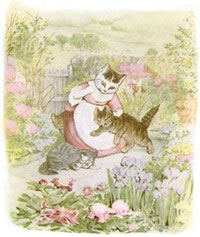
Farmer, award winning breeder of the best Herdwick Sheep, natives of my home Lake District – and one who has seen deep into the dark heart of the human condition. And as evidence for this perhaps preposterous claim, I offer you ‘The tale of Tom Kitten’

Now there is not time to tell all of this intricately woven fable of human existence, told in the form of a parable involving animals – so to fill in a few details – There were once three kittens, Mittens, Moppet and Tom Kitten – who loved to play in the dust, but one day, their mother, Mrs Tabitha Twitchit, was expecting friends to tea – So Moppet, Mittens and Tom Kitten had to be wash and suitably dressed, before the arrival of ‘fine company’.  Faces scrubbed – and squeezed into ‘all sorts of elegant and uncomfortable clothes’, ‘Mrs Tabitha Twitchit unwisely turned them out into the garden, to be out of the way while she made hot buttered toast . . .’ Well of course like any children sent out to play in the garden in their best clothes . . . it was not too long before all the clothes were in disarray, indeed, dirty, torn and eventually discarded, where they were espied by the puddle ducks . . . where we pick up the tale ‘Mr Drake Puddle-Duck advanced in a slow sideways manner, and picked up the various articles. But he put them on himself! They fitted him even worse than Tom kitten “It’s a very fine morning!” said Mr Drake Puddle-Duck. And he and Jemima and Rebeccah Puddle-Duck set off up the road, keeping step -pit pat, paddle pat! Pit, pat waddle pat! THEN Tabitha Twitchit came down the garden and found the kittens with no clothes on. She pulled them off the wall, smacked them, and took them back to the house.Tom-Kitten-22“My friends will arrive in a minute and you are not fit to be seen; I am affronted!” said Mrs Tabitha Twitchit. She sent them upstairs: and I am sorry to say she told her friends they were in bed with the measles; which was not true. Quite the contrary; they were no in bed; not in the least. [SLIDE] Somehow there were extraordinary noises over-head, which disturbed the dignity and the repose of the tea party . . .

How like Life 🙂 We’ve made all our plans – we decide what a perfect life would look like and we set about securing it for ourself – this is the way we want life to be – we’ve made a huge effort to get everything right . . . and then others mess it all up! And the dignity and the repose, the elegance and the refinement, or the quiet perfection of life as we’d like it comes crashing to the ground . . . and the question is – what do we do next?? For like Mrs Tabitha Twitchit, it is others who refuse to co-operate – it is as if we surrounded like willful children . . . how often do we hear the complaint, oh they really need to ‘Grow up!!’ for like Mrs Tabitha Twitchit, we are affronted!!! We exclude more and more others from our life, we try to secure our existence, and if that means I go nowhere near so and so, all well the good . . . and our lives shrivel as we surround ourselves with those who reflect the person we’d like to be back to us – in other words, we are lost in our selves, like Narcissus who can only bear to see himself in the world around him, who cannot bear to be wrong, who cannot bear being wronged . . .

Which is all well and good until we come to the Church, for in Christ, we are all one body, called to Life Together with no get outs. We cannot at once be close to God in Jesus Christ, and distant from those who refuse to co-operate with our attempts to secure life on our own terms, to give us what we want . . . as if that was their role, as if they existed for us . . . for we cannot bear to be wronged . . .

St Paul was not blind to this in the life of the church in Corinth and his words to us may well unmask our own attempts to secure a life for ourselves. For he finds that the Corinthians are not sorting out their disputes amongst themselves, rather they are taking their fellow Christians to court (which sounds terrible until of course we remember that in the C20 Christians went to war with each other over ‘higher ideals’ . . .) One of the glories of the Scriptures is that there is no papering over the cracks, the naughty kittens aren’t sent upstairs as if they didn’t exist – here in the Bible we read of how God’s people still forgotten who they really are – that their lives are no longer their own. So Paul asks a shocking question, I wonder if we heard it?? Rather than try and assert your ‘rights’ he asks, ‘Why not rather be wronged? Why not rather be defrauded?’ Why are you so insistent on trying to secure this Life you have built for yourself?? You see you cannot build a life for yourself and follow Jesus, because Jesus invitation to follow him is to leave the life we build for ourselves behind, and accept the true life he offers us . . . there is no carefully refined respectability in the Kingdom of God, there is just the life of Jesus, who sleeps in the dust, who is wronged, who gives up all rights . . . and yet whom God raises even from death.

Elsewhere Paul says to the Corinthians, ‘But with me it is a very small thing that I should be judged by you or by any human court. I do not even judge myself. I am not aware of anything against myself, but I am not thereby acquitted. It is the Lord who judges me.’ In this he is entirely like Christ who

Listen to what St Peter says about Jesus . . . to this you have been called, because Christ also suffered for you, leaving you an example, so that you should follow in his steps.

‘He committed no sin, and no deceit was found in his mouth.’

When he was abused, he did not return abuse; when he suffered, he did not threaten; but he entrusted himself to the one who judges justly. Jesus is utterly wronged, but his security is not in his own sense of self  worth, which can all too easily be torn to shreds like Mrs Tabitha Twitchit’s plans for a dignity and repose. His security is in the very life of His Father, God. That is what fills his consciousness

When we like Mrs Tabitha Twitchit are ‘affronted’ – when we shudder for the repose and dignity of the life we have tried to make for ourselves is assailed – it is a sign that we haven’t begun to follow Jesus. We are still trying to secure our own life – and we are rejecting the life he calls us to. The disciples are called from the life they have made for themselves to a life with Jesus. A life in which we are healed from our deepest sin, our desire to have life on our own terms.  He himself bore our sins in his body on the cross, so that, free from sins, we might live for righteousness; by his wounds you have been healed. For you were going astray like sheep, but now you have returned to the shepherd and guardian of your souls.

And that is the heart of Baptism – the abandonment of our attempts to build a life on our terms – to follow Jesus, the one who entrusts himself entirely to ‘the one who judges justly’