For those who would like a humourous take on the book of Ruth which is also on the mark in terms of the text – here is the first of a series of video cartoons
For those who would like a humourous take on the book of Ruth which is also on the mark in terms of the text – here is the first of a series of video cartoons
The Scheme for March – April can be found here
Jos 10-11; Tit 1-3; Psalm 136
I grew up in a church tradition which looked down on ‘mindless repetition’
It seems to me many years later that this was foolish on more than one count
Firstly it was INCREDIBLY judgmental in more ways than one – it presumed that people were just saying things without thinking, it presumed that repetition was in itself a poor substitute for what transpired eventually to be mere novelty (who can honestly remember all those NEW songs that were SO with it :), it assumed that if the mind was not engaged nothing was, which so privleleges the mind [and thus a sophisticated ‘intelligent’ elite] in a way that Scripture never does.
Secondly, following on from the last of those examples, it showed a complete lack of understanding of how we learn deep truth – learn things so that they become second nature. We do this all around us all the time without thinking about it. I drive a car. My conscious mind cannot be engaged all the time on every aspect, indeed most (95%) of driving is ‘unthinking’ – and I could multiply examples many times over. Oh that we so deep learned the things of faith that they passed into our unconscious and were JUST LIVED! 🙂
Thirdly it completely overlooked the value of what was being repeated. Repetition in itself was seen as a bad thing (see note above about novelty). Actually as human beings we seem to be hard wired for novelty – it sets off our chemical responses in the brain – with terrible effect in more ways than I can even begin to recount. God’s ‘new thing’ (behold I am doing a new thing) is the death and resurrection of Jesus!! There is not a long list of new things to keep uas entertained and away from boredom – no rather we go into the DEPTHS of this ONE new thing.
So our Psalm today . . . of course in Joshua and Titus we may find many things to be distracted, angry, disturbed, confounded by . . . whereas in the Psalm we repeat over and over ‘for his steadfast love endures for ever’. Without this lesson anchored deep within our hearts we cannot begin to cope with the other scriptures before us today. Let it sink from mind to heart – that we might KNOW it. For in the end the only Knowledge that counts is that which resides in the very depths of our being, where Christ dwells if we did but know it. Why seek for anything new, when Everything is to be found there??
These are just the brief notes – I hope to include some audio – but for now I hope this gives you a flavour
St John the Evangelist, Roslyn
LENT COURSE 2013
Called to be Saints –
The Extraordinary Nature of
‘the Church Militant here in Earth’
‘It is probably the case that only a vibrant fullness of the Christian Church,
that is itself sufficiently mature to be the bearer of a Christian ethos,
is capable of surviving the onslaught of modern secularism.’
Fr Stephen Freeman
Session 5 – Church as Community of Formation – Lessons from the past
A prayer of St Thomas More (1478-1535)
‘Give us Lord, A humble, quiet, peaceable, tender and charitable mind
And in all our thoughts, words, and deeds a taste of The Holy Spirit
Give us Lord, A lively faith, a firm hop, a fervent charity, a love of you
Take from us all lukewarmness in meditation, all dullness in prayer
Give us fervour and delight in thinking of you, and your grace and tender compassion towards us
The things which we pray for, give us grace to labour for
Amen’
Speaking the truth in Love
Confession and forgiveness – the way to growth
The challenge to unconditional love – Love one another, as I have loved you
Shared Life – not just ‘sharing’ our lives
Koinonia = Communion cf. ‘Fellowship’
Christ Is our Koinonia – 2 or 3 are gathered
Is it possible to come together and NOT pray??
‘Take my yoke upon you and learn from me, for I am gentle and humble in heart
Humility as the touchstone
Church reimagined – in the light of Christ and the announcement of the Imminent Kingdom of God
Jesus is LORD – all of life must be re-oriented around him
Church as the foretaste – Church as Eschatological community – expressing in itself the age to come as made known to us in the Risen Christ – Community of the Resurrection
Ephesians 1:15-22
Church – Community of re-orientation – disciples following Jesus. Growing more and more in his likeness and thus more and more distinctive in the world. I.e. Growing in faith
Embodied in relationship. (John 13:34-5 – ‘as I have loved you’ – Losing our life for the sake of one another)
Church decerebrates Faith
The uniquely toxic nature of modern society and its impact on Church – the shattering of connection – the loss of Common Life
The most poignant of questions in all of Scripture – ‘Where are you?’
From Garden to City? The move from Rurality to the Urban
From Common Lives to Virtual ‘Space’ – ‘Family mealtime’
The end of History and the end of geography
From mutual accountability – to radical individualism
From a faith of Growth, to Faith as as set of fixed ideas
From Stability to radical mobility
The Age of Entertainment and Novelty
Some questions
What resonances do I find with the story of the church here?
When was the last time I changed how I was living because of something I read in Scripture or heard in a sermon, or someone said to me?
To whom have we been accountable in our life?
To whom ARE we accountable?
St Paul says ‘submit to one another out of reverence for Christ. How might mutual submission benefit our faith?
A story from the deep history of the Church
A bleak picture, BUT – There is nothing new under the sun – We have been here before
A history lesson – the loss of church as communities of mutual accountability – ‘Submit to one another out of reverence for Christ’ – The Genius of Benedict (RB 1.3-5) Community forms faith
Monasticism as a renewal movement – a place of formation, from the beginning
If you wanted to be ‘a Christian’ you went to the monastery
A contentious suggestion . . .
Life needs a vessel – the neo-pentecostal dilemma, life without structure
Treasure in clay jars
Shared life requires shaping – Vows (Commitment) and Regula (Shaping)
Obedience
‘Conversatio moralis’
‘Poverty’ – Common ownership
Stability
‘Chastity’ – Faithfulness
Stability as ESSENTIAL (Yet we move from church to church, driven by more important things like career . . .)
Staying put – the garden as the place of growth
Pruning – when church gets uncomfortable its quite possibly doing its work 🙂
Place and people
‘God places us in a community of people with whom we would not have chosen to live, had it been up to us’ – cf Marriage also 🙂
Human – humus – of the soil – Adam – Admah – Mud creature 🙂
Neo- monasticism – exciting but costly – like following Jesus 🙂
NEXT TIME!!! Exploring Vows and Rule in the Life of a church
Apologies, but I inadvertently published an empty posting
And so we come to the last hour – we take an hour out of our ordinary lives to come and contemplate that which, as Jo reminded us last night, is the very heart of our faith . . . take an hour out of our ordinary lives . . .
If you really want to irritate a Priest, tell them about how life is ‘in the real world’ – some of course may well be irritated because they wish they still ‘lived in the real world’ – but others will be irritated because hundreds if not thousands of sermons have fallen on deaf ears. To paraphrase the writer Eugene Peterson, ‘the work of the minister is quietly to put a bomb under people’s preconceived ideas of The Real World’, steadily to remind those in there care that Sunday Worship – participation in the Eucharistic feast is The Real World.
For our assertion as Christians is not so much that the events of the Triduum – the three days that perhaps a little lazily we call Easter – our assertion is not so much that these are the heart of our faith, which they are, but that they are the Centre of all human existence. That these days define The Real World. That if we are going to make any sense of the world in which we live, we can only do so using these three days as our starting presuppositions about reality. The death and the resurrection of Jesus, defines Everything.
Of course our culture of tolerance and refusal to allow anything have the last word on anything, except that is, the twin gods of technology and economics, would deem such a claim arrogant in the extreme. To say that in contemplating the death of Jesus we are seeing into what Richard Neuhaus calls, the ‘axis mundi’ – The hub of reality around which Everything is ordered – is to the ears of many, too much to swallow.
But there is no room for arrogance in this assertion. There is here, to thwart the modern hermeneutic of suspicion, no attempt here to seize power, only in humility to declare what is True. One of the unremarked repetitive elements of the Scriptural narrative is how often God works whilst we are asleep. Adam must be put to sleep in order for humanity to come into the fulness of male and female, the disciples notoriously cannot stay awake in the midst of the transaction between the Son and the Father in Gethsemane – and that failure to stay awake takes us way back into this story – to that of Abraham.
We are trained, not entirely unreasonably to understand Good Friday in terms of Moses and the Exodus from Egypt – but there is another Old Testament Narrative which serves just as well, if not better, the story of Abraham.
In Genesis 15 – God makes his covenant with Abraham, but there is a crucial difference between the Sinai Covenant, which of course the New Testament writers say is inneffective and the covenant God makes with Abraham, and that is Abraham has no part in what happens. We think of a Covenant as an agreement between two parties, and that it is, but in the mysterious text of Genesis 15, Abraham having set the stage for the covenant Then God said to Abraham ‘I am the Lord who brought you from Ur of the Chaldeans, to give you this land to possess.’ But he said, ‘O Lord God, how am I to know that I shall possess it?’ He said to him, ‘Bring me a heifer three years old, a female goat three years old, a ram three years old, a turtle-dove, and a young pigeon.’ He brought him all these and cut them in two, laying each half over against the other; but he did not cut the birds in two. And when birds of prey came down on the carcasses, Abram drove them away.
As the sun was going down, a deep sleep fell upon Abram, and a deep and terrifying darkness descended upon him. Then the Lord said to Abram, ‘Know this for certain, that your offspring shall be aliens in a land that is not theirs, and shall be slaves there, and they shall be oppressed for four hundred years; but I will bring judgement on the nation that they serve, and afterwards they shall come out with great possessions. As for yourself, you shall go to your ancestors in peace; you shall be buried in a good old age. And they shall come back here in the fourth generation; for the iniquity of the Amorites is not yet complete.’
The covenant to bring God’s people into God’s Land is made with Abraham – but he is asleep – God makes the covenant with himself, God is the only party to the covenant. We are asleep – Like the disciples, as God the Son prays with God the Father in Gethsemane. The covenant is made – not my will but thine be done – and we are asleep. Unlike Sinai, the covenant of bondage which we could never keep – here God covenants with himself to redeem the world
Again we think of Abraham with respect of Genesis 22 – the story of God’s command to sacrifice Isaac, which is stopped only at the last moment – here we see how the covenant will be made. The faithful one of the Covenant will himself provide a lamb – provide a Son for the sacrifice. God will not require anything of Abraham – except faith – he will provide the Son
So that is all that is asked of us, faith that that which we witness once again today is in truth the axis mundi – the heart of Everything.
There is no place for arrogance on our part. We are not the centre of all things – we are asleep in sin and death – and, mystery of mysteries – there is no arrogance in God. The Cross is no act of Power. No, it is God’s willing submission into the hands of evil men, that is you and I – God does not overcome by force, but by willing submission. He proves to us, a lesson we are slow to learn, that Love overcomes all things.
Jesus last words from the Cross – ‘it is finished’ – the world can throw no more at him – the hatred of the world has done its worst – he has absorbed it all – he has made himself nothing, becoming submissive unto death, even the death of a cross.
The chief deadly sin is Pride – like all sin it is nothing less that the contradiction of The Imago Dei – the Image of God in us. Pride is the Contradiction of the image of God.
In this utterly broken, scourged naked Jew, nailed to two rough timbers the fullest nature of God is revealed – his utter Humilty. Much rightly is made of how the Cross expresses God’s Love for us – but more than that, it expresses his utter preparedness to go to any lengths – to be utterly humiliated for us. Without humility, love is not possible. Love demands the divesting of all power. If as we are so bold to assert ‘God is Love’, then God is the one who refuses to call legions of angels, refuses to use any power, refuses to leap from the temple, to turn stones into bread, to worship demonic pride and power.
At the Last, The Cross returns us to the beginning of the journey of Lent – it is all of a whole – we lay down all our pretensions to life in our name, and so discover Life in His, the one who lays down everything, in Humility and Love.
This is the Axis Mundi – This is the Meaning of Everything – This is the Real World – The Word made flesh – crucified before our eyes
One of, if not The key elements that sets Christian faith apart, is its understanding of God.
As The former Archbishop of Canterbury, the late Michael Ramsey said, God is Christlike, in God there is no unChristlikeness as all. So as we see Jesus, we must thus reshape our understanding of God.
In Holy Week we are faced with this Incarnation of the radical undoing of any idea of God that is a projection of our wish fulfilment, ultimately upon the Cross, the God who is Crucified, the God who dies.
Throughout the week there are markers of this strange God revealed to us in Christ.
Firstly at Palm Sunday, we are reminded that we worship a God who makes himself dependent upon us. Throughout the gospels we are confronted with the needy God, the one for whom there is no room in the inn, the one who must ask the Samaritan woman for a drink, the one who has nowhere to lay his head, the one who has no coin, the one has need even of a lowly beast of burden, the one who thirsts, the one who in the end will lie in a borrowed tomb.
He sends his disciples to find the colt, and the words he gives them is The Lord has need of it.
This is how this strange God comes into the world, not in fullness and power, but in emptiness and need. Challenging all our preconceived ideas about God, and continuing to challenge those ideas about God which even after 2000 years we refuse to lay down. Challenging our ideas also about Mission.
Our ideas about Mission tend to start with our Power, our Resource, and the need of others. Yet when God comes into the world, all he offers is himself, he even relies on others to feed him.
Rowlands Williams in an address to the Benedictine community at Monte Cassino, spoke of how Emgland was converted by Augustine’s monks, that the people were won over by their poverty and prayer, that like the disciples of old they took nothing with them and were entirely dependent upon the people to whom they went. How different to our perceptions about church and mission.
Our ideas if both are based on fullness and power, we ‘need’ our own money, education programmes, paid staff, etc etc etc. Yet, if Christ lives in us, why do we need all these extras? If . . .
Jesus comes as one entirely dependent upon those to whom he comes, there is Nothing that stands in the way of his message, He Is the Good News.
‘With Jesus our only possession . . . ‘ goes the words of a song. Dare we, like Christ be dependent on those to whom we go?
As Christians we seek to reveal the love of God amongst ourselves
Gods love is utterly care-less
Loving the unlovable
Forgiving the unforgivable
Outrageous
Utterly beguiling
Life
Sermon for Lent 5 – Year C – 2013
Isaiah 43:16-21
Philippians 3:4b-14
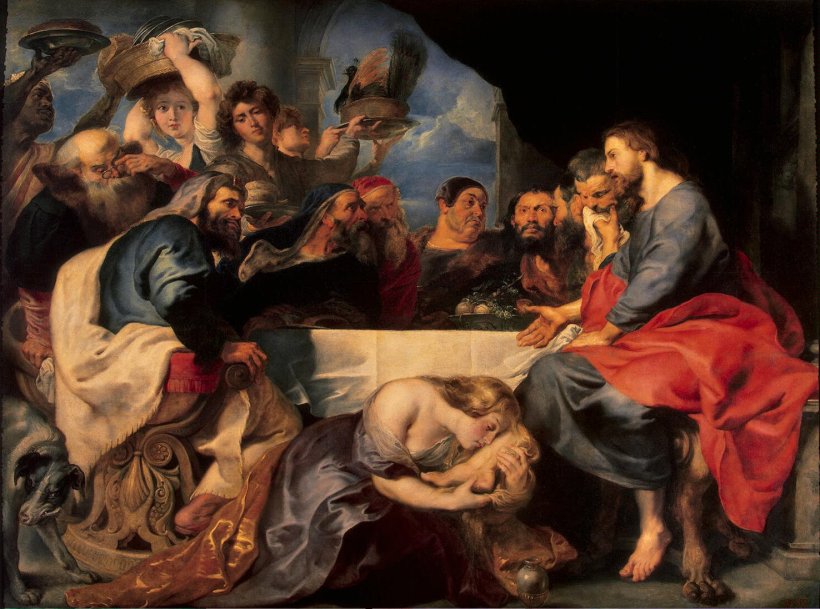
John 12:1-8
‘I will make a way in the wilderness and rivers in the desert.’
Last week we were treated to a fine sermon from Jo on the Parable of the Prodigal Son – and I’d like to take a few moments this week just to reflect a little further on that parable, for it leads us beautifully into our texts for this week, and the theme ‘Extravagant Love’.
The Father in the parable displays a shocking extravagance in his response to his younger son. In many ways we might call that parable, the parable of the Prodigal Father, for after the son has squandered his father’s goods on prostitutes and dissolute living, the Father squanders himself on the son, welcoming him back with open arms, Killing the fatted calf, throwing him a party and giving him The Best Robe, the Ring of Sonship and Sandals. The Prodigality of the Son is dwarfed by the Prodigality of the Father. And the elder son picks up on this – ‘You are wasting yourself on this wastrel of a son of yours . . .’
And as I’ve noted before, this Wastefulness can strike us, like a slap in the face – that we might also cry out ‘That’s not fair!!’ Or with Judas – ‘Why didn’t you give it all to a deserving cause . . .?’ However much we try to separate ourselves from Judas’ motivations – of course we are not into waste because we want to remain secure . . . – his response to Mary’s outrageous extravagance with the perfume strikes a chord with us. ‘This could have been sold for $40k and the money given to the poor . . .’ Because of course if we found ourselves in possession of a pot of perfume worth $40k, that’s exactly what we’d do with it, isn’t it . . . we wouldn’t keep any of it for ourselves would we?
The Command of Lent, given to us on Ash Wednesday, has two aspects, but they are two sides of the same coin. ‘Repent and believe the Good News’. To Repent is not primarily to stop ‘being naughty’ as we might perhaps teach our children. Rather repentance is what the Prodigal does – he realises that the story of Life with him at the centre is no life at all – which it isn’t. You take what you can get out of life, you do the best you can with it and then you die. Not much of a life really. The Prodigal realises the utter poverty of his life.
This is why in an age when we are so materially comfortable, we have so much difficulty really hearing the gospel. Like Judas we imagine the meaning of life is to secure ourselves against the harshness of life and have enough to keep going until we stop – indeed perhaps enough to put off the stopping for a few years longer than most. The anxiety ridden story – Get a good education, get a good job, get a good spouse, raise your children well so that in your old age they won’t abandon you, and leave enough money in the pot to pay for a decent burial. And we call this ‘The Good Life’. And when as in a culture like ours these things are at least on the surface moderately easily attainable, we can’t even begin to imagine that relatively speaking we’re sat eating pig scraps, compared with what might be ours were we to return to God. That what we have been trained to call the Good Life is in reality the Devil’s anaesthetic. In the words of CS Lewis, “like an ignorant child who wants to go on making mud pies in a slum because he cannot imagine what is meant by the offer of a holiday at the sea. We are far too easily pleased.”
So repentance is difficult for we don’t see any need to – as every missionary or evangelist will tell us, the gospel is at best utterly subverted, and at worst ignored by the rich – whereas the poor, like the prodigal sat with the pigs don’t need all that much encouragement to believe that life in God’s Kingdom might perhaps be a bit of an improvement on what they have.
Repentance and believing the Good News are in essence the same movement. That is, saying no to the life we painstakingly build for ourselves – a life of great care, a life if we are religious of trying not to break the rules, of living ‘moral’ lives; and saying Yes to the Outrageous Provision of God. To understand that he provides for his children – that Jesus was not lying when he said ‘Seek God’s Kingdom and all your material needs will be looked after’ We don’t believe in God’s provision – That ‘He who did not spare his own Son, but gave him up for us all–how will he not also, along with him, graciously give us all things’????
To enter Life we must abandon the idea that we have to look after ourselves – we have to let go of the story of careful frugality and that ghastly parody of the gospel – ‘God helps those who help themselves’ – why?? Because that is not Life – because the only Life there is is the Life of God who is outrageously prodigal – outrageously wasteful – who receives this outrageous act of worship, for it reveals the heart of the Father – the Prodigal God. Mary is a child of God – she lives in the same utterly Care Less abandon and generosity, wasting a pint of pure nard on Jesus
The life of careful frugality is NOT the Life of God – it is merely a sign that we have not heard the Good News of a God who throws banquets for the utterly undeserving. We remember the parable Jesus tells in this regard – the invitations are sent out – and back come the polite refusals – I have business to attend to (I need to watch my security) – I have just got married (I need to watch my security) – I have new oxen to break in (I need to watch my security) – I am too anxious about my miserable life of cares to take time to feast on abundance.
The Apostle Paul, in terms of the times in which he lived had it all – he was circumcised on the eighth day, he was a REAL Jew, a Hebrew born of Hebrews, a Pure blood – regarding the Law, unimpeachable (The Pharisees WERE morally Pure!), as to zeal – he was hot to persecute any false way – Paul had it all in the world’s terms – but when he encountered Christ, he realised that it was all – manure. HIs eyes were opened – he realised that he was sat amongst the pigswill, and yet in the world’s terms he had a life all would envy him for. HE had it all carefully controlled, carefully managed, he’d been to the right schools, if he had children I guess they’d gone to the right schools to – he’d bought entirely into the world’s lies. Then he met Christ – and his eyes were opened.
And to everyone who knew him, what happened next must have seemed utterly outrageous – he threw away all his carefully cultivated security, and like the fishermen before him, set out to follow Christ – in the life of Abundance – as outrageous as the Prodigal Love of the Father for his son – as outrageous as the Life of the one whom the Pharisees saw squandering his Life on Prostitutes, and tax collectors, on galilean peasants, on sinners. The Prodigal Son is of course in a sense Jesus himself
Well, before I close a couple of brief reflections – what does this mean for us as a people. Firstly as the people of God in this Diocese. We have been listening too long to the wrong story – a story of Scarcity. A story which denies the Gospel we proclaim. We have assumed that the bottom line is the bottom line – we have chosen to believe that God is Not outrageously generous to those who chose to live in such generosity – put another way, we don’t believe Jesus when he says ‘Give and it will be given to you, a good measure, pressed down, shaken together and running over, will be poured into your lap. For with the measure you use, it will be measured to you.” As things stand in the Diocese at the moment, there would be at least a degree of consternation if someone wasted $40k on perfume for Jesus . . . Which story will we live by in the Diocese? The myth of the life we have to scrape together for ourselves, or the Story of God’s abundance for all who live this life of Abundance? The central challenge is that of Faith – that God is who he says he is – The God who provides – and to enter His Life
And what about us, as the people of God at St John’s – we shall in a short while have our Annual meeting – when we consider the state of play for the church. I just want to say ahead of this that this year Vestry has decided to give a double tithe of the fair proceeds – one tenth to Servants Health Centre in town – a charity which gives medical care and attention to those who cannot afford it – and a tenth to Cyclone Relief for our Pasifika neighbours in Samoa. Good. But I want to suggest that next year we try and imitate God our father – that we hold a fair Purely for the benefit of others. That we discipline ourselves as a church to do that, to Be imitators of God as dearly loved children. To put in all that work and time of preparation entirely in order to bless others, as our God gives all he has for our sake.
Imagine the headlines in the ODT ‘Church holds fair and gives all the proceeds away . . .’
Father welcomes home wastrel son with a banquet – God wastes himself on the undeserving – Fishermen leave their nets and follow Christ – ‘Church holds fair and gives all the money away’ . . .
You may have noticed in the gospel that Mary had bought the perfume for Jesus burial . . . and it would have been perfectly in order to think, ‘well all that is used up so there won’t be anything for the burial . . .’ but if we read on in John, then after the death of Jesus we read After these things, Joseph of Arimathea, who was a disciple of Jesus, though a secret one because of his fear of the Jews, asked Pilate to let him take away the body of Jesus. Pilate gave him permission; so he came and removed his body. Nicodemus, who had at first come to Jesus by night, also came, bringing a mixture of myrrh and aloes, weighing about a hundred pounds.
Mary wasted a pint of Nard on Jesus – God the Prodigal Father blessed that and provided ‘myrrh and aloes, weighing about a hundred pounds’ – may we too do likewise and so come to know the Extravagant Love of God. ‘The measure you give will be the measure you get – Good measure, pressed down and running over . . .’
The Scheme for March – April can be found here
Num 4; 1 Cor 15; Psalm 95-96
Paul’s profound exposition of the Resurrection is utterly remarkable. As I have noted elsewhere, any attempts on the part of the church to render itself credible in the eyes of the world are radically undone by the central claim of our faith – that he died for our sins . . . was buried . . . and that on the third day, God raised him from the dead. Not metaphorically, not in some sense that ‘life’ as a principle cannot be overcome, but as a flesh and blood Fact. In many respects the Resurrection is the vindication of the doctrine of the Incarnation. It is utterly remarkable that often those who make most of Christ’s incarnation, are the very ones who for the sake of relevance or because ‘we know so much more about the world now’, must deny the Resurrection.
Paul reminds us that if the Resurrection of Jesus is not historic fact in the plainest sense of that phrase then we may as well give up on the whole idea of church and faith – being ‘of all people most to be pitied’.
But in fact Christ Has been raised from the dead. The outworking of this we think little about – the idea that the Resurrection of Jesus is meant to transform our lives in the here and now – we still relegate it as a doctrine to the ‘for use after I die’ pile. Rather Paul would have us die every day, put our lives on the line. That is to live lives that only make sense in the light of the Resurrection – lives which have no security in the things of the world, for they have a far more sure and certain security – the Risen Christ.
The Scheme for March and April can be found here
Lev 26-27; 1 Cor 11; Psalm 91
As we saw yesterday, Paul’s arguments concerning both the unity of the church, and also the question of meat sacrificed to idols, come to a focus in the Eucharist.
Here we see how so much of Paul’s theology of the church and the work and life of Christ is shaped by the extraordinary and unique genius of Christian life and faith, foreshadowed in the Old Testament – that is God’s radical identification with his people. In Ephesians 5, we read Paul speaking of the union that is betwixt Christ and his church using the imagery of marriage – the two becoming one flesh. We think supremely of the words of the Risen one in John’s Gospel – ‘abide in me, as I abide in you’ [It is always the Risen one who addresses us in the gospels and this is explicit throughout the gospel of John where the glory of the Cross is not hidden as it is from those who have no faith]
Given that identification, Paul’s language of ‘discerning the body’ is that double edged sword – it is discerning Christ in bread and wine and it is discerning Christ in our brother and sister. We cannot come to the table of the LORD – put another way, we cannot enter the Kingdom of God – if we do not discern Christ. Upon the Cross he takes hold of his people – in Baptism we enter into his death, and are also raised to new life in His resurrection. To look upon or brother and sister is to see, though through a glass darkly, the new creation that is Christ, the Risen one.
Thus Paul is quite clear, our relationships with each other are every bit as significant as our relationship with Christ. They are not one and the same, but Christ has taken our brother and sister into himself in his death ad resurrection, as he has us. We cannot be present to Christ, and absent from our brethren. The measure of our Love for Christ is discerned in this discernment.
By This shall all know that you are Mine – your love for one another.
NZ Finest Woodwind, Brass and Stringed Specialists
Orthodox Christianity, Culture and Religion, Making the Journey of Faith
Cultivating Christian Culture in a Post-Christian Age
Homilies and Commentary on the Christian Life Today
flotsam, jetsam, messages in bottles
Scottish Doctor, author, speaker, sceptic
Neither polemic nor compromise, but engagement
Spirituality, Sustainability, Hospitality and Community
the sensation of life
Live, work and worship in a rural community in England. Covering UN CSW56 Feb / March 2012 and continuing after that.
Life and Faith as Everything Changes
Life and Faith as Everything Changes
Reflections from a northern English town
Musings of a restless bishop

