Through the Bible in a Year – January 14

The Scheme for January and February can be found here

Genesis 29-30; John 11:1-27; Psalm 19

Throughout the story of the Patriarchs there are rich elements which are as much comedic as anything – perhaps none less than the deceits between the deceiver Jacob and Laban, as they wrestle with one another (a foreshadowing of the life of Israel with the LORD). Not least in the wonderful set up of Jacob having laboured for seven years for Rachel, to wake up and find Leah in the marriage bed . . . Again there are common themes. Marriage within the broader family, the well, the two spouses echoing Hagar and Sarah, one barren the other blessed – yet as before the one who is barren finally gives birth to a ‘saviour’ in Joseph as Sarah had borne Isaac, the one who dies, yet he lives.

We would no doubt wish for a tidier picture – a neater engagement – a more moral story – but then of course it would truly bear little relevance to the story of our lives. However strange the story of the patriarchs is to us culturally, those who inhabit it are as recognisable to us as those who look us in the mirror. We can only wonder that the Holy One deigns to work out his purposes through frail human flesh. Wonder, and Worship. And certainly our reading from John blows all our senses of moral and right to the four winds

Wonder and Worship – perhaps the pre-eminent Christian posture – is all that we can do before the telling of the story of the death of Lazarus. We cannot hope that God will work in the messiness of our lives, if we hope at the same time he will dance to our tune. There is no neat and tidy healing for Lazarus. The Healer delays. His ways are not our ways. We would not come to save folk like ourselves. He does. We cannot but rush to try and help, he does not. What we do avails little. His Purpose overarches everything. His words leave us staggered. I am the resurrection and the life. Those who believe in me, even though they die will live, and everyone who lives and believes in me will never die.

That which is humanly impossible – coming to save faithless deceivers – refusing to do the obvious ‘Right’ thing. All we can do is worship and follow. We cannot see the way – Faith alone is an adequate response. “Yes Lord, I believe that you are the Messiah, The Son of God, the one coming into the world”

Sermon for Epiphany 2 – Baptism of Christ

Epiphany 2 BAPTISM OF CHRIST

LINK TO SERMON RECORDING BAPTISM OF CHRIST 2013

Acts 8:14-17
Luke 3:15-17, 21-22

And all of us, with unveiled faces, seeing the glory of the Lord as though reflected in a mirror,  are being transformed into the same image from one degree of glory to another;
for this comes from the Lord, the Spirit.

Last week we celebrated the Epiphany of Christ, and we are now in the season of the Epiphany which extends until the first Sunday in February when we shall celebrate Candlemas – the feast of the Presentation, albeit a day late, for that feast, falls on Saturday February 2nd.

This habit we have in the church of shifting festivals to the nearest Sunday is a symptom of something which I fear in the end will do us no good. Of making faith fit our lives, rather than making our lives fit our faith. Christmas is unusual, to an extent in that we still come to church on that day irrespective of whether or not it is Sunday, and some folk still come to worship through Holy week, but on the whole we have given up on the celebration of major festivals on the day they fall. We either transfer them to an adjoining Sunday, or ignore them altogether. When, I wonder was the last time we celebrated The Feast of the Transfiguration?  It strikes me that such a festival, with its theme of the Glory of Christ, falling as it does in August . . .??? Does anyone know the date? Well it is August 6th – a time when here in New Zealand we are stuck in the darkness of winter. What a wonderful idea to come to church in the darkness and find it ablaze with candles as we celebrate that feast.

Taking time out to worship according to the calendar might not seem much, but it is a simple discipline of ordering our lives to faith – and it is in the accumulation of such small things that our distinct Christian identity becomes more manifest – as we are conformed to the Life of the risen Christ in the church. The gift of the whole season of Epiphany is about the manifestation of the Glory of Christ. Four weeks to contemplate Him. Actually the church gives us half the year to contemplate Christ. From Advent, through Christmas and Epiphany, with perhaps a brief break, then into Lent, and then Easter, Pentecost and Trinity – the subject of our attention is not ‘how to live the Christian life – how to be relevant in the world – how to do mission’ – no. for half the year we are called to attend to the person and work of Christ and that is very necessary.
The crying problem of the church today is not the irrelevance of the church to the world – that church doesn’t fit the world we live in – it is not fitting our faith to our lives – no. It is that so often church does not fit the life of God revealed to us in Christ, and that I suggest is in no small part because we give insufficient time to the contemplation of his glory.
Epiphany especially is given to us for that contemplation. The Glory of Christ is revealed to us – the traditional readings are his revealing to us in the visit of the magi, in the changing of water of wine at Cana where he reveals his glory, the presentation at the temple where Simeon cries out ‘I have seen thy salvation which thou hast prepared in the face of all people’, how he is revealed as the Servant of The Lord, the fulfillment of Scripture at Nazareth = and today – in his baptism – he is revealed as the Son of God – and Uniquely baptised with the Spirit. He is Clothed with the Spirit of God. The Spirit that had departed the Temple and caused the people to cry in dismay ‘Ichabod’ – the Glory has departed. He is clothed as were Adam and Eve at first, not in animal skins, but in the Glory of God. Having taken their life in their own hands, the glory departed.
Perhaps we do not notice this, because unlike the Israelites of old, like those first disciples at Cana, we have not seen his Glory – we do not see how our lives are so small in comparison with the Glorious majesty of God revealed in Christ – we seek too readily to move away from contemplation of his glory – his beauty, his majesty. We want something Practical – some hints and tips for Our everyday lives, not realising that he seeks to utterly transform the essential nature of those lives.

A few weeks ago I saw a rather sad Facebook post – it said ‘Of course if it had been three wise women who came to the tomb, they would have brought something Far more practical, like a supply of nappies and a blanket!’ And it struck me as very sad that someone would use what is a story of immense mystery – something which Mary ponders in her heart – was used to make cheap political gain from. I wanted to say “can you not see?” Can we not see His glory? Have we not been held captive by it? That these gifts tell us here is a child like no other . . . like no other. He comes to be one with us – but he is like no other. He embraces fully our humanity . . . but he is like no other

Jesus comes with the crowds – they are All coming for baptism – he is in the crowds that are all asking if John the Baptist is the Messiah – their Messiah stands among them – they do not see his glory. They do not recognise their Messiah. They look as anyone else would look – John in his own way is impressive – he stands out, certainly! ‘Perhaps he Is the one’, they are all thinking. But they are wrong. They do not See.

So Jesus comes to be baptised . . . and his baptism sets him apart. 21Now when all the people were baptized, and when Jesus also had been baptized and was praying, the heaven was opened, 22and the Holy Spirit descended upon him in bodily form like a dove. And a voice came from heaven, “You are my Son, the Beloved; with you I am well pleased.” His baptism is like no other – he alone is baptised with the Holy Spirit. He alone is declared to be the beloved of God. Just this week I was reading about perhaps the cardinal sin – that of Envy. It is said that Jesus was crucified because of the Envy of the Pharisees – he was like no other – there was something about him that set him apart. He was a tall poppy – and we know what we do with tall poppies! The Life of God is Too Big for us – let’s cut him down to size.

And we also try to cut him down to size. ‘Let’s think on something practical – lets not contemplate the mystery, the gold of kingship, the frankincense of the one who ever lives to intercede for us – the Myrrh – his death’. A death foreshadowed in his humbly going down into the water of baptism.  How readily we turn from thinking about Christ to thinking about ourselves. How often do we think of our baptism, how infrequently, even on this Sunday, about His.

This setting apart of Christ at his baptism is I suggest an offense to our modern predilection for not wanting to know of anything more beyond the scope of Our lives. As I meditated upon this earlier in the week, I was reminded of a story – a story with which this ‘cutting down the tall poppy’ was thrown into a horrible irony and contrast.

It is said there was an old woman, who was in hell. The angels of God as they are wont to do sought desperately to find a way to bring her out of hell, and discovered that Once in her life, she had committed a kind act. A passing stranger had asked her for food, and the woman had thrown him an onion. Well it wasn’t a Huge thing – but the angels saw in that a hint of goodness and thought that this might draw her out of hell. So they lowered an onion on a long stalk down into hell and called on the woman to take hold. And as she did – they began to draw her out of the lake of fire. But others seeing that she was being drawn out clung to her clothes, and miraculously many people were being drawn out of hell – until the woman realised what was happening and spat and screamed at them – get off! this is My onion!! and at once the onion stalk broke and they all fell back into the fire.

Well, what we might ask is the parallel between that sad story and our thoughts on Jesus – on our discomfort with him being set apart – like no other . . . well it is simply this – that it is precisely because he is not like us, that He is able to draw us out, to draw us upwards – to draw us into His life – and our cutting him down is like the cutting of the onion stalk. We are saying to Him – don’t be different!! We can’t attain to you – stay down here with us. But he says, why would you stay down there – no you cannot attain to me – so I will come down – to draw you up.

Christ does not come to us to leave us where we are. All our attempts to deny his otherness – that he is like no other – prevent him from doing what he comes to do – to draw us up into the fulness of his life. A life for which we have very little feeling because I suggest we have given little time to contemplating his glory – we are not thirsty for the Life he brings.

Until His Life is released into the world at Pentecost He alone is baptised of the Spirit – perhaps those who had not yet received the Holy Spirit in our reading from Acts were those whom Jesus disciples had baptised before his Passion as John recounts in his gospel. He passes through death, to be raised to new Life – so that we might follow him – so that we might ourselves follow that path – so that we might know His Life, as he baptises us with the Holy Spirit – with His Life.

As I said last week – our faith is not a set of ideas – a moral scheme for living better – a set of ideologies – it is not even About Jesus – it is Christ – His Life is our Faith The more our lives are turned to him, shaped around him, the more we will find the Life he offers us – and to go back to that story of the sad woman – the more, seeing that we are being drawn up to Life in him, others will want to hang onto our coat tails and be drawn up also.

So let us not be quick to turn from the contemplation of his glory, for as St Paul tells us that is key to the transformation of our lives, as we ‘contemplating the glory of the Lord as though reflected in a mirror, are being transformed into the same image from one degree of glory to another;’

Amen

Through the Bible in a Year – January 13

The Scheme for January and February can be found here

Genesis 27-28; John 10; Psalm 18:31-50

Once more the rich interplay between the texts reveal the unity of Scripture – that it is of a whole

Firstly though we are warned once more of the significance of the Word. We find the story of Isaac, Jacob and Esau so strange because, to our peril we have lost sight of the Creative word. The idea that Blessings and curses are ‘more than mere words’, is beyond us. The idea that Isaac is Fast Bound by his giving of the blessing to Jacob, even though he has been deceived – even though Lying words have been used to bring forth the blessing, seems to us a nonsense. How infrequently do we now hear in our culture the praise ‘He is a man of his word’. We are often called to promise, but we no longer think a promise binds. Thus we have let go of the building blocks of Life. It is little surprise that we are lost without a Shepherd.

Jacob as he flees Esau is privileged to find ‘The house of God’ – the dwelling place where God is present to humankind once more. This ‘dream’ dimly evokes Eden, but also heralds the Tabernacle, the Temple and The Living Temple – a crescendo of Grace.

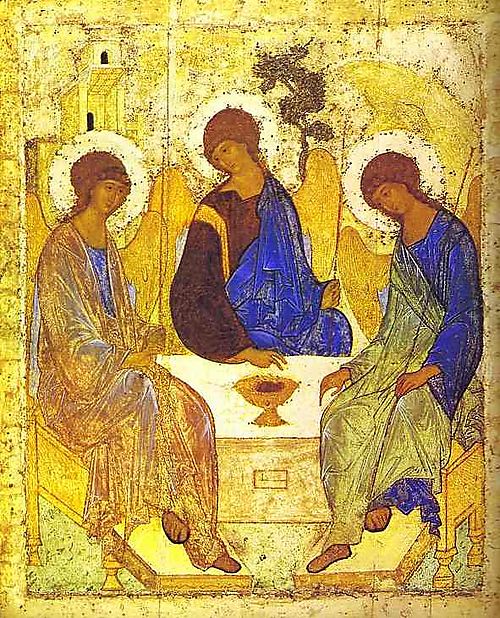
So comes the Good Shepherd. It was a difficult task to find adequate artwork for this. All the pictures are highly sentimentalised. It is to our romantic imagination, a ‘nice’ idea. But the Good Shepherd as revealed in John’s entire corpus,  is a figure of the profoundest Mystery. He is the Shepherd, who also is The Lamb of God, slain since the foundation of the world, who is also the Temple.

“For who is God except the LORD? Who is a Rock besides our God?”

Through the Bible in a Year – January 12

The Scheme for January and February can be found here

Genesis 25-26; John 9; Psalm 18:1-30

As we have followed the story of the Patriarchs we have also been following in the footsteps of Christ. Here, in this pivotal chapter of John’s gospel,  the ministry of Jesus reveals many of the themes of the Life alluded to in and through the LORD’s relationship with Abraham and Isaac and Jacob. Primarily that of Faith and Sight. the Pharisees are offended by what they see with their eyes and hear, and that offence drives them to unbelief. Paradoxically it is the blind who see and those who trust to sight are blind.

Some of that seeing we get a sense of if we understand the ‘allegorical’ way of reading scripture – that its true meaning, like the Life revealed in Christ, lies hidden. Note how often Jesus disappears in the gospel of John, only to reveal himself as he chooses. The early church fathers understood this way of reading scripture well. It is no clumsy allegory, where ‘This is That!’ – rather it is a way of recognising the life of God hidden in the deep intertextuality of the Scriptures, of how Christ is made plain, as to those on the Emmaus road, in the Old Testament. We have no need to ‘read between the lines’ of a single text to fill in our own meanings. If we will but read between the lines given us, of the Old and the New, there are many hidden treasures

For more on this approach to Scripture, especially early in our exploring and in the Calendar year, you may wish to consider this blog article by Father Stephen Freeman on The Baptism of Christ.

There are many other things worth pondering in our readings today – but I shall just briefly consider two. Firstly that the theme of God continuing to work in the highly ambiguous details of his children is magnificently portrayed in the story of Jacob and Esau. How is it that even through ‘he who deceives’, God’s story continues?

Secondly we note how there is a repetitive element in the tale. As we shall see, the metaphor of the bride at the well is played out once more in the life of Jacob as it was in Isaac, and here Isaac’s relationship with Abimelech parallels that of Abram’s double deceit regarding his wife. The Patriarchs continually disown their wives out of fear . . . perhaps it is not surprising that when The Groom comes to the Well to offer the Water of Life, he finds one who has no husband . . .

Ambiguity and allegory at play. Playfulness which is a source of Creative Life [cf Proverbs 8:30 in some translations]

Through the Bible in a year – January 11

The Scheme for January and February can be found here

Genesis 24; John 8:31-59; Psalm 17

In Jesus’ encounter with ‘the Jews’ we see more of what it means to be the offspring of Abraham, children of the Promise, of Faith. Jesus allows that his opponents are descendents of Abraham, but not his children. There is the line of blood, but not of faith – for they do not do what Abraham did, which was to believe.

His opponents declare him to be a Samaritan and hearing that we are opened up to the richly textured and multilayered world of Scriptural revelation. For John has already introduced the Samaritans, in the woman at the well. And she meets Jesus at Jacob’s well. In this encounter between the Life giver and the woman with no husband, deep memories of faith are evoked. Of previous meetings between Patriarchs and their betrothed at a well. Encounters which are generative of much life as Abraham’s obedience begins through the stumbling lives of his offspring begin to bear fruit.

We are also reminded of the significance of Truth, that all that has turned sour comes from the lies of the serpent in the garden. Of course Jesus’ words leave us staggered – how can these be true? ‘Amen. Amen. I tell you, whoever keeps my word will never see death’ We are reminded of Abraham, who kept his word, rejoiced to see His day. True words, from the Life Giver – the one who alone can say in Truth, I AM. ‘And they took up stones to throw at him’

Through the Bible in a Year – January 10

The Scheme for January and February can be found here

Genesis 22-23; John 8:1-30; Psalm 15-16

Paradoxically it is here in the darkest of all texts, that Light is most clear. It is worth perhaps meditating on Isaiah 50:10-11 as a commentary on this story in Genesis.

As many many people have noted down the ages, this story of Abraham and the call to sacrifice ‘your son, your only son Isaac, whom you love’ is The Story of Faith. Abraham is confronted with the starkest of choices. Both ways seem to him to be ways of darkness. On the one hand he may say ‘Yes’ to God’s summons – and yet once more and now in the very starkest of terms he is confronted by the impossibility of Faith. For saying ‘Yes’ to the summons, Obeying, seems to do nothing more than contradict God’s Promise. The God who has said to him ‘It is through Isaac that your offspring will be reckoned’ – now calls him to sacrifice this son.

[In a sense here we face the essence of the struggle of our own walk – for we walk in obedience but rarely can we see what it will bring forth]

Yet the other choice is no less stark – Say ‘No’ to the God who has from the beginning summoned him forth? One way or the other he must say No to life. Of course God’s promise is Not that Isaac will live, it is that through Isaac will the descendents of Abraham be brought forth. The Promise goes way beyond what Abraham can see as he looks at his son. And thus is faith. We can choose to live by sight and trust our own judgement, obedient to ourselves, or live by faith, which is nothing more nor less than obedience to the one who has Promised to bring forth life through our obedience.

It is in darkness that faith comes Alive. When all we have to hold onto is the promise of God, Faith is most True, for it is All we have. It is in that discovery that we are set free – Abraham chooses to die, and trust the God will bring forth Life. He hears the word of one who was lifted up, who in his obedient dying bears much fruit and follows Him. Life revealed in and through Death. And thus, through faith Abraham does rejoice to see the day of the Living One. In the choice of faith in darkness, The Lamb of God is revealed, the Light of the World shines forth.

Protect me, O God, for in you I take refuge.
 I say to the LORD, “You are my Lord; I have no good apart from you.”

Through the Bible in a year – January 9

The Scheme for January and February can be found here

Genesis 20-21; John 7:25-52; Psalm 13-14

As we read on in the story of Abraham, a theme continues – that of Abraham’s inability because of fear to live in truthfulness. Once more he pretends Sarah is not his wife – once more there are hash consequences for others

We are encouraged to ponder how our lives are so interconnected that these small hidings, deceits, fracture a much broader reality. Once more we see how Words can create and destroy world’s  – bring forth Life as the life giving promise of the LORD is revealed in the birth of  Isaac – or how deceit closes off life, as the people of Gerar suffer for Abraham’s deceit.

The face of the father of lies is not well hid, and his narrative of death constantly struggles for ascendency, finding a home in our fears, the antithesis of faith.

Abraham may well have asked “How Long oh Lord? Will you forget me forever?” But what is at stake here is not the LORD’s faithfulness but that of his people. Abraham has been stood beneath the stars and shown the future – he is called to live in the grandeur of that vision, rather than with a constant eye to preserving his own life.

The centre of God’s revelation in the age to come is the Temple – and from the Temple of his body, life giving streams of water will flow to those who thirst. Yet as for Abraham, the question for us also is ‘who will believe?’ Who will trust in the one whose Word is Life – who listens yet for the whisper of the snake?

Through the Bible in a year – January 8

The Scheme for January and February can be found here

Genesis 18-19; John 7:1-24; Psalm 11-12

Yet once again our Genesis text takes us into the deep water of the Ancient things that hold the world together. Here in these familiar stories of the visitation to Abram and the destruction of Sodm and Gomorrah – we see how the deep things, that are good can be now in human experience for Good or Evil.

Hospitality is the theme that runs through both – hospitality given and received – honoured and abused. Too many read the story of Sodom and Gomorrah to answer questions the text does not begin to seek to answer. What we see played out here is a society so corrupt that the stranger is seen as means to ends, and not honoured, as The Stranger has just been welcomed by Father Abraham.

We think of the words of the writer to the Hebrews reminding us to honour strangers with hospitality, reminding us of the visit of the LORD to Abraham who entertained angels unawares . . . as did the people of Sodom.

The seriousness of every encounter is laid plain before us. Perhaps this is why we shrink from these texts, finding them Primitive. They are too demanding in setting Reality before us too plainly. as we often say, when thinking of how we treat others ‘it is very difficult’. The text will not allow us this deceit.

God’s presence is Known in hospitality – in giving and receiving it.

This matter of Life is serious, we should not laugh

Who knows who it is that walks among us in secret? What their Promise means?

“In the LORD I take refuge”

Through the Bible in a year – January 7

The Scheme for January and February can be found here

Genesis 15-17; John 6:41-71; Psalm 10

“Does this offend you?”

In the story of Abram, there is much to offend our modern sensibilities – just as the words of Jesus offended those of his own time. Abram hears the promise of God but does not receive the gift of the promise. The promise is too far fetched he thinks for this strange God who has called him to put into effect. Sarai casts around for a way in which her lord might be spared the ignominy of Faith, of which the Psalmist often reminds us. Her eye lands on her Egyptian slave-girl Hagar and no good comes of it – yet once more, as in the story of Cain, God intervenes in the messy and ambiguous outcome, not staying removed.

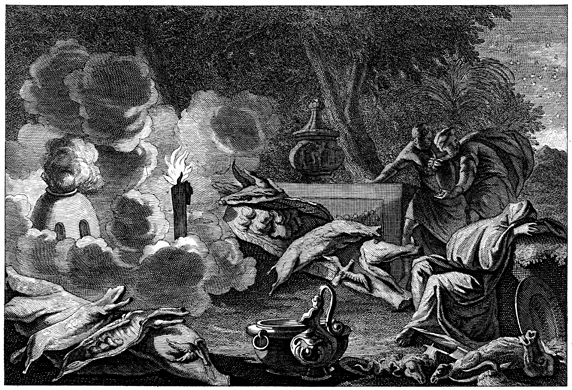
The dark scene of the sacrifice feels prehistoric to us – yet it speaks of something profound of which we have lost sight. The Power of Word – or Promise – or Oath – that we are taken with immense seriousness. If the Word of God endures forever, does not that of the human made in his image? The divided animals were potent reminders of the significance of the human word – that it was a Bond. ‘Thus be it to me as it is to these animals if I do not keep my word’ [Thus do not swear . . . let your yes be yes, your no, no] Words are the creative power of life, and the destructive power of death. As Noah creates division enmity in blessing and cursing, so oaths have deep power. Yet here one party is taken out of the picture. Abram falls into a deep sleep – who walks between the pieces, with whom does the LORD make this covenant, but with himself. Abram as we see cannot be trusted [‘he knew what was in a man’] – Abram will try to do it for himself – he will not be a covenant partner. God swears by himself  – and when man fails – God pays the price

Anyone who does not see that the entire world is built for better or worse upon human sacrifice is blind to Reality. The offensiveness of the words of Christ are two fold – we think we have moved on from these deep primitive archetypes and metaphors – we think his words are nonsense, for we do not treat words with seriousness, And we like Abram and Sarai still believe that we can have life that is not Promised. The Gift that comes in the Creative Word – made flesh and blood – that is offered to us as real food and real drink – that we might have life within us.

Sermon for January 6 – EPIPHANY 2013

EPIPHANY2013 [Link to recording of sermon]

EPIPHANY 2013 – YEAR C – Text of sermon as prepared

Isa 60:1-9
Eph 3:1-12
Matt 2:1-12

Latecomers

Well I hope that you have celebrated Christmas fully – the whole twelve days!! 🙂 As I noted a few days ago, my weighing scales seemed to be measuring out the twelve days pretty accurately, if you count out time in additional pounds! 🙂 As we’re often told, we don’t know the actual date of Jesus’ birth, although if Jesus was born six months after his cousin John the Baptist then we can say with some certainty that Jesus was born in September. John’s father Zecchariah was on duty in the Temple at the time of the announcement of John’s birth and thus, knowing when his family would have been on duty as we do – Luke tells us Zechariah was of the order of Abijah – it’s merely a matter of adding 15 months which brings us to September!! So we were ALL late for Christmas!!
However many Christians are even later than we were. For Orthodox Christians, who make up about 1/3 of the world’s Christians celebrate Christmas today – the Feast of the Epiphany – so if you like a good reason for some more celebration – then conversion might be a good idea 🙂

Of course the reason that the Orthodox celebrate Christmas today is because it is today – the feast of the Epiphany – we remember the Revealing of Christ to ALL nations. The Magi, the Wise men from the East being foreigners – outsiders on the story of Jesus – who in some regards represent Us. We are so used to being Christians, we forget that we are latecomers to the story of God’s people. That as of old, it wasn’t our story.

Even that first Christmas story isn’t really ours – no matter how much we try and domesticate it in Nativity plays. We pay little or no attention to the fact that the events around the birth of Jesus are all Jewish. The gospel is first announced to the Jewish people – and then and only then to the Gentiles – that’s us.  Not only is his birth announced in this order – the Shepherds coming to Bethlehem long before the Magi – Jesus himself says ‘I was sent only to the lost sheep of the house of Israel.’ and he sends out the twelve saying ‘Go nowhere among the Gentiles, and enter no town of the Samaritans, but go rather to the lost sheep of the house of Israel. and first to the Jews is the way that the Gospel is proclaimed. So on the day of Pentecost Jerusalem is full of Jewish people – yes from all over the known world, but all of them Jews. It is only following Peter’s conversion through a strange dream that the Gospel is then taken and announced to God fearing Gentiles in the household of Cornelius. And so Paul writes to the Ephesians – I Paul am a prisoner for Christ Jesus for the sake of you Gentiles – AND – Although I am the very least of all the saints, this grace was given to me to bring to the Gentiles the news of the boundless riches of Christ, and to make everyone See . . . !

Listen to the words of the prophet, Nations shall come to your light, and kings to the brightness of your dawn. 4Lift up your eyes and look around; they all gather together, they come to you; your sons shall come from far away, and your daughters shall be carried on their nurses’ arms. 5Then you shall see and be radiant; your heart shall thrill and rejoice, because the abundance of the sea shall be brought to you, the wealth of the nations shall come to you. 6A multitude of camels shall cover you, the young camels of Midian and Ephah; all those from Sheba shall come. They shall bring gold and frankincense, and shall proclaim the praise of the Lord. 7All the flocks of Kedar shall be gathered to you, the rams of Nebaioth shall minister to you; they shall be acceptable on my altar, and I will glorify my glorious house – These are words of promise for the Jewish people – ‘You’ here, is not us 🙂
If we remember the parables that Jesus told of the Kingdom being like a great feast, then Epiphany is a reminder that we weren’t on the original guest list! We are latecomers. And so perhaps celebrating Christmas at This time is a good idea. Not only because we have become so accustomed to Christmas Our way the comfortable way we’ve always known it, it is easy to forget that this message is not about Our ways. It is about God’s way. This Christmas story is as always meant to disturb us, to shake us out of our familar ways and to place us in the midst of something far greater – and to make everyone see what is the plan of the mystery hidden for ages in God who created all things

And what is that mystery?? Well our reading comes in a little late as well – it’s not just Christmas that is late – Paul puts it like this in the verses before our reading So then you are no longer strangers and aliens, but you are citizens with the saints and also members of the household of God, 20built upon the foundation of the apostles and prophets, with Christ Jesus himself as the cornerstone. 21In him the whole structure is joined together and grows into a holy temple in the Lord; 22in whom you also are built together spiritually into a dwelling place for God.

God’s secret plan – the mystery hidden for ages – is that he desires once more to have a place to dwell upon earth and as I said on Christmas day, reflecting on the words of John ‘The word became flesh and tabernacled amongst us, that place is in and amongst his people’ ‘With Christ Jesus himself as the chief cornerstone’ With Christ Jesus himself as the foundation – The foundation  – of everything . . . and as we know all too well here in New Zealand, mucking around with foundations brings buildings down – and so the house of Herod – the one who himself had tried to have himself made ‘King of the Jews’ by dictat – the house of Herod is shaken to its foundations ‘Where is the child who has been born king of the Jews?’ Such an innocent enquiry – and one that threatens everything – all that Herod had planned and built. But like any ruler always on the lookout for those who might usurp his power (partly why we can never expect grown up politics . . .) Herod announced himself ‘King of the Jews’ and ordered that his sons succeed him, but then had them executed!!1 When King Herod heard this, he was frightened, and all Jerusalem with him

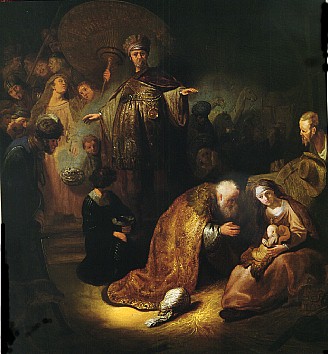
And so the Magi come to offer their gifts – Gold Frankincense and Myrrh – and knelt down and paid Him homage. Not paying homage to Herod – homage to the one who is the corner stone for the dwelling place of God

And having been warned in a dream not to return to Herod, they left for their own country by another country . . . this is dangerous knowledge . . .

To know Him who is the cornerstone of the dwelling place of God is dangerous knowledge – as it remains today, at least where the church has retained the understanding that all knees must bow before him to pay homage . . . the understanding that actually We too are outsiders . . . that our obligations are not to the rulers and pricipalities of this age – but of those of the age to come

On an almost daily basis I receive from around the world news of the persecution of Christians – just this past week I read startling evidence that Christians are overwhelmingly persecuted for their faith over against all other faith groups. From our context here in New Zealand this must sound very odd – what after all is very threatening about being a Christian?? We don’t need to be warned in a dream not to tell folk about the one who has been born into the world to supplant all human rule and authority – we just don’t do it.

There is I think a very necessary strangeness in the visit of the Magi – those who come from the East. Whose focus is no human rule but one divinely revealed in the shining of a strange star. I think we too readily try to undo this story – try to make it make sense on our terms and when it doesn’t, then dismiss it – we fail to be troubled by it, in much the same way we have lost sight of the troubling idea that this Faith isn’t first of all ours – that we were only lately invited to become the people of God, and that the birth of Christ into the world really does challenge everything we are so accustomed to.

This is Not an easy story – and the life we are summoned to is not a life of ease. our reading from Paul stops at Verse 12. He continues I pray therefore that you may not lose heart over my sufferings for you; they are your glory. This Glory that the angels announce – and that the Wise men behold will come about only through suffering and on our part, the chief part of that is the knowledge that in being insiders to to the mystery that has been revealed in Christ – we find ourselves outsiders in the world in which we ha learned to be so comfortable

In a sense I think that this is the great adjustment we need to make at this time. Most of us have grown up with church being a very ordinary part of things one way or another – certainly I did. But that is rapidly changing – once more we are coming into an age where to Know Christ is, as it is for so many of our brothers and sisters to be in possession of dangerous knowledge – But Life giving knowledge. In the early years of the church Christians met as they do nowadays in China and PAkistan, in Iran and many other places, behind closed doors. There as in the early days of the church, the wider world’s hostitlity was shut out as God’s people met in secret – to worship and adore – to lay their treasures before him . . . and the church grew like never before as it continues to in those places – so that through the church the wisdom of God in its rich variety might now be made known to the rulers and authorities in the heavenly places.
Perhaps The great strangeness of Christian faith in this world today is that it is not primarily a set of ideas, an ideology, a way of life, it not about values. No it is about a person. We bleieve in Jesus Christ the only son of God eternally begotten of the father, God from God, Ligth from Light, true God from true God, begotten not made, being of one substance with the Father through whom all things were made. Our Faith is to Know ourselves to be His –  in relationship with Him, the Babe of Bethelehem, the King of the Jews, the Son of God most High. It is Only in and through worship and adoration that we like the Magi begin to comprehend what we are called into, and how Graced we are that we who were once far off have been brought home.