An Anglican Priest of Northern English extraction
Discovering Home
Learning to be a Friend, father and husband - but above all, and indeed radically redfining all of this, a Disciple of the Risen One
‘Beloved borthers and sisters: Unto us is born this day a Saviour. Let us Rejoice!
It would be unlawful to be sad today, for today is Life’s birthday, the birthday of that Life which, for us mortal creatures, takes away the sting of death and brings the bright promise of an eternal hereafter. It would be unlawful for anyone to refuse sharing in our rejoicing. All have an equal part in the great reason why we are joyful, for our Lord, who is the destroyer of sin and death, finding that all are bound under condemnation, is come to make all free.
For when the fulness of time was come, the Son of God took upon himself human nature so that he might reconcile that nature to him who made it; hence the devil, the inventor of death, is met and conquered in that very flesh which had been the field of his victory.
Let us give thanks to God the Father through his Son in the Holy Spirit, who for his great love wherewith he loves us has had mercy on us and has quickened us together with Christ even when we were dead in sins, that in Him we might be a new creature and a new handiwork.
Let us then put off the old nature with its deeds, and having obtained a share in the sonship of Christ, let us renounce the deeds of the flesh.
Be conscious, O Christian, of your dignity! You have been made a partaker of the divine nature; do not fall again by a corrupt manner of life into the beggarly elements above which you were lifted.
Remember whose Body it is of which you are a member, and who is its Head.
Remember that it is he who has delivered you from the power of darkness and has transferred you into God’s light and God’s kingdom. By the sacrament of baptism, you have become a temple of the Holy Spirit. Do not cast away this guest by evil living and become again a servant of the devil. For your freedom was bought with Christ’s own blood.
From the ‘Sermons on the Lord’s Birth’, St Leo the Great
Sermon for Christmas – 2013
John 1:1-14
‘In the beginning was the Word, and the Word was with God, and the Word was God.
The same was in the beginning with God.
All things were made by him; and without him was not any thing made that was made.’
I wonder what the word Christmas summons up for you?
Perhaps you might just like to take a moment to rest and reflect in that.
Christmas. Many years ago, growing up as part of the church in the North of England, I frequently seemed to be in services led by the then Bishop of Carlisle, David Halsey. For some reason I cannot fathom, it seemed that every time I heard him speak he gave the same sermon recounting what had happened to him one Christmas at a midnight service where he’d expected no one to turn up and the church ended up packed. I cannot to this day remember what the point of the story was, but his capacity to summon up images with his words means that the picture is clear in my mind. Words call forth entire worlds, worlds of imagination and worlds of existence.
Words Create worlds. Many years ago whilst at University I shared a room with a young and very troubled man. Stephen was a student of the English language and spent much of his time sending his poetry to every publisher he could think of – apart from the odd encouraging reply, to no avail. But it was He who first taught me in a most graphic way the power of words. In many senses, his troubles were rooted in his fascination with the literature of Occult practices. There was a perpetual and at times impenetrable darkness to him, especially when he had been reading such material, and of an evening and long into the night purely by speaking he would ‘summon up’ worlds of such oppressive darkness that the darkness was tangible and capable of doing no less than creating a cold dead place in my soul.
Of course not all such Creativity with Words is as obviously life denying, but our carelessness with the Creative power of Words still leads us into dark places. What culture can hope to remain humane where Rest homes are termed ‘end of life facilities’, or where in the workplace we have carelessly named ‘Human Resource managers’. Once you call a human being a resource, they become categorised along with coal and oil and gas, with soil, and hammers. Something to be Used – and to Use a human being is Always to Abuse a human being. We should take care with our words – they speak our pasts and they create our futures.
Words Create Cultures. If you want to get to understand a culture, then tourism will do you little good. If you want to truly inhabit a culture, you must learn its Words, its language. For me one of the sharpest lessons of coming to New Zealand has been learning this afresh. As Mark Twain said of the English and the Americans, ‘Two nations divided by a common tongue’, so our two cultures use the same words, but differently. This is even more perplexing than having difficulties with Mandarin Chinese, or Usbek – for we miss the point that the Use of words is what creates a culture – so different cultures may have the same words, but very different languages – as my eternally frustrated American friends realise when they speak with me! Same words, but we are not communicating, for our words mean different things to us.
Words Express a culture – Here in New Zealand, the culture is ‘She’ll be right’, and revealing the roots of our common culture ‘Good as Gold’. But that also reveals that Words Form Us. To grow up a New Zealander, or indeed English or American, is to learn a Way with Words. We tend to think that language is primarily about our self expression, but we fail to see that the self we express has already been shaped by our birth cultures words. For example we see this when we reflect that the ideas about our unique individualism, are passed onto us by our culture – so our thoughts are, I regret to say, mere products of our culture – and should we decide to rebel against this, then they are products of our rebellion against our cilture. Blood as they say, will out.
Of course here we are also ‘gifted’ by being a bicultural nation – We Should be Very wise about Words for we readily use Maori where the paucity of English becomes clear. It surely is Obvious here in New Zealand that Words express cultures? That they crate words of imagination that are more than that, that have a concrete quality to them that profoundly affect our lives together.
And of course, here in church tonight we are awash with Words – most Very familiar – the Carols and the readings – although there is something which for most of us is Not So familiar and that is the words of the liturgy. It is both pertinent and interesting to note that the collapse of congregation sizes in England, and I suspect here also, coincided with changing the liturgy. All of a sudden the words were no longer the common language of worship – it was as if once more we were at the tower of Babel. Without a common tongue, you have no common people, all you have is the primeval formlessness and void, and so the people dispersed . . .
But we ARE gathered here once more tonight – in the middle of the night – and whatever impulse it was that drew us here in large part it is rooted in Words. Imagine for a moment that you knew in advance that all the Carols would be unfamiliar, or the readings . . . that in an effort to be relevant the new Vicar had completely rewritten the service . . . knowing that to be the case . . . would there have been the same Pull to be here?
Formed by words, what Words have as it were drawn us forth?
What draws us out of the comfort of our homes tonight? Perhaps it was the gentle cajoling of a Spouse or a parent? Or perhaps indeed the plea of a younger one to come and know what it was to be in church in the middle of the night? Perhaps we were sat alone and it was the memory of all that was in the past – voices seemingly gone, yet not forgotten – summoning us forth
I was speaking recently with someone relatively new to the church and the Deep things of faith, who expressed his journey thus . . . it was as if the words were summoning forth the person I had always wanted to be . . .
And it struck me what a wonderful expression that was of a person coming to faith in Christ. The Word that summons forth those people we were created to be – The Word that spoke to Lazarus, four days dead in the tomb – Lazarus! Come Out!
At the very heart of this Eucharist is this truth expressed in words but which words are in a sense inadequate to contain, that ‘The Word’, the Primeval Word that is the the Creation of all that is, The Word of the Beginning, The source of All Life, ‘And the Word, THIS Word became Flesh’. Going deeper into our memories than children’s nativity plays, than the story of the first Christmas, the words of the gospel of John taking us back, taking us back to something which predates all our cultural separateness, taking us back to our common root, our Creation as the Image of God, Christ THE image of the Living God, The Creative Word from which all creative life giving words flow, steps into human flesh and dwells amongst us
And we beheld his glory, the Glory as of the only begotten of the Father. It is as if that pale flickering light that is God’s image in us, if we trace it back to its source is like the Glory of a thousand Suns – Here in the middle of the night, Inexpressible Light.
I often wonder what might indeed be the impact of our coming to understand the fulness of all we are engaged in when as Christians we gather for the Eucharist – Where the Word made flesh is presented to us in Bread and Wine. The Light, that Inexpressible Glory, which darkness cannot comprehend, which is the Life of all people – reduced to a mortal span and present with us. But perhaps it is only right that we cannot fully understand, that we cannot put it fully into Our Words, for it is not we who create the world. our lives, our selves, our very thoughts the product of so many words of others. The deepest truth about ourselves we encounter in this Holy Night, not that we speak – but that we are Spoken . . . In the beginning was the Word, and the Word was with God, and the Word was God. He was in the beginning with God. All things came into being through him, and without him not one thing came into being. . . . And the Word became flesh and dwelt among us, and we have seen his glory, the glory as of a Father’s only son, full of grace and truth.
What is summoned up for you, on this Holy Night? May that Word speak and summon forth in us Light and Life from the forgotten depths of our being, and may we know what it is to be born of God, in Christ the Living Word, to the eternal glory of the Father. Amen
In this Holy Night, let us pray that Christ may be born in us, and fill us with His Light and Peace
Silence is kept as we wait on the One who prays within us
Eternal God, You made this Holy Night shine with the brightness of your one true light. Bring us who have seen the revelation of that light on earth to see the radiance of that heavenly glory, through Jesus Christ your Son our Lord, who is alive and reigns with you and the Holy Spirit, One God, now and forever. Amen
‘When the sun rises in the morning sky, you will see the King of kings coming forth from the Father lioke a radiant bridegroom from the bridal chamber. Alleluia’
Litany
The Word became flesh in order that all of humanity might be revealed as children of God. Let us pray to him and say: Jesus, born of Mary, hear our prayer
That holy Church enjoy a rebirth in this glorious feast and proclaim throughout the world the eternal kingdom of heaven, we pray Jesus, born of Mary . . .
That we show forth the birth of God’s Son by a new way of life, a new love for people and a new regard for the good things of this world, we pray Jesus, born of Mary . . .
That Christian communities celebrate this feats with joy, with all the happiness and delight of the family of God, we pray Jesus, born of Mary . . .
That with simplicity of spirit we stand in wonder to proclaim with the shepherds joy and glory and peace, we pray Jesus, born of Mary . . .
That we all find Christ reborn in our hearts so that together we may show forth his meekness and poverty, we pray Jesus, born of Mary . . .
Concluding prayer
Lord God, whilst all the world lay wrapp’d in deepest silence, and night had reaached its mid-point, your all-powerful Word came down. As year by year the beauty of this night returns, growing old with the aged and renewed in the wonder of children, so may we, grown old in sin but reborn to grace, proclaim with our lives what we chant with our lips:
Glory to you, our God, in the highest heaven, peace on earth and in the depth of every human heart. We ask this through our Lord and Saviour Jesus Christ, God with us. Amen
The Advent Antiphons are said or sung before and after the Magnificat at Vespers each evening of the week immediately prior to Christmas. Each one speaks of an aspect of the One who is to come, Israel’s hope and a Light to the Gentiles.
This set of reflections juxtaposes each of the Antiphons with one of the seven ‘I AM’ sayings of Jesus Christ, the embodied Hope of all Creation – the Word made flesh.
In this video, the Dominican brothers of Blackfriars Oxford sing the Magnificat Antiphon, O Immanuel
O Emmanuel, Rex et legifer noster,
exspectatio Gentium, et Salvator earum:
veni ad salvandum nos, Domine, Deus noster.
O Immanuel, our King and Lawgiver,
The One Expected of the nations, and their Saviour,
Come and save us, O Lord our God
(Translation from Benedictine Daily Prayer: Liturgical Press)
Today we come to the last Vespers before the feast of the Incarnation. The Antiphon, O Emmanuel, is the briefest, and yet the most breathtaking in its scope. In holding together those things which in our human frailty we cannot begin to conceive of as other than antithetical, more so even than ‘King’ and ‘Shepherd’
Immanuel, ‘God with us’, we know from its root in Isaiah, is a sign of the one who ‘is coming with judgement to save us’. [Psalm 50, one of the great Advent Psalms expresses this as the prayed Word of God] And thus also of an imminence beyond our senses and comprehension of The Transcendent One. He who Is Other, whose ways and thoughts are most assuredly Not ours comes to dwell amongst us.
In this simple Antiphon, all the Antiphons coallesce and find a home as the Hope of the Nations comes to us.
Jesus in his ministry amongst the Pharisees creates the same indigestible possibilities. ‘How can this man give us his flesh to eat?’
Almighty and eternal God With Us – the Judge who comes to Save us – who commands ‘unless you eat the flesh and drink the blood of the Son of man, you will have no life within you.
Advent, primarily is about Faith. Faith makes us Expectant. Faith is the midwife of Hope. Faith causes us to Watch, to Wait, to Listen, to Strain our senses to catch the first rays of the rising dawn. By Faith we acclaim Christ as King of the Nations, the Lord of All. By Faith we Know him to be The Way to the heart of the Father, the Wisdom which at once describes and IS all of Creation in its plenteous goodness.
And by faith we now come to the Great Feast – where we feed on him in our hearts by faith. It is when we assent to these apparent impossibilities that our eyes are opened and we See and are healed.
The Advent Antiphons are said or sung before and after the Magnificat at Vespers each evening of the week immediately prior to Christmas. Each one speaks of an aspect of the One who is to come, Israel’s hope and a Light to the Gentiles.
This set of reflections juxtaposes each of the Antiphons with one of the seven ‘I AM’ sayings of Jesus Christ, the embodied Hope of all Creation – the Word made flesh.
In this video, the Dominican brothers of Blackfriars Oxford sing the Magnificat Antiphon, O Rex Gentium
O Rex Gentium, et desideratus earum,
lapisque angularis, qui facis utraque unum:
veni, et salva hominem,
quem de limo formasti.
O King of the Gentiles, and the Desired of all,
you are the cornerstone that binds two into one.
Come and save poor humanity,
whom you fashioned out of clay.
(Translation from Benedictine Daily Prayer: Liturgical Press)
To most of us the titles ‘Good Shepherd’, and ‘King of the Nations’ sound poles apart. Shepherds are not Kings and Kings are not Shepherds. The Nativity of Jesus seems only to enforce this, as Shepherds come to worship whilst Kings seek to kill and destroy pretenders to their power.
Yet deep in the memory of Israel – the One who is to Come is at once both King And Shepherd, for instance in Psalm 23. Yahweh, Israel’s God and true King, is my Shepherd.
But Israel’s desire for a King had been so that they might be like all the other nations and so Kingly Rule in Israel followed the path it did and the Kings from David down were not a source of blessing and life, but curse and eventual desolation and exile as graphically prophesied and recounted in the Fifth Gospel, the book of Isaiah.
Jesus declaration ‘I Am the Good Shepherd’ takes us straight back to the vision of the Psalm – indeed its imagery of being led by still waters, of the restoration of the soul, of tables being laid for His flock are found all through the gospels.
The One who is also the Gate, is declared to be the Good Shepherd who enters by the gate, whose sheep know his voice and follow Him. The One who does not expect his flock to lay down their lives for him, as human kings do, but rather lays down his life for his sheep – thus exposing the mythical necessity of laying down ones life for the ‘king’. The True King of Israel, the ‘One born King of the Jews’ whose star rises suddenly and without explanation, has come. The Shepherd is amongst his flock.
Yet He goes further – this Shepherd has sheep of ‘other folds’. Israel’s true King is also King of the Nations – the One before whom every knee in heaven and earth and under the earth shall bow, Saving All who hear his voice and Like Lazarus come forth and follow Him.
Sermon for Advent 4 – Year A 2013
Isaiah 7:10-17
Romans 1:1-7
Matthew 1:18-25
‘Chosen – Righteous Joseph’
School, on the whole is not good for the soul. Often as I took parties of youngsters onto the hills of Northern England I would reflect on how much more humane were our encounters away from the classroom. Schooldays we were told were the happiest days of our lives. Many, indeed in all probability most, would beg to differ.
Amongst the many humiliations of my early schooldays, one endured by countless youngsters over the ages was the weekly football. (I have two left feet, dances find me lurking in the kitchen or indeed the bar, trying to escape the horror of the invitation to dance and the inevitable disappointment of my partner.) But probably worse than the humiliation of playing Football, of endless freezing cold afternoons in the bulk buy nylon Wolverhampton Wanderers strip – the details are etched in my mind, as with an iron tool upon lead – worse than all of that was the ritual of picking the team.
Week by week the two best footballers would take turns to choose their team. Some of my gifted classmates would jump up and down saying ‘pick me, pick me!!’ and find themselves as the glamour boys, the strikers, then there were the not outstanding, but not incompetent ones who would pack the midfield, then finally the scrapings. Week in week out, without fail. Being chosen carried nothing glamourous – I was amongst the ‘no choice’ candidates – to occupy the Defence. Picked for standing around doing nothing if your team was doing well, and being shouted at by the rest of the team when, as was inevitable, the Good players ran past you as if you weren’t there and scored a hatful of goals. The PSychotherapy has been expensive and only partially successful!
Of course, the idea of being chosen usually carries with it a certain kudos. Being chosen to be head boy or head girl at school, Being chosen first for a sports team. You are Wanted – You are special, and ‘the chosen ones’ at my High school – the First XV rugby team wore their chosenness as many do – corridors cleared ahead of them – we were taught to live in fear, an almost Holy Awe of these chosen ones, who did not wear their election lightly, but KNEW they were Special.
Being chosen is also an integral part of the story of our Common Life and faith. Last week we rehearsed the story of ‘God’s Chosen people’, the Jews, as we built up our Jesse Tree, but this is chosenness of a different order. (Indeed although my spellchecker does not recognise ‘chosenness’, if your Google it – every hit is a reference to the Jewish people).
A Substantial part of the story of Israel, was the constant stream of humiliations visited upon them when they forgot that their being chosen did NOT mean that they could behave like the first XV. The focus of their faith was not that they were chosen, it was the one who had chosen them. Not WE have been called by God, but ‘we have been called by GOD’ Called not to be full of themselves, rather to be empty of themselves, and quite literally full of God, as revealed by the Temple in the midst of them. A chosenness which was not a vehicle for self regard, a cause for pride – a chosenness which required Absolute attentiveness to God, expressed in Faith Full Obedience.
Now there is One way of telling this story which goes like this. God Created the world full of goodness, chose Israel and they screwed it up, they weren’t up to it – therefore God had to put into effect Plan B. Jesus as it were as an afterthought – a second try, and indeed we might then look around us and hope that God has a plan C. But like joining the dots, its always possible if you have enough dots to draw whatever you like. So whilst there are elements of truth in the story that so many tell, it is wrong in two key elements.
Firstly that Israel was Chosen to be the bearer of the very Life of God, in the Word made Flesh – in Jesus Christ. That was Always the plan, that God himself would dwell amongst his people, and that through them All the nations of the world would be blessed.
That was what the faith of the Patriarchs in particular Abraham, ‘the father of many nations’.
And the ‘Jesus was God’s plan B story’ is also told wrongly, because it says ‘Everything had gone to the dogs – there were NONE who were righteous, none whose attention was still on God and his promise.
Yet the story of the people of Israel is throughout the story of a faithful remnant, even though the people as a whole go astray. As Advent moves to its climax, the hopes and fears of all the years are coming into sharp focus in two of these remnant of faithful Israel. Mary, who without realising why ‘has found favour with God’ – When our attention is on God, even the fact that we are attentive to him is hidden from us, and , oh yes Joseph . . . also chosen . . . like Mary, like faithful Israel, chosen for obedience.
Joseph is overlooked from the earliest years of our Christian walk. ‘I’m going to be Mary in the nativity!!’ is a far more joyous cry in households, than ‘I’m going to be Joseph’ – so peripheral in our imaginations to the Incarnation is Joseph, that it’s not much above being picked to be a sheep . . . ‘Mary. . . and of course angels :-)’ – ‘Joseph and the sheep’. [I’m not for a moment suggesting there are certain gender imbalances which need to be addressed here . . . ;-)]
In Year A we focus on Matthew’s gospel and thus the account of the birth of Jesus is told through the story of Joseph – not his perspective mind you. We get little or no insight into the workings of Josephs mind. I remember once seeing a wonderful stage play which was in effect an extended dramatic monologue of Joseph in his carpenters shop musing on being ‘chosen’ in this way. We like to do this – to put ourselves in Joseph’s place – but really when we do this we are dragging Joseph into ours. We project how we would feel onto him. None of us know how Joseph would have felt. And such flights of fancy distract us from what Matthew tells us.
Joseph we are told discovering that Mary is pregnant ‘being a righteous man and unwilling to expose her to disgrace, planned to dismiss her privately’ – Joseph ‘being a righteous man’ . . . Sadly and I think to our almost infinite loss, the word righteous as an adjective for a man or woman, has become horribly devalued. Because of our focus on Jesus and his encounter with the Pharisees – because of our own experiences of some people with whom we rub shoulders, because of a failure to understand properly what it means to be a sinner, or a saint, indeed to totally misunderstand the Work which Jesus comes to accomplish, we do not think the word Righteous can be a truthful life giving adjectival modifier of ‘Woman’ or ‘Man’. And it has slipped from our speech. If we read someone was a ‘Righteous man’, we tend to think they are at best unutterably dull, or at worst a hypocrite – usually a combination of the two. But this is not the witness of Scripture. Indeed if we have been attentive to our Advent readings we read of ‘A righteous branch to spring up for David’ – Jeremiah’s version of the Jesse Tree.
Joseph is a righteous man – that is he is of the type described in Psalm 1 – to be righteous is to be attentive to and obedient to God Happy is the one who does not follow the advice of the wicked, or take the path that sinners tread, or sit in the seat of scoffers; but his delight is in the law of the Lord, and on his law he meditates day and night.
They are like trees planted by streams of water, which yield their fruit in its season, and their leaves do not wither. In all that they do, they prosper. – These are the ones who are marked as Righteous in the Scriptures. There is nothing of Self Righteousness in them – they are not absorbed in how they appear to others, they are absorbed in and absorb like Water from a stream, the Life of God. In a Very important sense they are the chosen – Called AND chosen – responsive to the Call of God – He is the focus of their faith.
One of the deepest mysteries of our faith is how God puts himself into our hands – he is in a strange sense reliant on those he has called. And this is VERY important for how we understand Jesus. Jesus is both utterly divine AND utterly human. It is all too easy to imagine Jesus as a ‘special case’ in his humanity – as if his humanly obvious righteousness, his life of prayer and fasting and obedience to what God says to him, is entirely a one off. But to do that is to as it were see his human life as nothing more than a veil for his divinity. It is as if we say – Jesus can only be attentive to the Father Because of his divinity. It is to say that it is Not human. But precisely because Jesus IS fully human, that Righteousness we see in him is not only divine but humanly transmitted, through Mary and to the external observer, through Joseph as well. The Righteousness of Jesus is utterly divine, but also though MAry and indeed Joseph, utterly human. The scriptures take with full seriousness our human nature and how our life towards God is transmitted humanly as well as through the waters of rebirth.
And Because Joseph is righteous, he is receptive to what God wishes to say. Faith revealed in obedience. The Christian life, the life of the Righteous, is a life of faithful obedience to what God is saying.
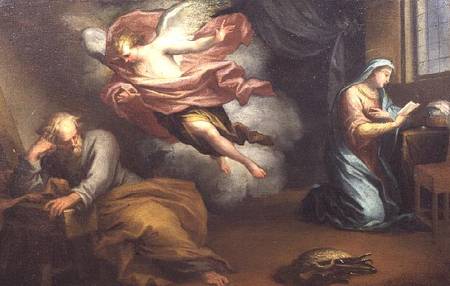
Of course Joseph at first tries to protect Mary – from the shame but then attentive, righteous Joseph is spoken to by an angel through a dream. ‘Joseph, son of David, do not be afraid to take Mary as your wife, for the child conceived in her is from the Holy Spirit. 21She will bear a son, and you are to name him Jesus, for he will save his people from their sins.’ Joseph, son of David – Joseph is announced as part of that Righteous branch of David that Jeremiah spoke of, the faithful Remnant. And he is given work to do ‘Do not be afraid to take Mary as your wife’ You Watch over her – and a tremendous privilege – and you will name him ‘Jeshua’ – which literally means God Saves. And BECAUSE he IS righteous, because He is Attentive and desires Only to do what God desires of Him, He Is Obedient.
When Joseph awoke from sleep, he did as the angel of the Lord commanded him; he took her as his wife, . . . and he named him Jesus.
Exemplifying the obedience that comes through faith of which Paul speaks as he introduces the Gospel of Jesus Christ, The Obedient One, The Righteous One. And this is why as we draw ever so close to the birth of Christ, we rejoice and give thanks for Joseph and Mary – who are chosen for faithful obedience, and pray for the grace to be similarly God attentive, and obedient to what He requires of us – to his eternal glory. Amen
The Advent Antiphons are said or sung before and after the Magnificat at Vespers each evening of the week immediately prior to Christmas. Each one speaks of an aspect of the One who is to come, Israel’s hope and a Light to the Gentiles.
This set of reflections juxtaposes each of the Antiphons with one of the seven ‘I AM’ sayings of Jesus Christ, the embodied Hope of all Creation – the Word made flesh.
In this video, the Dominican brothers of Blackfriars Oxford sing the Magnificat Antiphon, O Oriens
O Oriens,
splendor lucis aeternae, et sol justitiae:
veni, et illumina sedentes in tenebris, et umbra mortis.
O Rising Dawn,
Radiance of the Light eternal and Sun of Justice:
Come, and enlighten those who sit in darkness, and the shadow of death.
(Translation from Benedictine Daily Prayer: Liturgical Press)
Those of us who live in higher latitudes, especially in the summer months *, have perhaps little sense of the sudden change from day to night of those lands closer to the equator, such as the land of Palestine. Here night falls, and day breaks. There is not much by way of dawn or dusk. This suddenness of the Rising Dawn in the East in this Antiphon – draws us to the words of the prophet : ‘the LORD whom you seek will come to his temple’ So as the one who watches for the dawn has only the briefest of opportunities to announce it, the Light of the World does not slowly dawn on our consciousness, rousing us gently from slumber . . . thus we are commanded to Keep Awake! through Advent. To remain alert and attentive, for the signs of his presence remind us that He Is Near.
And a more sure and certain light we could not hope for.
The Psalmist describes the Word of God as a light to our paths and a Lamp to our feet. Often the world may seem a very dark place – often it seems that we know not what we should do, yet He Is Near. Jesus tells us that He is the sure light, the Light of the World. Which way should we go? ‘Follow me!’ he at once invites and commands us. ‘Whoever followsme will have the light of life and will never walk in darkness’. He is Near, Always Near! If we have lost sight of Him it is because we have fallen prey to the distractions of the World.
The World promises much to us which glitters and glistens, which suggests security and salvation but they deceive.
On some mornings I am graced to see the sun rise over the Pacific Ocean *. Where I live it is particularly intense, but it is never certain. When we look for other lights, they fail. ‘Put not your trust in princes or in any child of man’. They fail, they are flawed. Put not your trust in the abundance of your possessions for they will perish. Rather put your trust in the one who is the World’s true light.
Advent like all of the seasons of the Church is given to sharpen the essentials of our faith. In Advent we renew our sleep threatened attentiveness – the continual practice of waiting upon the Lord, ‘as the eye of a maid looks to the hand of her mistress’
This Antiphon of the Rising Sun, reminds us that the time draws very near. Wake! Watch! Pray! For your Lord comes! Suddenly! Light!
* This blog is written in Southern New Zealand where it is at once Advent and the days are at their longest
The Advent Antiphons are said or sung before and after the Magnificat at Vespers each evening of the week immediately prior to Christmas. Each one speaks of an aspect of the One who is to come, Israel’s hope and a Light to the Gentiles.
This set of reflections juxtaposes each of the Antiphons with one of the seven ‘I AM’ sayings of Jesus Christ, the embodied Hope of all Creation – the Word made flesh.
In this video, the Dominican brothers of Blackfriars Oxford sing the Magnificat Antiphon, O Clavis David
O Clavis David, et sceptrum domus Israel;
qui aperis, et nemo claudit;
claudis, et nemo aperit:
veni, et educ vinctum de domo carceris,
sedentem in tenebris, et umbra mortis.
O Key of David, and Sceptre of the house of Israel;
you open and no-one closes;
you close and no-one opens:
Come and deliver from the chains of prison
those who sit in darkness, and the shadow of death.
(Translation from Benedictine Daily Prayer: Liturgical Press)
Perhaps the most obscure of the seven ‘I Am’ sayings of Jesus is ‘I Am the gate for the sheep’ – the most obscure but in one sense perhaps the most clear in focussing us upon the very person of Jesus?
At the heart of the Christmas message is the category shattering pronouncement ‘and the Word became Flesh’. That which might to John’s Greek speaking listeners have been taken for the organisational principle of Reality, not merely ‘puts on’ flesh, but Becomes Flesh. This is the most powerful Move away from Abstraction, to the Concrete. And a very particular Concrete, that is the man Jesus of Nazareth.
We have spoken of the need to Contemplate – to Abide in Him. And that need remains as Life giving and urgent as ever, for we are wont to make of the gospel a set of principles, or a story, or a system of salvation, or a set of morals, veering as we do into a self referenced Deism, with plenty of room for us as the Centre of all things for apart from the concrete reality of Jesus, there is noThing to fill the void of ideas and principles.
The Word becomes flesh and invades our Space. And the language of The Gate moves us on from the Davidic gate keeper of the Antiphon. Jesus does not merely stand watch over the gate, He IS the Gate. We can only enter in and through Him in his concrete existence. Indeed any attempt to reduce Him to principles or morals, or words, (even ‘good’ words such as ‘Grace’) – marks us out as vagabonds and thieves, trying to steal in a different way – to take a course more suited to our own desires, rather than the way of the Cross, the Way into which we are baptised at the outset.
One of the perils of our age, which is beyond all that have gone before it ‘wordy‘ (and I am not unaware of the irony of pointing it out here), is that The Word becomes just that, a collection, a seemingly perpetually expanding collection of words, innumerable abstractions, propositions and principles. And so the Challenging Simplicity of faith in Jesus of Nazareth, born of Mary, the eternally begotten Son of the Father, is lost.[Indeed all attempts to move away from the Trinitarian Name as our means of addressing God does just this]
Ours is a Sacramental Faith and necessarily so. Through the Water of Baptism, we enter the Jordan with Jesus in His baptism, we are immersed in the death of His Body, and raised to New Life. In our encounters with one another we are presented constantly with opportunities to Love Him. And in the Eucharist – we feed on Him, who is our Life.
Contemplation and Deep abiding in Him are Advent practices which focus on the person of Jesus of Nazareth – the one in whom all Ideas become Flesh and blood Reality. In whom there is No abstraction, and through whom we might enter and be saved, and throughwhom we may go in and out and find safe pasture.
The Advent Antiphons are said or sung before and after the Magnificat at Vespers each evening of the week immediately prior to Christmas. Each one speaks of an aspect of the One who is to come, Israel’s hope and a Light to the Gentiles.
This set of reflections juxtaposes each of the Antiphons with one of the seven ‘I AM’ sayings of Jesus Christ, the embodied Hope of all Creation – the Word made flesh.
In this video, the Dominican brothers of Blackfriars Oxford sing the Magnificat Antiphon, O Radix Jesse
O Radix Jesse, qui stas in signum populorum,
super quem continebunt reges os suum,
quem Gentes deprecabuntur:
veni ad liberandum nos, jam noli tardare.
O Root of Jesse, you stand for an ensign of humankind,
before you kings shall keep silence,
and to you all nations shall have recourse.
Come save us and do not delay.
(Translation from Benedictine Daily Prayer: Liturgical Press)
One of the wonderful traditions of Advent is that of the Jesse tree. Like the Evangelists we too rehearse the Ancestral line of Jesus, patiently day by day and hour by hour rehearsing the story of his long awaited Coming.
But here, perhaps more clearly we might see that Advent has a different meaning for us. For we now await the One who has come as the fulfilment of the hope of Israel, and by Grace are found amongst those ‘least in the Kingdom of heaven’ [Matthew 11:11]
As the Life of God waited patiently in the world, down through so many generations, so in Christ this line of Kings reaches fulfilment. The fulfilment of the Hope of Israel, the fulfilment of the Law and the Prophets.
But who, to our astonishment and perplexity, like a grain of wheat falls into the ground and dies . . . to bear seed . . . how many fold?
He becomes the source of Life for all who believe in his name and the work He calls us to is that of ‘believing in him’ – the work of patient trust – of Abiding in Him, as He Abides in us. He calls us to the Waiting of Contemplation, like that of a farmer watching his crops.
This too us may well seem rather passive – like those who hear the word of Jesus telling them that ‘the work of God is to believe in the one he has sent’ – we have little time for contemplation. But thus we are easily uprooted from the vine, for we are then ‘free’ to be pulled hither and thither, this way and that. Prey to every Siren voice, we lose sight of the ‘dwelling place’ he has prepared for us in the throne room of His very heart.
Those who abide in me and I in them bear much fruit, because apart from me you can do nothing.
Over many years, the Word patiently waited, until the time was right. Down through the ages, through the line of Jesse, He Abided in his people. We too now are invited to Abide in Him, to in Contemplation behold His Face, that of the Father’s only begotten, and thus be transformed from one degree of glory to another.

 the elves are heading west