Through the Bible in a Year – February 14

The Scheme for January and February can be found here

Exodus 8-9; Acts 20; Psalm 56-57

Two hearts are revealed in our readings today.

There is the heart of Pharaoh – which we are told continually is hardened towards God’s people, and thus of course to God, himself. Pharaoh is outwardly utterly secure – all the wealth of Egypt belongs to him, and even his magicians seem to be able to control the natural world, to manipulate it, if rather perversely, towards the judgement of God. Externally strong, internally hard.

Then there is the heart of the Psalmist – exposed to the destroying storms, trampled on by his foes, lying down amongst lions that greedily devour human prey. Externally weak,  and yet whose heart is steadfast, turned continually to God that in the midst of adversities, he sings and makes melody – he so rejoices as to awake the dawn.

In the eyes of the world, Pharaoh symbolises life, but his heart is dead. In the eyes of the world the Psalmist symbolises death, but his heart is Alive!

We see this summed up in Paul, in the difficulties he faces, and yet living as though he sees him who is invisible. And from this heart of Life, Life comes forth. Constantly breaking bread with the disciples, the bread of life sustains him and is a fountain of life even to those who have died. What is more his heart for his young churches leads him into the sacrificial life, pouring out his life for them, preaching through the night, never ‘shrinking from doing anything helpful, proclaiming the message to you and teaching publicly from house to house’ – ‘for tree years, night and day, I did not cease to warn you.’

His heart is open to the one who Is Life – he follows him in obedience towards Jerusalem – the story of his Lord cannot have been far from his mind at anytime. His heart is open, Alive – Captive to the Spirit. May it be also for us who hear these words.

Through the Bible in a Year – February 13

The Scheme for January and February can be found here

Exodus 6-7; Acts 19; Psalm 55

Confuse, O Lord, confound their speech;
for I see violence and strife in the city.
Day and night they go around it
on its walls,
and iniquity and trouble are within it;
ruin is in its midst;
oppression and fraud
do not depart from its market-place.

Moses and Aaron go therefore in fear and trembling before Pharaoh, he who to the eyes of the world wields absolute power, whose word is reality, whose story appears to be the only one in town.

In a powerful sense this is precisely the world we live in. When we think of what our lives might consist of, the stories we we tell a) do not account for the ‘I AM’, and b) have a strange familiarity about them. ‘Life’ so called consists of childhood, education, more education that we are fit for work, marriage (perhaps), children (perhaps), a home, retirement . . . this story, so common, has an even greater commonality, its destination. Christian faith is in our day  used to suggest another ending . . . not another story.

We read two days ago in Acts of how Jason and other believers are accused of turning the world upside down, by those in the market place . . . They suggest there is another King – they suggest that there is another story. The powers are exposed in Ephesus – behind the false god Artemis lies human desire for wealth and the power it brings – and so Paul and Silas find themselves similarly hauled up to answer for this strange teaching – another life, another story

But the story we inhabit is ‘safe’ – we know its parameters, we figure out that we know how its supposed to work and those of us with advantages of birth, often are highly skilled at playing out that story that the world suggests to us, the death narrative. We may even, skilled as we are, shape our understanding of the gospel and life, so that it fits the death narrative – our perversity knows no limits.

In the face of Life we see three responses in our reading from Exodus. There is the response of the powers that be – Everything they stand for is threatened – the cost is too high – ‘how hard it is for the rich to enter the Kingdom of heaven’ Pharaoh has Everything – he must die to live and he refuses the trade.

Then there are the Israelites – but they could not believe in this other narrative, this other story – ‘because of their broken spirit and cruel slavery’ – indeed the story of Israel to the time of Christ can be interpreted as a refusal at the end to believe the other story, for once they are freed, they continue in the same story as before, but now playing Pharaoh.

It is given to those called to enact the other story – and how hard that is. As the disciples follow Jesus, they struggle to believe – as too do Moses and Aaron. They are as yet not attuned to that voice that calls us forth from the tomb, that bids us live, that declares that there IS another story, that calls us to the adventure of faith rather than the anxiety of navigating the Death Narrative ‘successfully’ to its end  . . .

Through the Bible in a Year – February 12

The Scheme for January and February can be found here

Exodus 4-5; Acts 18; Psalm 53-54

We thought yesterday about how we are still dominated by the Narrative of Death – and Moses too is fearful. This Strange God, the ‘I AM’, the God of Abraham, Isaac and Jacob, who IS Life challenges Moses to his core. HE is exposed before him – his weakness, his fallibility, his stumbling speech. As he is afraid of Life, so he knows that the Israelites are not ready for this Life.

God in his infinite mercy, meets him where he is. As before he had bargained with Abraham over Sodom and Gomorrah, so too he gives him something ‘magical’, which Moses is still at a level that he will entrust himself to it [Pharaoh’s magicians do the same – Ex 7:8-13], he gives him Aaron – but all the same God’s anger is kindled in the face of such unbelief and it is only through blood that Moses is protected.

As Moses and Aaron draw near to Pharaoh, as Life is revealed in the servants of the LORD, immediately the Death Narrative struggles to re-assert itself. Knowing that its time is limited, it seeks to take to itself all that it can. In the midst of this conflict, Moses pleads with the LORD for a quiet life. But this Life is not quiet. Moses has little comprehension of what he is caught up in – no sense of Awe, that God’s purposes are infinitely greater than simply changing the mind of Pharaoh – rather that in the Exodus which he will effect for his people, his Glory may be revealed.

This is the Gift that is given to the Church – to reveal his Glory in the resurrection of Christ – present amongst us – Manifested in lives of worship and holy obedience.

Through the Bible in a Year – February 11

The Scheme for January and February can be found here

Exodus 1-3; Acts 17; Psalm 52

As our narrative resumes in Egypt we find an echo of the deeper story of the Creation, of the vocation of the children of God. The Israelites have been ‘fruitful’ and ‘multiplied’, ‘so that the land was filled with them’. The Narrative of Life that was in the beginning [Genesis 1:28] – but they have left The Garden, they have not come to the Land of Promise – and another Narrative is at work, a Narrative of harsh labour and of pain through childbirth. Yet those in the midst who fear God, still live out of the Primal story and Life continues to spring forth.

For Pharaoh and all those who know not the first story, this ‘New Thing’ is a terrible force of which they have no comprehension – indeed it is related to him in miraculous terms ‘the Hebrew women are vigourous and give birth before the midwife comes to them.’ – and Pharaoh tries to stamp it out, as much later they would try to stamp out the Life of the Church as we have been reading in Acts. This message of Life is ‘turning the world upside down!’ – the people of the city are disturbed – but Life continues to spring forth – ‘Many of them therefore believed’

The Gospel is The Narrative of Life – wherever it is revealed in God’s people, it reveals the Narrative of Death, it exposes it. It reveals ‘ordinary life’ for what it is, no life at all. The carefully planned world in which we would all feel secure is shown to be a terrible hoax.

Wherever there is Life this is so. It is the churches in those places where the Death narrative is obvious which flourish. Those such as ours in the ‘West’ shrivel – we have confused the two Narratives, and have put our lives in the hands of Pharaoh and called it Good. We would not dream of acting in a way that turns the world upside down, it suits us too well.

Perhaps this is most evident in our loss of the sense of ‘The Holy’ – ‘The Fear of Israel’. We no longer approach our God with our feet bared. We have little sense ourselves of ‘the Power that is at work amongst us, like the working of His great power when he raised Jesus Christ from the dead’, that in Christ, Death is no more. There is no fear of God before our eyes, merely the fear of our own demise – we believe the Narrative of Death.

Convalescence

When I were a wee lad. . .

I went to hospital for a ‘minor op’

It took two weeks

A week leading up the surgery

And a week’s convalescence

We have forgotten much – nowadays, UK at least I’d be in and out inside two or three days

Fixed

Productive once more

Able to ‘function’ and take my allotted place in ‘the bigger scheme of things’

Back then life was undeniably harder in some regards

It was also gentler

Wiser

The modern world is a hard task master and some of us are more than hard enough on ourselves

We need to convalesce

To get to that point where we are Utterly Frustrated with being kept in bed, by those who are Wiser than we. To be Well

It is like the walk of faith
We think we’ve ‘got it!’, but we’re not yet well

We need to convalesce

After all, God is at work

We’re not really all that necessary . . .

We ‘need to concentrate on getting well’

And That is a parable of sorts

You have to laugh . . .

As some of you may be aware, I am on retreat at present and largely withdrawn from the ‘interweb’ until Easter, but I couldn’t resist sharing the following

Sat in the sun with a light Sunday lunch, I was once more falling prey to ceaseless internal dialogue – when as occasionally happens, I came to my senses and realised what I was doing.

Choosing to spend the time rather being consciously in God’s presence, I unthinkingly put down my beer . . .

Funny how we are unconsciously conditioned about what is right and proper when we are in God’s presence – I laughed long and hard and raised my glass in the presence of the one who not only loves me but likes me and wasn’t in the slightest bit bothered that I was enjoying a beer with him.

Radio Free Babylon have a regular feature, ‘Coffee with Jesus’ – well, I’ve just had a beer with Him – and it was OK

[Actually the beer was pretty rubbish, but I couldn’t fault the Company 🙂 ]

Cheers!

We are Very Bold to say . . .

One of the prefaces to the Lord’s prayer in the Anglican tradition, says “As our Saviour Christ has both commanded and taught us, we are very bold to say . . .”

As Stanley Hauerwas noted, it is good that we say this – and I must admit that as I pray it, it is a prayer that finds us out – it exposes us

We pray ‘Our Father’ – we make the dangerous presumption of belonging to those called into familial relationship to the One who has brought all things into being.

And we pray “Forgive us our sins, as we forgive those who sin against us” – We are so bold as to say to the one we call Father – ‘use the measure of forgiveness we use towards others, as you forgive us’.

Both the initial address and this call for forgiveness are intimately related. It is only in being like him in being vessels of Grace and mercy that the truth or otherwise of the initial address are revealed – that we are shown to be God’s children.

Jesus twice makes a similar point – “Blessed are the merciful, he says – They [the Greek is very strong at this point – THEY] will receive mercy” Forgive us, as we forgive

and again “the measure you use, will be the measure that is dealt to you” Forgive us as we forgive.

In my readings of Orthodox Christians, I am frequently utterly challenged by their frequent call to complete and utter forgiveness. Their understanding of theosis, that we are being renewed in the image of God, leads them inevitably to this point

Can I so forgive? Dare I pray that prayer?

‘ I don’t want to be a burden . . . ‘

These are perhaps the most desperately sad words I ever hear

I remember once rebuking my Grandmother for saying them. I rebuked her gently . . . but it was from the pulpit, at my mother’s memorial service . . .
[and I’m not bragging about it, I was a lot younger and a lot more insensitive than I am now, and those who know me well will indeed be saying ‘not possible’ . . .]

To be human is to be a burden to others

To be human is Not to be independent, but interdependent

Not to allow ourselves to be a burden, nay burdensome, is to deny that Life that is in us

The Father depends on the faithfulness of the Son, and the Life of the Spirit to save the world
We are made in the Image of that God

To say, I do not need you, is to say, ‘I don’t need God’

To say ‘I don’t want to be a burden’ is to deny Life itself

The Son of Man comes to serve

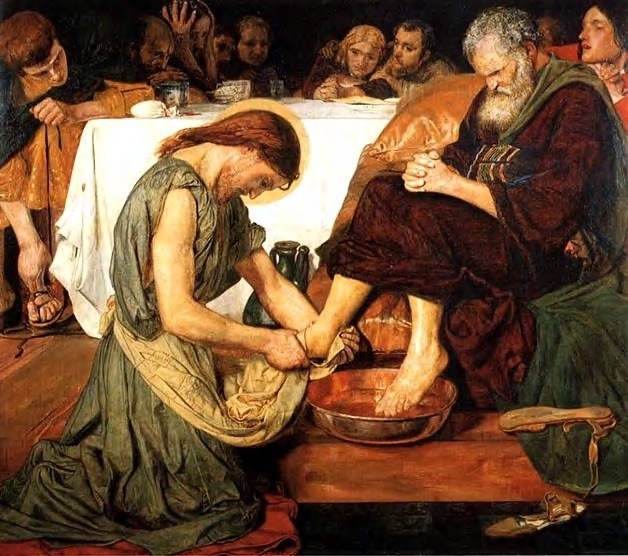
‘If I do not wash your feet, you have no fellowship with me’

Allow yourself to be loved

This is Life

Through the Bible in a Year – February 10

The Scheme for January and February can be found here

Job 40-42; Acts 15:36- 16:40; Psalm 51

Yesterday we thought of ‘surrendering ourselves to the unfathomable mystery of the Love of God’ – that which sustains all life and upholds the universe and is its most profound meaning.

In the sure and certain confidence of such love we may pray Psalm 51. In the Orthodox liturgy it is said every day at morning prayer. It is an acknowledgment of who we are – and who God is. It is fundamentally honest with regard to ourselves and our relationship to God. ‘Against you only have I sinned’ Our sin of course always has consequences which hurt others. Every sin does this – we are I think hopelessly naive about how our lives are so woven together that every sin has consequences of which we cannot dream, and perhaps that is just as well. [There is I think, a helpful parallel in chaos theory – which famously suggests that the beat of a hummingbird’s wing in the Philippines leads to hurricanes over the Atlantic – thus it is with our sin]

But rather than hide this profound truth about ourselves, we live out of an even deeper truth – that we live our lives in even deeper weave with that of God, who is closer to us than our own heartbeat. And so we come with confidence before him, not parading our sins, but confident in his love and mercy, with broken and contrite hearts. All our efforts to please turned to dust – which is of course the raw material of life, from the dust of the earth we were made, and from dust God can and does remake us, in his tender Love and mercy.

We say with Job ‘I know that you can do all things, and that no purpose of yours can be thwarted – my eye has seen you and I repent in dust and ashes’

Job is commended for speaking the truth about God. To daily seek forgiveness in confidence and trust, is such truth speaking, and therein lies our great Hope.