Through the Bible in a Year – August 2

The scheme for July and August can be found here

2 Ch 21-24; Acts 17; Psalm 118

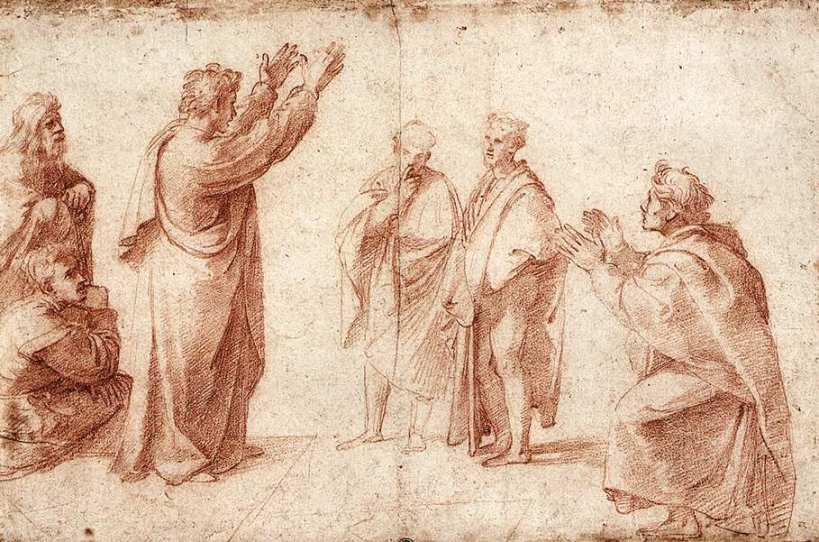
As Paul walks through Athens he notices how religious they are, to the point of as it were hedging their bets. He finds an altar to ‘an unknown god’.

Let us ask ourselves, are we too hedging our bets in the matter of belief? Is our life like Athens full of idols to which we pay great devotion, whilst paying lip service to the God and Father of our Lord Jesus Christ?

Through the Bible in a Year – August 1

The scheme for July and August can be found here

2 Ki 10-12; Acts 15:36-16:40; Psalm 116-117

Gratitude for healing is the mark of Psalm 116, and gratitude marks out much of the language of the Psalms. In this sense they are somewhat alien to us. the Psalmist seeks at all times to see the hand of God in his life – at times that is a struggle – but even the struggle is expressed in prayer. the Psalmist understands that all of life is held in the hand of God and expresses himself accordingly. Thus when he recovers from illness he gives thanks to God for his deliverance.

For most is not all who read this blog, such a sense is something which is difficult for us to maintain, primarily because we have bought into the myth that we are in control of our own lives and destinies. A myth which our wealth, which historically is monumental, enables us comfortably to maintain.

Let us look around the room in which we are sat now. Look at our possessions. How many were gifts? How many have we accumulated ‘by the strength of our arm’, bought for ourselves out of our wealth? This is one simple expression of the way in which we are able to ‘build a life for ourselves’. And if we have built this life for ourselves, then why be thankful?

We may say, ‘I can be thankful that I have been given the strength to accumulate these things’, but is that the purpose of our lives? ‘Ones life does not consist in the abundance of our possessions’

The Psalmist on the whole lives much more on the edge. Even if the Psalmist is King David himself. Unlike Solomon who follows him, David is not renowned for his wealth and the David story which we read in 1 and 2 Samuel tells of a man living very much on the edge for much of his life – indeed his downfall occurs precisely at the point where he is settled and made a palace for himself. When he starts to live life on his own terms, taking that which is not his, seeking to possess.

Imagine what it would be like to live on the edge – not to know where your next meal was coming from. Imagine gratitude when it does come along.
Psalm 72 – The true King

From my morning office

Captivated by Psalm 72 – how the true King is acknowledged by all the nations because he defends the needy and crushes the oppressor, because he shall deliver the poor, because he shall redeem their lives from oppression and violence, because their blood is dear in his sight.

This year the Sunday Gospel is predominantly taken from Luke where this theme of the True King who does justice to the poor is most clear. From the announcement of Jubilee in Nazareth, the declaration that all the land and wealth the rich had amassed would be redistributed – to the blessings and woes, on the poor for theirs is the Kingdom, against the rich for they have already eaten well – to the parable which makes this most plain, that of Dives and Lazarus – Luke reveals the coming Messianic King foretold in Psalm 72

Through the Bible in a Year – July 31

The scheme for July – August can be found here

2 Ki 8-9; Acts 15:1-35; Psalm 114-115

Rounding up some of the themes of the past few posts, the first verse of Psalm 115 is fertile ground for life giving prayer, meditation and contemplation.

Not to us, O Lord, not to us, but to your name give glory,
for the sake of your steadfast love and your faithfulness.


Amen

Through the Bible in a Year – July 30

The scheme for July – August can be found here

2 Ki 6-7; Acts 14; Psalm 112-113

Yesterday we thought briefly how the source of the Life that was in Elisha was his absorption in the life of God. So devoted was he to God that he did not even rise to answer the door when Naaman came to call. [Of course we find this very hard to accept – witness the many sermons on Martha and Mary that sympathise with Martha, or that say ‘we need Marthas and Marys’ – completely ignoring the words of Jesus]

To be so absorbed in God is to see that there is no division between the Earthly and the Heavenly – only the heavy shroud of our own self obsession keeps us from seeing the chariots and horsemen of Israel.

This perception is of course what the scriptures enjoin us to over and over again. The Fear of God, which means we have no fear even if our city is surrounded by opposing forces, let alone the many minor fears which beset us.

Once more we are enjoined to pray the Psalms – to let go of our self obsession, that is the blindness of Sin.

Through the Bible in a Year – July 29

The scheme for July – August can be found here

2 Ki 4-5; Acts 13:13-end; Psalm 110-111

Our readings follow the ‘career’ of Elisha, the prophet who came after Elijah and yet whose work far outstripped that of his predecessor.

In the incident of the healing of the Shunemite’s son – there are of course parallels with the works of Jesus. But here I would stop to consider the means of healing Elisha employs. In the church we have absorbed much of the spirit body duallism of our forebears and this incident seems to some almost distasteful. But in this healing Elisha does not stand at a distance, or even at the bedside and prounce healing. His body is the vessel of the Spirit – it is the vessel of Life. The intimate contact reveals this. Jesus almost always heals by touch. In the church we have Sacraments – the Life is in the Material, the Spirit is in the fleshly.

Perhaps most clearly we see this in Confirmation and Ordination neither of which can take place without the laying on of hands – the Spirit cannot be passed on except through the flesh. The Word becomes flesh.

Later we see Elisha so absorbed in God, that he doesn’t even come to the door for Naaman. Whilst Elisha is the vessel for the life of God, it is only because his life is consciously devoted to God. He portrays the Great commandment – in loving God with all he has and is, he becomes Love for the neighbour.

To the world, the one who is God’s servant will always seem unduly preoccupied with God, but that is only because for most of us, we are preoccupied with anything but the Life and Love of God.

And no, it is not a matter of balance. Love the Lord your God with All you have and All you are.

Through the Bible in a Year – July 28

The scheme for July and August can be found here

2 Ki 1-3; Acts 12:1- 13:12; Psalm 109

Yesterday we considered how the praying the Psalms not only places us before God in a way that perhaps no other portion of scripture can. What is more we thought of  how they freed us from our obsession with ourselves, most especially if we pray them sequentially as the tradition has taught us these past 200 years.

Today we read of the succession of Elijah by Elisha. The two form an interesting pair and comparing them one can see how Jesus is understood as the one who is preceded by Elijah, in the person of John the Baptist.

Elisha is determined to followed his mentor, but his request is a bold one – ‘a double portion of your spirit’. We pray for many many things, how much do our prayers echo this prayer of Elisha, so powerfully and vividly answered?

Jesus teaches us that without Him we can do nothing. Although we tend to think of this in terms of his presence, alongside, encouraging etc. we should I think think of it more in terms of his Life, his Spirit. In John’s gospel Jesus declares that those who follow him will do greater things (cf the words of the Baptist re Jesus) – perhaps we might learn from Elisha’s hunger for the Spirit?

However, before we do, we would do well to consider that which we ask for. Once more, one will search in vain for paintings of Elijah’s ascent from earlier generations. It is only our modern world which thinks it a small thing to represent those things that angels shield their eyes from.

Through the Bible in a Year – July 27

The scheme for July and August can be found here

2 Ch 19-20; Acts 11; Psalm 108

Nowadays much is made, and justifiably so, of the lack of lament in the liturgy of the church [although this accusation may not be levelled at the Orthodox church whose liturgy encompasses much lament according to the season].

Yet we may well ask – whilst the liturgy of the church shies away from lament and towards Praise – do not our own personal lives of prayer exhibit the reverse tendency? How long is it since you last exalted and worshipped God – praising him for his Glory in your private devotions?

Here again the Psalms come to our aid. Praying Psalm 108 is a great antidote for our self obsessed prayer lives.

Through the Bible in a Year – July 26th

The scheme for July and August can be found here

2 Ch 16-18; Acts 10; Psalm 107:23-end

The ‘conversion’ of Cornelius draws our attention for the very good reason that this message of salvation is received by the Gentiles as well as the Jews. This marks a key point inthe life of the infant church. but there is more, much more. this narrative calls into question so much of what we have been taught to think about ‘conversion’

As the conversion of Paul challenges our self centered religion – leaving Paul with the question ‘What wouldst thou have me to do, Lord?’ (as he recounts on the two occasions when he tells the tale to others) – so today’s reading reminds us that this whole business of becoming Christian is not what so many of us have been told.

Cornelius lives a repentant life – he is turned towards God, and others. He prays continually and his life exhibits the generosity of God. There are many who have bought modern conceptions of ‘becoming a Christian’ who do not exhibit these outward signs of repentance towards God, signs which are looked for in The judgement.

The ‘Conversion’ of Cornelius reminds us that to become a Christian is nothing less that the reception of God’s very Life, the baptism of the Holy Spirit which Jesus’ death and resurrection have made possible.

If we read the accounts of john the Baptist and his description of his ministry with regard to Jesus, we see this plainly. John comes preaching a baptism of repentace towards God. Cornelius is already repentant towards God, and thus is judged worthy of the Life of God – the promised baptism with the Holy Spirit.

Through the Bible in a Year – July 25

The scheme for July and August can be found here

2 Ch 13-15; Acts 9; Psalm 107 vs 1-22

Yesterday we thought briefly about the Psalms – about how they place us before God. As we say the Psalms we are directly addressing God in words given to us by God. Praying the Psalms recenters us – it turns us outward from ourselves towards God, ad thus the other. Thus they reverse the headlong dash to incurvatus religion beloved of most in the church today.

Our fundamental orientation is incurvatus – turned in on ourselves. The work of Conversion is to turn us outward – that we Love God with all we have and are and in all cases seek to ensure that those whom we meet are as well treated as we treat ourselves, the task of obedience to the Great commandment – that which brings Life.

This conversion is perhaps nowhere better illustrated than in the story of Saul / Paul. It is worthwhile considering this story and allowing it to inform our own necessary conversion – that we to wait on the Lord til he tells us what he requires of us.